>“Complete nonsense,” retorts Pierre Ferragu of New Street Research, a financial firm. tsmc has almost simultaneously launched a new fab in Taiwan, with four times the wafer capacity—and more advanced technology—than the two proposed Arizona foundries. Its bet on America is more of a long-term insurance policy than an immediate game-changer. It enables tsmc to start the tough job of recruiting a workforce and amassing suppliers in America, providing a baseline for expansion “if the Chinese are crazy enough to bomb Taiwan”. For the foreseeable future, though, most r&d is likely to remain in Taiwan. So will at least four-fifths of tmsc’s capacity.
It is unfortunate the truth and decent analysts dont get enough press coverage because they dont fit the narrative of current trend.
- The only way to understand the Press is to remember that they pander to their readers' prejudices.
It is in China's interests that Taiwan not be the centre of global chip manufacturing. And the US's interest. Europe's too. The situation is delicate, but I suspect in time Taiwan will become less strategically important. Too many powerful players would benefit from that industry going somewhere else. An economic competitive advantage is not enough to make the US take strategic risks, or to hold China off.
It makes sense that there would be literal conspiracies a work in this situation. If I were in Taiwan, I would assume that the US plant represents some sort of threat to the geopolitical status quo. Regardless of what some analyst thinks.
I suspect the PRC won't outright bomb much of Taiwan but instead go straight for the presidential palace in Taipei and try to force an ROC capitulation early.
I think they're counting on the ruling class / landowners / capitalists to pressure the government to capitulate at fear of property destruction, which I also expect to be in line with reality. Doing capitalism in a country like taiwan is better than in the PRC, but doing it in the PRC is better than not being able to do it at all because all your assets were obliterated.
What I think none of these people are counting on is that there are rabidly anti CPC people here in Taiwan, leftist or otherwise, and some of these people engage in post-military service training and drilling. I suspect that if the above comes to pass and the CPC is successful in forcing an ROC surrender, the factories are burning one way or the other, due to "self-sabotage" by workers or guerillas.
Then the PLA gets to have fun for a decade chasing guerillas around the choking thick jungle and mountains that make up the majority of the landmass in Taiwan. Many of these will be indigenous who have lived in the mountains for generations and per capita by demographic make up more of the (non conscripted) military than any other demographic.
I don't think any of this will come to pass though because I, like most people in Taiwan (including the usa consulate staff), believe the possibility of invasion is slim.
The old ‘capture the leadership and the country will surrender in a few days’ strategy. Works every time. The thing is I’m sure the PRC Intelligence service have done analyses of what would happen if Russia invaded Ukraine, and what would happen if China invaded Taiwan. I wonder what the first one said? If the credibility of the Taiwan scenario is tied in Xi’s mind to the credibility of the first, that would give us a rough idea of the likelihood he might go for it.
The other problem is that China is way more dependent on outside trade than Russia. They rely on food and energy imports too much, while Russia is self sufficient in both. The same sanctions as on Russia would bring China to its knees in months. In case anyone say “but everyone was saying the sanctions on Russia would cripple them too”, no, not everyone was saying that. The same magazine, The Economist, was explaining why that wasn’t going to happen right from the start.
Why do people still compare Taiwan with Ukraine, can people not read maps? This isn't 1996 anymore. Contrary to the US China has hypersonic missiles that the US military admitted they work.
The area Russia has captured in Ukraine is 3 or 4 times the size of Taiwan. Ukraine borders a couple of NATO countries with huge borders, has pipelines going through its country that Russia didn't touch the entire conflict. Taiwan on the other hand is 150 miles away from China and thousands of miles away from its big backers. Most of eastern Ukraine was Soviet infrastructure heavily fortified over 8 years. Taiwan on the other hand is mostly uninhabitable mountains that barely have roads going through them with very densely populated cities on the west.
Taiwan gets its oil and gas from Indonesia and most of its resources from China. Last time they did missile drills they had to stop them because the launchers failed.
China just embargoed the island for a couple of days and nothing could move in an out. China doesn't really need to do anything to win. There isn't really any scenario where this plays out in Taiwans favour. The US can't even keep up with Russia's ammunition production[1], how would it match China's manufacturing?
While the US moves their warship through the area every now and then as a show of power everyone agrees that there is no protection from hypersonic or even most supersonic missiles and that much of the US Navy are sitting ducks if there were ever a real conflict.
Biden was born in 1942 and believes the world is stuck in the 90s. It's extremely dangerous to think and act like that.
You’re getting downvoted for stating extremely uncomfortable truths. It’s not what westerners want to hear. Ignoring these objective facts is foolish and dangerous.
The reality is, with hypersonics (currently deployed), Russia or China could disable entire surface battle groups and there’s not much the US could do about it (conventionally).
I encourage everyone to break from their myopia and get a better understanding of the significant geoeconomic and power realignments going on right now.
It’s no longer 1992. We’re either headed towards global nuclear holocaust or back to a multi-polar world. May calmer heads prevail.
It's neither uncomfortable nor a truth. If it were that easy Taiwan would have been conquered years ago. It isn't Ukraine - China can't just invade by rolling tanks and artillery across a field.
Its invading force will have to cross a 150 mile sea where it will be decimated before landing on one of about 4 viable landing sites where the invading force will again be decimated. Setting up supply lines would essentially be impossible. Keeping morale up when 6 out of 10 invading soldiers snuff it before reaching the island will be impossible.
US carrier groups would be useless in this war, but they're useless against anything resembling a peer competitor. US nuclear subs would tear up the invading fleet though, while Taiwanese missiles would turn the PRC economic heartland to ash.
US subs can't operate permissively in strait and increasingly within 1IC where PRC has built comprehensive seabed monitoring infra. Or that current TLAMs from SSGNs aren't performant againt even shit tier Iraqi/Russian hardware (~50% failure/interception rates), of which US has only 4 with 612 shots. Nor does TW remotely have or can stockpile enough fires to dent PRC heartland with aggressive defense budget. For reference currently US doesn't either hence rush to build up stockpiles for potentially 100,000s aimpoints most of which will be delivered by b21s 10+ years from now and that's just for some current PLA targets. Realistically PRC would destroy most of TW C4ISR in openning strikes and prevent TW from threatening invasion fleet which would make 150 mile sea transit relatively uncontested. Under such conditions - open waters where modern sensors has less noise to sort - establishing maritime logistics would be easier to protect than the land/air logisitics wagon US had to sustain for AFG. Current US vision for TW porcupine doctorine rests on TW fighting to the last man on TW soil because it's forgone PRC can land massive amounts of troops and hardware. The hope is US can disrupt this as TW buys time, not TW itself. Ultimately, PRC simply wouldn't attempt landing without securing theatre air superiority first, by the time they commit to maritime invasion, thousands of UAVs and would be droning a TW resistence reverted to Taliban tier capabilites. The other fundemental uncomfortable truth is PRC can mine TW shores and destroy airfields long term to siege island, and historically sustained sieges that prevent resupply generally end in capitulation.
All this plus PRC can blockade TW and completely sink their economy (while also straining all the economies that depend on their chips, including their own). In fact, they could even do that without physically invading the island after the C4ISR hit and just wait for TW to cry Uncle and capitulate. PRC has escalation dominance in this arena and without going nuclear, I don’t see the US winning. The solution here is political compromise (as it should have been in Ukraine). Either that or nuclear holocaust.
Glad to see a book by Andrei Martyanov being recommended here. I have read all three of his books. There is no reason to trust or agree with everything he writes, but unfortunately the current trend is to try and suppress any kind of discussion rather than try and understand someone's viewpoint.
I also don’t agree with everything he writes or says (his YouTube channel is wildly entertaining). But I trust him more than others as he’s a pro western US citizen who has a solid background in the Soviet navy (anti shipping missile expert, I believe). He even gets into military mathematics and field manuals from time to time.
Yes I watch all his videos. My favourite is “Some very needed comparisons”. I started doing.(just for fun) a complete under-graduate and graduate course in Mathematics in my spare time after watching this video.
Are you doing an online course? Funny enough, I was thinking of the same thing (or at least some mathematics basics before an online CS curriculum). I'd love recommendations if you have any. Cheers.
No, just via books. I have a degree in mathematics which I completed 20 years ago so part of it is just recalling what I had learned. But otherwise I just bought books covering the entire curriculum - some based on Susan Rigetti’s blog post on mathematics (should be easy to search).
They’re not the same, I even pointed out some specific ways they are different. My point is though that if (just a guess) the PRC analysis said Russia would take Ukraine easily, the fact they got that one wrong points out flaws in their approach to strategic analysis. If their strategic analysts is flawed, then that damages the credibility of any of their analyses.
Chinese and Russian hypersonic capabilities are a money bell for American defence contractors. For cross-strait warfare, they’re irrelevant. (Conventional artillery dominates at that range.)
That carriers would be sunk pretty much instantly is a given, and has been for a while now. The USN invests heavily in subs, and you don't hear much about them for a reason...
You lose a ton of credibility and weaken your position domestically. No leader relished the prospect of a humiliating defeat in a war of aggression. In an authoritarian system it can be severely career and life limiting.
> instead go straight for the presidential palace in Taipei
Will that work if the politicians work from home?
On the recent Brazilian uprising, when the election losers stormed the capital they found out that it is a holiday and there’s no some special object in the government buildings which makes you the new leader once you physically obtain it.
China is Taiwan's largest trading partner. 42% of Taiwan exports go to China and Hong Kong. 22% of Taiwan imports are from China. Around 200,000 to 400,000 Taiwanese work in China. China doesn't need to militarily invade Taiwan. Like Hong Kong, it can just wait until the economic reality is that Taiwan is already a vassal state dependent on China. At that point, it can move military troops into Taiwan if needed. There won't be a fight, because at that point, the USA will already be far more darkly insular.
China is the largest trade partner of many other countries, why only Taiwan worry about being turned into a vassal state?
The majority of population in Taiwan is Han Chinese, using almost the same language as mainland China. It's not surprising that many of them will like to work on the other side of strait if there are good opportunities. People from mainland China too, especially for people in Fujian and Guangdong.
And eventually, hypothetically, people in Taiwan prefer and choose to unite with mainland China, maybe after PRC evolved into something more ideologically acceptable, I see more good than issues.
This is an outdated viewpoint that doesn't take into account the newer generations of Taiwanese who are developing a distinctly anti Chinese identity and rejecting what older people call "Han" (華人). The younger generations are leaning into and exploring the diverse heritage of the island itself, including by going out of their way to learn indigenous languages and incorporate aspects of indigenous culture.
Taiwanese are also inventing their culture from whole cloth, forming cultural alliances named cute things like "the bubble tea alliance" in a direct oppositional effort against CPC cultural imperialism that centers around han supremacy.
Every year that goes by the presumptive and han supremacist viewpoint that "Chinese is Chinese" evaporates further in Taiwan. Every day 台灣中文 diverges further from 普通話; they are now classified by linguists as separate forms of Mandarin entirely (not just because of the character set. Obviously the languages are mutually intelligible though).
It's worth pointing out that "use the same language" is kinda silly to say in either case. Though of course most PRC speak Mandarin, and most Taiwanese speak Taiwanese Mandarin, both nations are filled with bi and trilingual people speaking all sorts of dialects.
I agree to some extent, especially with the newer generation. I still hold the probably old school view point, that believe the separation of China and Taiwan is mostly a political problem caused by ideological differences. (And personally hoping that PRC can get democracy and then China and Taiwan can reunite in some form).
But I'd like to point out PRC also have more than Han Chinese. Even myself doesn't fit in the narrow sense Han (汉). There are all sorts of dialects and indigenous local culture. The difference of language and culture within PRC can be even bigger than the difference across the strait (for example, I almost cannot understand 粤语 but have zero problem talking to Taiwanese colleagues in our most native language).
I routinely visit Taiwan based websites, reading 繁体/正体中文 and post in 简体中文, and apparently have almost no difficulty getting myself and Taiwanese understood.
By the way, you mentioned bubble tea... There are so many bubble tea shops in mainland China, some invested by Taiwanese, and I really miss them after moving to Europe.
Sure the US is turning insular, the only thing all politicians are on is that bribery is good and China is the main enemy. Which still means that Taiwan will be defended.
On the other hand if China bombs the fabs, 1) it cripples the west's economy (and potentially its military supply chain also), 2) it ceases to make Taiwan a strategic asset to the West since there are no more fab to defend. To me it's a no brainer, particularly if they think Taiwan won't let them capture the fabs anyway (will destroy them before China controls the territory).
> ceases to make Taiwan a strategic asset to the West since there are no more fab to defend
PRC control of Taiwan enables blockading Japan. It’s better strategy to turn Taiwan into China’s Afghanistan than abandon it because the fabs were blown. (One can also Werner von Braun Taiwan’s technical knowledge to the American homeland, thereby turning the entire endeavour into a Pyrrhic victory for Beijing.)
The us has poored too much of it's legitimacy into defending Taiwan to just say 'fabs gone, you are on your own'. Deterrence requires a response if lines are crossed otherwise future deterrence is much less effective.
When the fabs are still on the board, the US might be a bit more vigorous, but I doubt anyone assumes fab capacity survives a Taiwan invasion.
Probably worth remembering the "red line" episode with Obama in Syria, or Biden's initial reaction to the invasion of Ukraine, which was to impose symbolic sanctions and see how it deterred Russia in a month.
The US is perfectly capable of some symbolic protest if it doesn't want to be involved in a particular conflict.
I, born on the another side of the strait, also believe the possiblity of attacking is very slim. PRC's economy is still pretty dependant on exports to western countries. If a war with ROC start, CPC will have to pay a great cost to compensate the loss in exports.
However, for some reason I don't understand, a significant portion of people from PRC are expecting a war to happen, and ridiculously believing such a war can be good to them. Maybe CPC is playing the old game again, posturing the "pro-democracy" entities as hostile in the propaganda to gain support politically.
> I suspect the PRC won't outright bomb much of Taiwan but instead go straight for the presidential palace in Taipei and try to force an ROC capitulation early.
> I suspect the PRC won't outright bomb much of Taiwan but instead go straight for the presidential palace in Taipei and try to force an ROC capitulation early.
Taiwan is not Somalia. It's a fairly advanced country with a fairly good military (comparing to its size).
> I think they're counting on the ruling class / landowners / capitalists to pressure the government to capitulate at fear of property destruction, which I also expect to be in line with reality. Doing capitalism in a country like taiwan is better than in the PRC, but doing it in the PRC is better than not being able to do it at all because all your assets were obliterated.
China will do worse than Russia. People in Ukraine had reasons to join Russia, ie: their country is very corrupt and poor. I highly doubt the rich and educated Taiwanese will want to join the CPC.
> I don't think any of this will come to pass though because I, like most people in Taiwan (including the usa consulate staff), believe the possibility of invasion is slim.
The possibility is very slim at the moment. Of course, timing matter. In the future, it could go both ways. That will depend on the status of the US, China and Taiwan itself.
> Taiwan is not Somalia. It's a fairly advanced country with a fairly good military (comparing to its size).
Yes, I live here, all of my friends have served in the military. They believe a likely strategy is gun boats coming up the river for the presidential palace.
BTW, the military is quite effective, but numbers about size usually include the conscripted, who are basically useless as soldiers as they get to shoot a gun maybe once during conscription and spend most of their time sweeping rocks because boomer officers stuck at conscript boot camp have outdated and ageist ideas about discipline and take out their resentment on the conscripts.
From my time in the PRC the same is true for pla conscripts.
The only reasons could make PRC take over Taiwan is: 1) Taiwan declare official independence; 2) US blocks China from semiconductors so bad, it has to take over Taiwan to gain access to technologies.
CPC knows taking over Taiwan is costly to them, and it is not a good deal. It is not like we are so much better at analyzing the situation better than professionals.
> I, like most people in Taiwan (including the usa consulate staff), believe the possibility of invasion is slim.
There’s a paradox here. The more everyone believes this, the worse the preparations are and the more likely invasion becomes.
For instance, the RoC Army doesn’t have enough soldiers or the right equipment and pretty much everyone is ok with this because hey, possibility of invasion is slim. They prioritise buying vanity hardware like fighter planes instead of weapons that fit a porcupine strategy like Javelin missiles. (Porcupines don’t attack but defend really well).
You correctly point out that guerrillas can fight the PLA thanks to terrain. But that would be more realistic if they had a large supply of Javelins.
I mean, they’re expanding to Japan too. I can totally see how having at least one fab in your country would make you much less worried about choosing TSMC as your supplier, even if most of their actual capacity isn’t there.
The only reason why TSMC is expanding outside Taiwan is because protectionism is back.
Americans don't want to admit it though.
Hilariously it will make Taiwan more vulnerable because it makes defending the island less necessary.
During the cold war the enduring question was: is America willing to commit mass suicide to protect Western Europe if the USSR invades? Thankfully we never got a definitive answer on that.
I suspect their investments in the US are also simply because the US asked them to and they (including the Taiwanese government) are not in a position to refuse.
China’s problem is that they import something like 80% of their chips (predominantly from Taiwan). The thing is that semi-conductor fabs don’t exactly respond well to war time conditions. So unless China can invade without without any meaningful resistance, it’s likely that it could be a long time before before that capacity is back online, which would cost china (as a large importer) dearly
China does not have that long if they invade. The US does not need to counter Chinese military locally, just hold Japan and cut off Persian Gulf and all food imports. China imports almost all good and energy.
China can only invade Taiwan to start ww3, and only if it is ready to use nukes pretty soon.
That’s one thing most people don’t understand about China… they import most of their food and energy. They’re stuck playing the nice(ish) neighbor because of where their nation spawned on earth.
That statement is contrary to data [1]. China is the single largest exporter across the globe. What food and energy they import is "luxury" for the growing middle class [2] but not essential (to Chinese Gov't way of thinking) as they have food and energy enough internally to get by.
The geographic bind for China is the China Sea - they are a trading super power with no bulk overland routes and all sea trade funneled through the one body of water (unlike the US with two large coasts).
1. China relies on chemical and oil imports to create the fertilizer that feeds the country. Cut off these imports and China won't be able to feed itself.
2. Much of China's top exports are processed imports: e.g. China is the world's largest exporter of steel but imports most of its pig iron. The country isn't really "resource rich" in the way the USSR or USA is.
3. In most sectors of manufactured goods, China is only capable of mass-producing low quality goods and so the country is reliant on other countries to provide higher quality goods. Steel is a good example again, China is not only the world's largest exporter of (low quality) steel, it's the world's largest importer of steel, mostly medium and high quality.
1. Seems to be more than four years out of date [1](page 9) :
> China has been transformed from being a significant importer of all nutrients in the mid-1990s to a major exporter today.
> A program to develop China’s domestic resources was implemented, and China rapidly invested in nitrogen, phosphate and more recently potash capacity.
(Nitrogen)
> China has relatively limited natural gas resources, so gas based plants account only for a quarter of total urea capacity. Instead, it has turned to its relatively abundant resources of coal, which make up three quarters of urea capacity.
etc.
( Also, China has been overusing fertilizer and has recently cut back and still increased yeild [2] )
2. Yes. China has a strong GDP growth (for what that's worth as a metric) on the back of importing, processing, and exporting to the benefit of China - as a country it is still able to survive well enough on its own (perhaps to the chagrin of the the growing Chinese middle class who demand more and more 'luxury' items).
3. China is quite capable of producing high quality steel - they have some of the highest grade iron ore imports available about the globe and they do produce plenty of high grade steel. Where we agree is that China makes an awful lot of money selling an awful lot of low grade steel.
IIRC China imports 16x the tonnage of US iron ore annual production capacity from Western Australia alone - the Chinese high grade steel production can easily dwarf the capacity of US high grade steel production capacity .. and still lose that total tonnage in the magnitude higher production of low grade steel.
It's a chicken and egg story - are we blaming the Chinese for selling low quality goods, or the world for being satisfied to hand over substantial amounts of money for low grade goods? (If they'll pay for crap, why export better?)
china can get all mentioned resources (fertilizer, pig iron, food, steel) from their neighbors (esp. russia). no way to cut china off. the days of low-quality are long gone. semiconductors and some other hightech are the only pressure points still available, and the US tries to use these.
Which is why they are stuck being friendly(ish) neighbors. They may not be dependent on the USA but they sure as heck are dependent on their neighbors. That’s what happens when you’re resource poor.
A little bit of both. It's true to an extend but you're absolutely right that the PRC isn't as dependent as many foreigners imagine. Depends on our definition of luxury/necessary goods as well. To me eating pork isn't essential but to many Chinese it would definitely be a problem if there were a meat shortage. Nothing that would bring the regime to its knees though and not that the CCP leadership would care about citizens anyway as long as they can be kept from revolting.
Also people should be aware this is exactly the sort of thing they're preparing for, while many other countries aren't. The Chinese leadership isn't just massively increasing military spending year by year but also preparing the economy and especially vital industries like agriculture to be more independent and resilient. One could say it's a precautionary measure, in case war were declared.
My guess is democratic nations meanwhile are going to drag their feet and deny the changes right in front of their eyes. This happened with Russia and it doesn't seem like most have learned their lesson from it. Especially certain European nations.
This is a big part of the reason they want to invade Taiwan. Taiwan is strategically located to make it a liability to PRC shipping, should neighboring powers / America ever decide to blockade the PRC. If the PRC takes Taiwan, they gain more breathing room to act aggressively against their other neighbors too.
They would have plenty of land to be self-sufficient if their population was a bit smaller... Lots of countries outgrew their own land due to efficiency gains from globalism (India and Japan also come to mind).
The article alludes to but doesn't mention the "silicon shield".
This move by TSMC doesn't weaken the shield, but it weakens the spear. The most likely defender of Taiwan against an aggressor would be the U.S. military. Having a native chipmaking capability somewhat reduces the U.S.'s interest in intervening.
What it doesn't do is incentivize aggression against Taiwan. The likely aggressors would lose access to chips to fuel their economies as long as TSMC doesn't aid or allow those countries to build local fabs.
> The likely aggressors would lose access to chips to fuel their economies
Economic arguments for war being irrational and therefore unlikely have a history of falling flat on their face. Most infamously, this claim was made about major wars in Europe right before the First World War: https://en.wikipedia.org/wiki/The_Great_Illusion
Unless you're very careful and hedge your words, claiming that X ("war will cause economic harm to both parties") will cause a reduction in Y ("likelihood of war") leads everyone to say your claim is "disproven" whenever Y happens. Doesn't automatically mean the claim has actually been disproven.
It’s a different scenario imo. The economic ties between the US and China are much stronger than the European powers prewar, which were all colonial powers with protectionism and merchantilist trade policy.
News coverage of China is asinine, vacillating between the WSJ/Gordon Chang “the communists are about to collapse” nonsense and the “General <x> says the Chinese are aggressively aggressive and catching up” patter. The chip bullshit is all about Intel lobbying for billions to pull its nuts out of the fire.
IMO Chinese policy is methodical and not unlike what the RAND people cooked up in the 1960s. They make investments in Africa and Latin America that benefit China, build up a military power as deterrence, and have a trade relationship with the US and Europe that transformed the nation from a decrepit backwater into a global power in 50 years.
Why would they want a pyrrhic victory (or defeat that would damage the Beijing government) in Taiwan? Taiwan isn’t Hong Kong. Aggressive rhetoric and policy accomplishes political objectives, and the long game is to foment instability in Taiwan and wait it out.
The risk of conflict with China is North Korea and Japan, not Taiwan.
That would require their government to have acted rationally in the first place. The first 30+ years of economic reforms weren't done out of rationality, but one of necessity to survive as the country was on the verge of total economic collapse by the end of the Cultural Revolution. Their hands were forced in the process of keeping everyone employed and fed, which gave a sense of rationality. Even during this supposed golden era of economic liberalism, there was rampant government corruption, oppression of dissent, and censorship (that was easily permeable because the technologies and funding for total blanket surveillance weren't ready until the mid-2010s).
The “this time it’s different” arguments also have a history of falling flat on their face. That was the common argument in Germany in favor of energy dependence on Russia, for example. It’s a bit wild to claim this theory is still legitimate when we’re literally in the middle of a shooting war proving it wrong.
The cause of WWI, if you can boil it down to a simple statement, is that red lines, vaguely drawn, were crossed by both sides, resulting in escalating tit-for-tats, with no one on any side acting to deescalate the situation.
The risk of this happening in a US-China conflict is moderately high. Chinese red lines are vaguely drawn. US red lines are more firmly drawn, but the US government system has multiple loci of power, and China seems to have a poor read on US policy as a result. De-escalation on both sides looks rather difficult to pull off, especially because China has a tendency to do things like through hissy fits whenever it feels slighted and shut down existing mechanisms to help de-escalate.
Another way a war can break it is something like WW2 or the Russian invasion of Ukraine, where you declare a war because you think you have a window of opportunity for victory. And if you guess wrong, well, you can ask Nazi Germany how well that works out for them.
If there are US fabs, and China invades Taiwan then Taiwanese fabs are destroyed, and China loses access to advanced chips, but the US and the west do not. This puts China at a major disadvantage compared to the US, for at least a few decades in the future, if it decides to invade Taiwan.
It seems unlikely that US and west would get involved in a direct major military conflict with China, no matter what. The costs are too great. It is far more likely that they would only provide military equipment and intelligence (like Ukraine).
So this move of TSMC actually strengthens the shield a lot more than it weakens the spear.
That's because it's not a widely accepted term by any measure. I am all for Taiwan and its liberties, however, I cringe whenever I see journalists have made up a new term like "silicon shield" and expect people to adopt it.
When it comes to international security, I don't think those in charge think about TSMC more than just in passage. Just look at Ukraine. The US is helping Ukraine a lot, but there's pretty much nothing that Ukraine is/was producing that the US needs.
In practice, if war happens and TSMC facilities are bombed to avoid passing into Chinese control, how many years does the world go back in processor state of art? Are we back to 486 level, Athlon 64 level, core family first generation, or what? What is the new average feature size, in nm, we are likely to fall back to if things go south in Taiwan?
I mostly agree with your points but want to point out there's always potential for things to change. The PRC is still investing heavily into developing native chipmaking capability in all stages of the production chain despite a string of high profile failures in the last 5 years. For military purposes the chips don't have to be made with state of the art technology. They just need to be good enough to work and achieve their intended purpose, sometimes rather crudely. Should a breakthrough happen, Taiwan's "silicon shield" could weaken quite a bit.
I still lean towards a "no hot war" scenario because the PRC's demographic structure is deteriorating just like Russia's, and Putin has already demonstrated a lesson with the war in Ukraine.
In exactly what way is this conflict actually heating up lately? I've certainly noticed the increase in news coverage, but don't know of, e.g. military actions by CN/US that indicate conflict coming closer.
President Xi has more reasons to invade Taiwan now than usual. He is getting older, and Taiwan reunification has been on his wish-list for a long time, recently reaffirmed and suggesting force is on the table[1]. The U.S. is currently managing a situation in Ukraine and economic problems, and China is currently in an acute COVID crisis which sparked mass protests, and a less acute economic crisis (reduced GDP growth).
A war would be a great distraction for the local population. The inevitable sanctions and disruption of chip production would excuse poor GDP growth. To top it off, a "glorious victory" (Pyrrhic victory) is pretty likely. The U.S. has global reach, but it's still not as logistically feasible for the U.S. to fight from staged forces in Japan and the Philippines as it is for China to fight from their home territory.
If an invasion is to happen it probably has to happen the next decade. Xi is getting older and China's population has now officially started to decline.
I can't see an invasion happening without massive loss of life on both sides and destroying Taiwan's value. Perhaps their plan is to conduct a massive long-term blockade. This would be more in-line China's typical actions of being aggressive in diplomacy and in stretching the boundaries of international law. If they outnumber the US in the Pacific what can the US do but watch? The US almost certainly would be unwilling to fire the first shot.
Gotta play pedant for a second because it's important here: using the word "reunification" doesn't make any sense when discussing the PRC's imperialist desires to invade and capture Taiwan.
No matter what lense you use, the ruling government of the PRC, that being the CPC, has never ruled any territory controlled by Taiwan. There's nothing to "reunify," there's only further territory that the CPC wishes to capture and wrest control from a sovereign nation.
There's danger also in the CPC weaponizing the word "China," which is why I'm careful to refer to the country as "the PRC," as the propagandists in the CPC are happy to engage in cultural imperialism to justify their military imperialism. "Taiwan is China, the people there are Chinese (華人),the people there speak Chinese (中文 / 華語), they are of Chinese cultural background, we need to "reunify" these Chinese people."
If there is an imperialist invasion, and the PRC succeeds, then they will turn their eyes on other nearby "Chinese countries " filled with "Chinese people" speaking the "national Chinese language."
These are all propagandic falsehoods so there's no reason we should help them out, and those of us that are in places where it's safe to do so (outside the borders of the PRC) should communicate using the correct terms.
The ROC controlled both the mainland and Taiwan before being ejected from the mainland. Before that, Taiwan was part of the Qing empire before being invaded by the Japanese.
"Reunification" is factually the correct term for the aim of having the whole of China (mainland + Taiwan) under a single government and state. That the PRC/CCP want that to be under their control is actually irrelevant here. The term does not imply 'right' or 'wrong', either.
Of course you know all of this is if you are in Taipei.
Obviously the ROC did not control the mainland, since they were eventually forced to flee to Taiwan.
> Before that, Taiwan was part of the Qing empire before being invaded by the Japanese.
Anschluss is German reunification because Austria was part of the Holy Roman Empire. Ditto for the Sudetenland, and, well, why not the rest of Czechia, too.
Yes that's how annexation works. See for example Russia annexing Crimea. Historically Crimea has been populated by ethnic Russians since Rurik conquered the place. I think it's a good thing that wars of conquest have become taboo, but let's not kid ourselves, for the vast majority of history it was bog standard to invade a place occupied by your co-ethnics and claim it was always your territory.
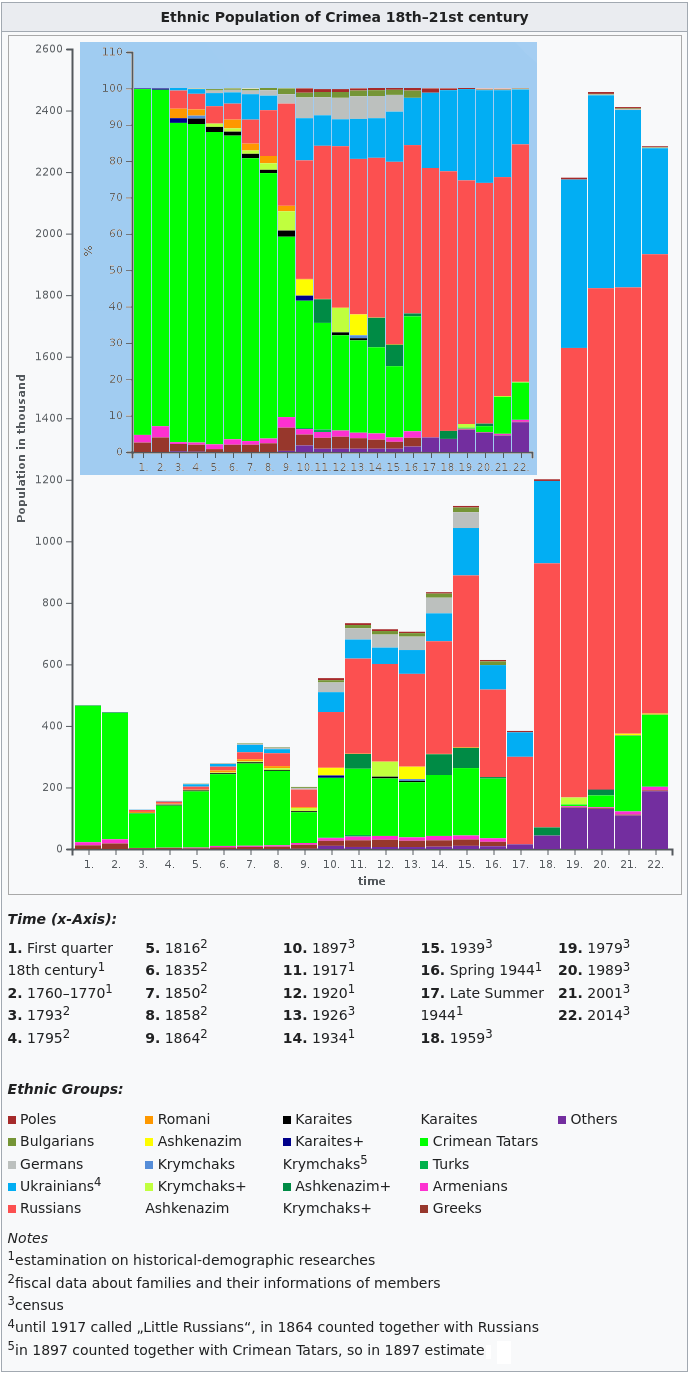
Crimea had barely any Russians until the mid-19th century and no outright majority until the mid-20th.
Anyway, either we live in a civilised era where things like ethnic cleansing and genocide should be condemned, or we live in an era where it is 'bog standard to invade a place occupied by your co-ethnics'.
After WW2, ethnic Germans were expelled from Czechoslovakia, Poland, and Königsberg and Poles and Ukrainians were uprooted forcefully into the boundaries of their modern nation-states.
If wars of conquest on the basis of 'this place contains our people' become 'bog standard', the ethnic cleansing of post-WW2 Europe and the post-Soviet Balkans becomes the inevitable and logical conclusion.
And that has absolutely nothing to do with anything I said; your claim was that Crimea was populated with Russians since Rurik, which is maybe true but extremely misleading because it constituted a percentage point or two at best. Bringing up the Ukrainian population accounts for nought unless you're suggesting expelling all the Slavs from Crimea and returning it to Tatar rule.
> The Ukrainian claim to Crimea is weaker than Russia's.
The Ukrainian claim to Crimea is stronger because they have a legal basis to its claim. If we return to a state of the world where claims to land are made on the basis of 'my group lives here, therefore it's ours', we will inevitably reap the consequences of post-war Europe.
On the same logic, Germany had a stronger claim to the Sudetenland than Czechoslovakia. But what did that get the Germans in the end? Complete expulsion from the Sudetenland.
"Reunification" would only be even in the realm of possibility of a correct term if the KMT took control of PRC territory. Since the CPC has never ruled Taiwan, it's nonsensical to say unify or reunify.
In any case that's impossible, the kmt government that once ruled is gone. It's been replaced by a government that held the name but is Democratic, and the KMT party has been losing power ever since then. The people have clearly decided to detach themselves from that way of doing things.
Furthermore, given the identities of the people in the PRC and Taiwan, any term involving "unify" is just engaging in cultural propaganda. The taiwanese identify as taiwanese, and lately as distinctly anti-chinese (binary oppositional development is an important sociological concept, see the difference between femininity and masculinity in many cultures, or, the French vs the English cultural identities), the PRC people identify as chinese, these cultures and preference for forms of governance are too different to "unify."
If one government rules both of these people anytime soon it will have been imperialism, plain and simple.
"China" died at the end of the Qing dynasty imo, since then it's just been a couple han supremacist governments weaponizing the term to leverage nationalist sentiment. There's no more Chinese nationalism in Taiwan so it won't work here anymore (despite even older taiwanese government officials blundering around with han supremacist presumptions even today). I think it's still working in the PRC and that's why they're allowed to do cultural genocide there without much pushback from their citizens.
The second reason that the CPC taking back land a population that fled the communist revolution currently occupied is still just imperialism: it's an entirely different populace with entirely different identity.
Taiwanese identity as Taiwanese. An ROC takeover of PRC territory would be imperialism. Luckily nobody in Taiwan has any such ambutions (that the roc constitution claims PRC territory is a political hostage taking: xi jinping has threatened a trigger invasion if Taiwan changes its constitution, even to remove the given claim).
If your first language is Mandarin but you used the unexpected and uncommon example of the ROC taking over the PRC, why do you say "Mainland" instead of "PRC" or "China?"
It probably wouldn't be to the benefit of China as a country. But that might not matter given how much Xi has consolidated power - the question is whether it benefits him. And if he wants to end up in the history books as "great leader who completed reunification of the country" or some such, he might have to rush even if that significantly increases the costs.
(There are good reasons to believe that something similar wrt Putin is the primary motivation behind the war in Ukraine, BTW.)
That's more true of Taiwan's population. Taiwan's fertility rate is set to be the world's lowest.[1] So it doesn't seem like the population is Taiwan's advantage.
It's a big call though, to risk starting a war and pissing off the population if they're already not to happy about Covid19's handling.
In contrast, Hitler made Germans feel like they were heading for a better place so he garnered support, Xi though, doesn't seem as charismatic and popular. So it's going to be a much harder sell to start an all out hot war over something that means basically nothing to 99% of the population.
Also invading a country is one thing, hanging onto it is another, Syria, Afganistan, Vietnam etc for example. China isn't exactly going to make friends taking the country by force.
>it's weird that Chinese people can't visit without a passport
They do visit without a passport, the same applies to ROC citizens in reverse. That's the whole point of the political amiguity on relations between the PRC and ROC.
I asked some Chinese college students about this about 10 years ago. "What is Taiwan?" "Province of China." "But don't you need a visa to visit?" "It's a special province."
Chinese college students are very likely to tell you one thing and believe another, it's a symptom of growing up in a place where having the wrong thing can get you in a lot of trouble.
People aren't that dumb, even if they are brainwashed.
How can you assume a person believes something other than what they say when there is no way for you to measure what they think except through their actions and their words?
Because I believe most people deep down don't want war, or invasion and aggression.
Most people given the choice would rather live peacefully with others. The outlier here is there is 1 billion+ Chinese furious and ready to invade China. Not the other way around.
That's your philosophical position then, are humans innately good or not. I wish it was true but in the entire history of humanity tribes fought for resources, did they change...
People from Mainland China need a special permit to enter Hong Kong. I don't think anyone doubts Hong Kong is part of the PRC by now. The fact that there are border and immigration controls within China isn't something new. Of course with an independent government and military Taiwan is de-facto independent, but having to get a "visa" to visit Taiwan doesn't really mean much.
Population's attitude has been prepared by the party well in advance. Lots of people are pissed off because Taiwan is not invaded yet, not the other way around.
You would have very little chance of knowing what Chinese people are thinking by the fact that thinking the wrong thing, let alone vocalizing it could maybe ruin you or your families life.
If literally all people whose opinion matters to you say and provide sound arguments that Taiwan needs to be annexed then if you are normal human (not a psycho) you'd eventually believe the same. And then who cares what those people really thought, because their expressed opinion is the only one that mattered. Sad, yes. The big issue with totalitarian regimes I guess.
Are they really? A small but vocal (and sometimes state supported) group of people are actually mad. Another group will mindlessly mouth such sentiment, but the majority seem not to care and just want to get on with their lives.
> In contrast, Hitler made Germans feel like they were heading for a better place so he garnered support
I mean, the Nazi's cap'd out at 37% [1] when they initially became the largest party and that dropped to 33% by the next vote. The average German never felt that he would lead them to a better place (otherwise it'd be 50+% not 37%) and more Germans felt Nazis were doing a poor job once they started governing.
Also, this is a First-Past-The-Poll situation so parties's popularity will be inflated in the voting results. i.e. more than 10x people voted for Nazi Party than were registered members; presumably the vast majority of Germans thought a different party would do better but between the Nazis or the Communists they picked the Nazis.
Xi is incredibly popular across the PRC, and the textbooks are changing to enforce a new cult of personality. I wouldn't risk speculating on his popularity as a measure of whether or not an imperialist invasion would happen.
The whitepaper protests clearly shows he doesn't enjoy incredible popularity, so are the massive censorship term lists that consist solely of nicknames of Xi. Why would so many of these terms exist if everybody liked him?
Leaked censorship list of 35467 terms containing references to Xi Jinping from LeTV, a once-popular video streaming service, issued directly from the State Council Information Office, circa 2016: https://chinadigitaltimes.net/space/%E5%9B%BD%E6%96%B0%E5%8A...
The bottom line is an invasion of Taiwan carries a high risk of ruin for the ruling clique in the CCP. There were multiple times when the ROC was in much more vulnerable positions both militarily and diplomatically (pre-Korean War and post-US-PRC approachment) and invasions didn't happen then. The PRC is much more export-dependent than Russia despite all the nationalist hysteria, and ruining all that with sanctions is going to do far more damage to themselves compared to simply keeping the propaganda machine running with inciteful editorials without organizing an actual military campaign.
Hmm? The Qing Empire, which both the PRC and ROC claims to be successors of, held both China and Taiwan for 250 years (until Japanese conquest of Taiwan)
Taiwan has never been under control of the Qing dynasty. The Ming dynasty pushed out the Dutch. 200 years of Qing rule did nothing with Taiwan. At the end of the Qing dynasty they decided to call Taiwan a province to deter Japan from invading. When japan invaded they threw their hands in the air and handed Taiwan over. Japan was not even convinced Taiwan belonged to China. The Qing dynasty had to convince Japan by claiming there are other parts of the world where tribes live even tho the country is ruled.
Before 1943 the CCP called Taiwan an independent nation and nationality. They advocated for Taiwan independence. Mao said they would help Korea and Taiwan seek independence.
It wasn’t until the allied forces asked KMT to adminster Taiwan until a later date that the CCP decided Taiwan belonged to them.
Taiwans claims to China are due to KMT writing the constitution. The reality is people in Taiwan don’t consider China part of Taiwan. Taiwan is its own country and they don’t care about China. They want to continue to live their life in peace.
Yes most of the eastern parts were unclaimed because the concept of nation sovereignty had yet to reach East Asia, but the era of Qing rule is very much integral to the history of Taiwan because majority ethno-cultural group directly descended from those who lived under Qing rule.
>Mao said they would help Korea and Taiwan seek independence.
Mao also said his home province of Hunan should also seek independence: https://www.jstor.org/stable/652585. Sun Yat-sen wanted to drive out all Manchus in his original revolutionary manifesto yet happily accepted the new multi-ethnic ROC that completely inherited most of the land that were not historically inhabited by ethnic Han. People change their views all the time, especially politicians who have much to gain from having flexible views.
And yes "reunification" is a direct translation of PRC political jargon that carries the (false) connotation of Taiwan being a breakaway province when in reality it was the CCP who broke away from the ROC in a rebellion to create their own country. Revisionist history is bad history no matter which side it comes from.
Your Wikipedia link doesn’t dispute anything I said.
Taiwan was not under control or rule for the majority of the Qing dynasty.
People were not allowed to freely travel to the island until 1875. It was called a province for ~10 years.
The Qing dynasty rule of Taiwan was shorter than Japanese rule on Taiwan.
By saying that it belonged to the Qing dynasty, we are saying that Russias occupation of regions of Ukraine is legal and legit. They are there so therefore they must own it. Despite the people not wanting to be ruled by Russia.
>Taiwan was not under control or rule for the majority of the Qing dynasty.
Clearly you did not comprehend the linked article. Surely a regime that appointed bureaucrats to be stationed locally in their administrative areas for nearly 200 years means it was Terra Nullius all along!
By your logic British rule in India didn't begin until 1858 when the British has been colonizing India for 100 years prior. Good job being a disingenuous revisionist.
>People were not allowed to freely travel to the island until 1875. It was called a province for ~10 years.
The very fact that the Qing dynasty had effective immigration controls over a land they supposedly did not "control" or "rule" is a testament to them actually exercising control over a land they managed to govern. The Qing Dynasty did not exercise immigration controls over the Chinese diaspora in Southeast Asia, because they did control those lands. That is not the case with Taiwan. The existence of immigration control is proof of governance. The PRC had strict internal immigration controls for the first 30 years of its existence, modelled after the Soviet Union. Would you say either of these countries did not effectively "control" or "rule" the very territories that formed them?
>By saying that it belonged to the Qing dynasty, we are saying that Russias occupation of regions of Ukraine is legal and legit.
Your nonsensical comparison to Ukraine just further reaffirms that. Nobody said a word about Ukraine until you tried to shoehorn it with gross disregard of the history of Ukraine.
>They are there so therefore they must own it.
The Qing Dynasty ceased to exist 100+ years ago and they have very little to do with the ROC or the PRC of today despite the ROC technically having legally suceeded the Qing Dynasty. So whether the Qing Dynasty "owned" Taiwan has nothing to do with cross-strait politics of today. Would you deny Tsarist Russia "owned" what is modern day Ukraine? And are you aware whether Tsarist Russia "owned" what is modern day Ukraine has absolutely nothing to do with Vladimir Putin's personal claims? I'm talking about the rampant historical revisionism seen run amok in every English language discussion about Taiwan that is ultimately infantilizing the real issues faced by Taiwan, not whether the PRC "must own it" (hint: the PRC has never "owned it" and never deserves to "own it").
> Clearly you did not comprehend the linked article. Surely a regime that appointed bureaucrats to be stationed locally in their administrative areas for nearly 200 years means it was Terra Nullius all along!
So if an Island belongs to no one, but is inhabited by people, and someone decides to sail to the Island and take orders from their home country. What you're saying is that it now belongs to their home country? And that means the entire island was adminstered and accounted for?
> Your nonsensical comparison to Ukraine just further reaffirms that. Nobody said a word about Ukraine until you tried to shoehorn it with gross disregard of the history of Ukraine.
Doesn't matter if I mention Ukraine or not. You're trying to argue that sending some people in and then saying "this belongs to me because I'm here" is a valid enough claim. If you make that claim you're supporting the CCP and you're supporting Russia. That simple.
>sending some people in and then saying "this belongs to me because I'm here" is a valid enough claim
Yes that is how much of colonization in the early modern period worked. I don't make up the rules. That's simply what happened.
>If you make that claim you're supporting the CCP and you're supporting Russia.
Oh since when is the CCP controlled by the Qing imperial family? Do you seriously type that out without putting it through some basic logical reasoning? If that's your conclusion then we are done here because you clearly do not have the ability to read or comprehend basic historical facts but instead choose what is the geopol equivalent of sh*t flinging, because you had decided to that historical revisionism with name calling is somehow an adequate replacement of your entire personality.
I should've known better before clicking into this comment section as HN always have the most downright unhinged awful takes on non-tech geopol topics because it's clear some of you have never opened a single history book. Goodbye.
The supposed population control did not last 200 years to begin with, contrary to the outlandish claims seen in this thread. Although the article mentiones "In 1759, for example, the gov't caught 25 smuggling operations in action resulting in the arrest of 990+ illegals." so it was enforced to some extent but ultimately immigration kept happening due to the natural demand.
Taiwan has /never/ been under control of the Qing Dynasty. That's true.
It wasn't until 1885 when it became a provience that they attempted to rule over Taiwan. But they didn't. Remember for over 200 years they did nothing with Taiwan. Right at the very end, they tried, but failed, they didn't rule or control Taiwan. Japan did tho.
So if you take Qing Dynasty point of view, their rule over Taiwan was shorter than Japan's rule over Taiwan.
That doesn't mean that Taiwan was ruled by the Qing Dynasty.
A war would be a great distraction for the local population until the quick victories stop happening. They would only do it when they have nothing to lose. And based on the amount of children of CCP officials in Ivy League schools (including Xi's own daughter) and Wall Street firms, they do have everything to lose for the foreseeable future.
I firmly believe in the odds of a hot war being extremely low until the children of high ranking CCP officials start a mass exodus from their comfy white collar lives in the Western world, much like Putin recalling his yachts on the eve of the war in Ukraine.
They didn’t enter Taiwan’s airspace. They entered its self-proclaimed air defense identification zone, which extends well beyond its own airspace and even into mainland China.
China’s recent actions have been increasingly provocative, but it’s erroneous to state that there were incursions into Taiwanese airspace.
I believe I just did 2 comments above, before you joined in, why the hostility?
Is it really so difficult to focus on the actual aggression against a sovereign country and instead squabble over exactly where they were practicing to invade the country.
The point is they are practicing to invade the country, is it not?
How is it an aggression if they didn't actually violate anything? Flying close to the edge of a border isn't aggression, it's almost common practice. Going by your standard, the US has violated pretty much every single country on earth. And no, that's not whataboutism. Precedent is extremely important in international relations and laws.
China has mass produced so many warships, they now outnumber the US Navy.
I don't expect that China will make a move yet though, they also are building capital ships, like Aircraft Carriers, and also producing ship killing Hypersonic Missiles.
So the nature is that China is preparing for a fight. Hopefully it's just bluster.
> they also are building capital ships, like Aircraft Carriers, and also producing ship killing Hypersonic Missiles.
The Chinese need a full compliment of carriers to enforce a total blockade of the island and effective hypersonic anti-ship missiles to fend off US capital ships. The launch platform (H-6N) for the hypersonics is already in their arsenal. When the carriers and missiles are available it's all over for Taiwan. This is less than 4-5 years out as China is urgently working on both.
Meanwhile the US is developing LRASM, Rapid Dragon and others specifically for this scenario. The missing piece is a really long range anti-aircraft missile to threaten the H-6 fleet without exposing nuclear powered US capital ships to Chinese weapons. The F-14 would have been an ideal platform for this.
Ultimately though, unless the US is willing to go all-out kinetic with China over Taiwan there is no hope. It's a small island 100 miles off the coast of an enormous, powerful, wealthy enemy with an epic chip on its shoulder, and its key ally is on the wrong side of the Pacific.
Smart money can see this so advanced fabs are popping up all over the West.
No one knows if those Hypersonics actually can kill a carrier though.
That's what I mean by "bluster". China is publicly saying they can, but... what if they just miss the carriers in practice? What if USA can actually shoot them down and protect our carriers?
It very well could be that China is just pretending that their missiles work to extract concessions during peacetime, and never actually plans to go to war. Etc. etc. There's too many futures, and the particular knowledge (ie: How good the missiles really are) is going to be top secret on both sides. No reason for China to want to let USA know how good the missiles are... no reason for USA to want to let China know how good the AEGIS Missile shield is.
> what if they just miss the carriers in practice?
I look to history for this question. Time and time again the navies of advanced nations have been caught off guard by anti-ship missiles. The US, UK, Israel and Russia have all had ships hit by anti-ship missiles, despite their supposed defenses. Some of those missiles were Chinese in origin. Two of those ships sank (Moskva and HMS Sheffield.)
Given the record I'll take China at its word. Their missiles will likely work.
> No one knows if those Hypersonics actually can kill a carrier though.
No one needs to. Just damaging a nuclear powered, nuclear armed carrier would be more than sufficient. Probably just making a splash near one. The design premise of these assets is fighting WW3 where the stakes are high enough to tolerate the risk, not a skirmish over a foreign island. Where they have been deployed since WW2 there was little to no risk or loss to enemy action. That is not operative with China.
Latest wargame IIRC says USA loses 2 carriers in the defense of Taiwan. If the USA decides to defend Taiwan, it means that risking carriers becomes an acceptable risk.
Remember that Taiwan controls over 60% of the world's chip production, including every single iPhone, iPad, Nintendo Switch, PS5, XBox, AMD, and NVidia chip ever made (as well as a couple of Intel Xe GPUs)... and most of those car chips also come from Taiwan. It has been identified as a critical infrastructure for even US Weapons, which rely upon some of these chips.
If Taiwan is lost, that means for a few years (or more), USA can't get new military equipment... at least not with any of the fancy high tech computer parts. US Factories of all kinds, consumer electronics, car manufacturing (especially electronic critical safety equipment: antilock brakes, airbags, tire pressure monitors), most servers (AMD EPYC and NVidia A100s are Taiwan made) and even weapon manufacturing shuts down.
The supply chain risk is astronomical. Two carriers would be cheap compared to the loss of Taiwan.
Does "latest wargame" compute the political equivalent of an extinction level bolide impact when a US Navy nuclear aircraft carrier gets destroyed, leaving propulsion reactors and nuclear warheads on the bottom of the Pacific, not to mention a few thousand men? I'm thinking you and I have different concepts of the stakes involved here. I believe the Western establishment will need far more at stake than a couple (more) years of supply chain troubles before it will put its capital military assets in the way of the Chinese military.
I suppose we'll find out. China will assert itself at some point and Taiwan is #1 on that bucket list.
> I believe the Western establishment will need far more at stake than a couple (more) years of supply chain troubles before it will put its capital military assets in the way of the Chinese military.
You're severely underestimating the importance of Taiwan. 60% of every chip in the world, and 100% of the most advanced chips (ie: Apple iPhone, AMD EPYC, NVidia A100) comes from that island, and no one else in the world knows how to make those chips.
I don't know how the economy will reorganized if Taiwan is neutralized, but it won't be pretty. It'd be an extinction level event for entire industries.
------------
USA isn't even economically tied to Ukraine, and you can see our response to that. Taiwan on the other hand, has deep ties that underpin the largest sectors of the USA's economic wellbeing.
The chip issue over the past few years is nothing compared to what would happen if Taiwan were successfully blockaded by China.
I really wish you had answered my question about war games.
> USA isn't even economically tied to Ukraine, and you can see our response to that.
There aren't any US nuclear assets at stake in Ukraine. No flag ships or other sovereign symbols. No body count of US servicemen. That's not a strong analogy.
China will likely launch missiles and attempt to destroy Japanese, maybe even Philippine bases to hamper US supply lines. USA will be forced to forward deploy multiple Carriers into the risk zone, and roughly ~2 Carriers are expected to be killed. China probably can weaken the US Navy enough to attempt a landing, but no such landing seems like it'd be successful. US, Taiwan, and China take major losses, but the island likely will remain in Taiwan's control.
> There aren't any US nuclear assets at stake in Ukraine. No flag ships or other sovereign symbols. No body count of US servicemen. That's not a strong analogy.
Funny how you ignore my point and rather focus on the side-comments.
Losing Taiwan is an extinction level event for multiple, major US Industries and service sectors. Period. USA is too economically tied to that island.
Bonus points: a lot of these technology sectors (ex: Servers / AMD EPYC, and AI with NVidia A100 chips) are essential to US strategic level initiatives, like our supercomputer projects, DoD cloud initiatives, and the like. Losing Taiwan would be a direct blow to US Military and weaken us in the decades to come.
Its not "just" an economic problem, it is also a military and strength problem.
You only wrote "latest wargames" whatever that is. I'm not wading through the dreck of the interweb to figure out what you had in mind based on that. Thanks for pointing out specifically what you had in mind.
While interesting, it is as I imagined; there is no political calculation involved here. When the time comes to weigh supply chain problems (even if severe) against going kinetic with China and risk losing carriers, destroyers, etc. I believe the US will decline. We're talking about nuclear fallout here. Recovering damaged warheads from the seabed on the other end of the planet. Respectfully, I just don't see it.
> Funny how you ignore my point and rather focus on the side-comments.
I don't think I deserve this. For my part I've been respectful of your comments and I appreciate your time.
> Losing Taiwan is an extinction level event for multiple, major US Industries and service sectors. Period.
As we've seen with COVID-19 the Western establishment is capable of causing great harm to private sector interests when, right or wrong, they've deemed it necessary. The US military hasn't been so irresponsible that it can't function without a continuous supply of 3nm GPUs. I'll grant you there will be great disruption, but it's neither fatal nor permanent.
> The US military hasn't been so irresponsible that it can't function without a continuous supply of 3nm GPUs. I'll grant you there will be great disruption, but it's neither fatal nor permanent.
You've grossly underestimated USA's military dependence on TSMC.
Case in point: swaths of the F35 Fighter is reliant upon TSMC semiconductors. Advanced FPGAs (AMD, previously known as Xilinx) are TSMC. That's the key to our RADAR systems. Not just F35 (and other electronic warfare platforms), but also our satellite / space systems.
I'm not talking GPUs here. I'm talking literally our military components are entirely dependent on that island.
On the one hand, TSMC isn't the only supplier. On the other hand, the other supplier is United Microelectronics Co, which is also based in Taiwan. So we have a problem here.
> The Lockheed Martin Aeronautics segment in Fort Worth, Texas will provide 83,169 field-programmable gate arrays (FPGAs) from Xilinx Inc. in San Jose, Calif., under terms of a $104.7 million contract modification.
> The communication, navigation, and identification friend or foe (IFF) avionics of the F-35 relies on Xilinx FPGAs, as do other critical electronic subsystems aboard the advanced jet. fighter-bomber. FPGAs enable Lockheed Martin to add new waveforms to embedded software radio systems in the F-35, as well as for real-time digital signal processing.
I could buy 1,000 freighters and have more ships and tonnage than the US Navy. I'm not sure what the metric is - firepower per square km of ocean? Maybe there is no metric for this question.
But you are using number of ships and tonnage, not me, and need to establish what they mean.
Tonnage _IS_ firepower, and a chunk of those ships are Chinese Stealth Destroyers that avoid RADAR.
Modern ship battles aren't fought with guns. The fight is with missiles, or airplanes that shoot missiles. Having more tons (aka: missiles) than the other side is a huge advantage.
Capital ships have some benefit of efficiency. But China has the benefit of only being a few hundred miles away from Taiwan, and also their Airforce (Its US Aircraft Carriers vs mostly ground-aircraft), and also Chinese Missle Force, which can use the entire Chinese Highway system to reposition themselves.
And unless the US Marines decide to make a landing in China to attack the Chinese Missile and/or Chinese Air Force, they can fire upon the US Navy with impunity.
That's not my undertanding. Again, freighters, or if you like, WWII warships could easily provide more tonnage, but not have even close to the firepower (or protection or mobility). Could you provide something to support your claim about tonnage and firepower?
Chinese Navy has more Destroyers (by weight) than the US Navy has ships (by weight).
Also, because the Chinese strategy is a mass of smaller ships, they also outnumber us on a ship by ship basis. USA strategy is around capital ships like Carriers.
There hasn't been a large scale sea battle since WW2. No one really knows how these two contrasting strategies will end, or who has the advantage.
--------
I think the combined US Navy + Taiwan Navy still outnumbers China though (both by weight and by ships). It's still a difficult road for China, but they are making more ships than us and will outnumber the combined fleets over the next few years.
I read a lot of foreign policy and also defense expertise. Nobody talks about tonnage this way or connects it to firepower, that I've seen. They talk about capability, for example.
I've given examples of warships with tonnage but not power. I don't see any support for your claim.
> USA strategy is around capital ships like Carriers.
The US explicitly left this strategy behind, several years ago.
Don't forget, USA has lots of missions around the world. China on the other hand, can basically solely focus on Taiwan. Fortunately, Taiwan isn't exactly a pushover (they've got some pretty nice defenses), but Taiwan will absolutely be reliant upon USA (especially our Navy) for defense.
----
As far as "capabilities", you know that the USA has no stealth destroyers, or ship-based hypersonic missiles. Remember that Chinese hypersonics can be launched on mobile platforms, meaning every single highway in China within 3000km of Taiwan is a potential hypersonic launch point. And remember that every single Chinese Air Force base will also be in play.
I don't think China will be able to take, say... Hawaii or Guam. My discussion points are hyper-focused upon Taiwan, a particular geographical region that China has _HUGE_ advantages in... while the USA has many disadvantages. Our Navy will only be supplied from Japanese / Philippines (reasonably close, but also small islands that just don't have the capability like Chinese rail or Chinese Highways / Docks will have).
-------
Worst: USA's "disadvantage" position will only be for a short timeframe. Our upgrade schedule for our ships is public. The world knows that USA's next generation ships / Navy is coming in the years 2030+ or so, which means China has a short... few year window... where they will be stronger / more capable than us.
The political implications are obvious. It is in the best interest of China to strike when their advantage is maximized. IE: Chinese latest-generation ships roll off their dry-docks into service... but before the USA upgrades our Navy in 2030s.
If China chooses peace (and I hope they do), they will lose the opportunity of a lifetime. US Navy obviously will outmatch the Chinese Navy in 2030s and onwards.
They are largely posturing, even including the arms race and airspace incursions. The risk of ruin of a direct confrontation of th PRC and the USA in a hot war is infinite because the USA reserves the ability to launch pre-emptive nuclear strikes which the PRC would retaliate.
Taiwan buying US equipment yields $$$ for the US. TSMC building fabs in Arizona yields $$$ for TSMC and the US. China selling manufactured goods to Taiwan and the US yields $$$ for China. Media/influencers writing panic-bait to hype up engagement metrics yields $$$ for content creators and shareholders. $$$ is the only thing that matters for every entity involved in this situation.
Also Xi’s consolidation of power and his stated goals, which makes earlier aggression much more likely over some other leader or more distributed power.
Events in Ukraine made us realize that, when one side makes a bunch of threats, and then does a huge "drill" on the borders of the other side, sometimes that's the prelude to an invasion.
And after Pelosi's visit a few months back things have only heated up.
For a long time China was relatively diplomatic about Taiwan. They claimed it was part of China, but they also didn't go out of their way to say "we will take it by any means necessary".
Who knows where this will end ... maybe it'll all be very anti-climatic, or maybe not ... But it's certainly a bit hotter than it was before.
How would you compare that against the US wanting to take proper control over Hawaii by any means necessary? Puerto Rico? Cuba?
For a long time, the US has been content treating Hawaii as a tourist destination and military base, but should the federal government laws apply there?
I don't see how any of that is relevant here. Many countries have committed crimes and injustices throughout history, and in some cases continue to commit crimes and injustices. That doesn't say anything meaningful about China and Taiwan.
Careful there. You can only propose such surveys when it serves the narrative and in certain places and not all, see southern/eastern regions of Ukraine.
They bought a whole bunch of these and other things... Too bad for the Taiwanese that all this kit is going now to Ukraine... Taiwanese weaponry backlog is growing month by month [1]. Another way China benefits from Ukraine-Russian war.
A false dichotomy from an insurrectionist (and the only Senator to oppose 95-1 both Sweden and Finland's entry into NATO). The American military-industrial complex is entirely capable of ramping up to meet production needs for both, especially in the time China would need to build up a D-Day style amphibious invasion capacity.
Because they don't have to, yet. It's an "if", and it's a big "if".
IMO, the US should publicly commit to a solid order for a very large number of the weapon systems Taiwan and Ukraine would likely need in an extended double conflict. We saw in COVID (with things like tests) that "we need a billion of X, but we'll dribble out the order in much smaller quantities" tends to make industry leery of evaporating demand after making big capital investments.
Indeed. Americans often seem to keep re-telling themselves the narratives of WW2. "America builds lots of cheap, effective equipment faster than our opponents." Except today, we build huge, complex, expensive equipment much slower than others.
China would completely swamp our manufacturing. However, they only have a small stockpile of the raw goods needed to keep up their current manufacturing levels. Even for something as basic as steel, which China's overwhelming dominance in is widely known...they are very limited by foreign imports of iron (75% of their domestic consumption of iron is provided by Australia). If China had to stop imports from Western nations, its war material production capacity would probably drop by about 75% after its 30-90 day stockpile of raw materials was used up.
How much America's production suffer without good from China? Probably fairly catastrophic as well, but more especially in the long run as industrial parts break and need replacement. The resultant domestic shortages and inflation here would quickly ruin our populations appetite for any major trade war over a small foreign island.
> they are very limited by foreign imports of iron (75% of their domestic consumption of iron is provided by Australia). If China had to stop imports from Western nations, its war material production capacity would probably drop by about 75% after its 30-90 day stockpile of raw materials was used up.
That’s a fair point, but US geopolitical decisions have incentivized an extremely close relationship between China and Russia, which has the third-largest iron ore reserves globally and is one of the largest producers of many other raw materials as well.
Yes and no. For example, production of Soviet-compatible ammunition is restored in some NATO countries. However, production rate is not high enough to have parity with RF. IMHO, Ukraine should capture Russian stocks in Transnistria to match RF stocks. Taiwan has no such option. Moreover, Taiwan sea routes can be easily interrupted with sea mines. If the war will start this year, then it's too late to bump up weapon production.
The Ukraine war has demonstrated you don’t need parity in shells. A dozen or two HIMARS turned the tide against hundreds of artillery pieces; mobility, range, and accuracy mattered more than being able to send hundreds of shells in a general direction.
While we’re comparing Ukraine and Taiwan, Taiwan has significant defensive advantages; tougher terrain, no land border, and they’ve been fortifying for decades. Even river crossings in Ukraine are fraught with peril, let alone an ocean strait.
Ahh yes, and that letter is worth taking very seriously because Josh Hawley definitely has no possible ulterior motives regarding limiting aid to Ukraine as a way to help a certain group of people he runs with.
That wouldn't be a great lesson. Russia was obviously, calamitously incompetent in their invasion. It won't be hard for China to do better. Also anti-tank weapons are an odd choice for a conflict that's likely to be mostly naval.
> Russia was obviously, calamitously incompetent in their invasion.
Sure, but China's not immune to the corruption that's helped make the Russian a much less effective force than it was supposed to be on paper. Some of the lessons remain important for a well-managed force; the effective use of drones and man-portable missiles has clear implications for every military.
> Also anti-tank weapons are an odd choice for a conflict that's likely to be mostly naval.
Javelins can be used on amphibious landing craft, and any successful amphibious assault would eventually land armored vehicles; Stingers would be useful against the almost certain paratroops. A building-to-building battle for cities in Taiwan would be absolutely brutal; I don't think China wants that.
Ah, yes. "When life gives you lemons, get a superpower on another continent to subsidize you to diversify your lemonaid production to within their borders."
You support Taiwan, not just with weapons, but also with shooting at China's invasion force. China of course shoots back. One side or the other loses that encounter and decides to escalate rather than backing down. If that continues, yes, you and China can jointly start WW3.
You have a long history of posting flamebait to HN. I've been asking you to stop it for years, and it's getting old. Surely you know the site guidelines by now? If you keep breaking them, we are going to have to ban you.
That really wasn't intended to be flamebait. It was intended to be a funny twist on "when life gives you lemons" combined with what TSMC is doing, building a fab in the US.
And I honestly don't see how you're taking it as being flamebait. Could you point out why it comes across that way? (It's been flagged, so I assume that you weren't the only one who read it that way...)
You rate-limited me, and bumping against that from time to time has been a good reminder to not flame people. I have been trying to watch both my words and my attitude when posting. As I said, I wasn't trying for flamebait here - more for a bit of a joke. (Yeah, I know, I know, guidelines on that too...)
Ok, I'll take your word for it that I misread you. Sorry!
It read like politically charged snark to me. The thing is, I can pretty well guarantee you that if one of us is taking it that way, probably lots of us are.
Can someone with some industry experience comment on how RISC-V will change the geopolitical dynamics? From what I understand it's a standardized instruction set (coming out of UCS Berkeley) that would provide a standard design for chips. From what I've read it doesn't sound like the architecture would be able to be able to be used on M1 and M2 chip design, but it does mean that fabrication of chips would be open sourced so long as it conforms to the standard.
To me this sounds like the US is adopting a bet on entrenched monopolies in Intel and TSMC while China is making a bid for open source architectures (I wouldn't say that there are "good guys" and "bad guys" here, only that in the Machiavellian sense the US has first mover advantage in chips and is engaged in import restrictions and RISC-V is a new standard).
I worry that this could have implications for Taiwan if they lose the geopolitical advantage of having a monopoly on chip production. I'm also concerned that the US administration could be placing big bets for the economy on shoring up tech firms that may become outdated when the chip making market becomes competitive again internationally.
The actual chips still have to be made and that's where the conflicts are happening, because China's domestic semiconductor production is still reliant on foreign suppliers such as ASML for crucial stages of production. This isn't a war about instruction sets or computer architecture. And no RISC-V doesn't provide a "standard design" for chips. It is about making different chips made by different parties to be able to run the same programs without the licensing nightmare of Intel-AMD duopoly or ARM.
Note that ASML machines will stop working if not continuously supplied with replacement parts, software fixes, and calibrations. The machines are incredible complicated on every level.
The West's weak reaction to Russia invading Ukraine has made an invasion of Taiwan likely.
One year later and Russia still occupies parts of Ukraine, Putin is still in power and while Russia has suffered losses due to their own incompetence, Russia itself has barely suffered (well, anymore than its usual state). Russian oligarchs and the family of Russia politicians are still allowed to live in the west as well...
If China's only consequences would be sanctions, they'll gladly take it since half the world cares only about their own needs and would still trade with them, sacrificing Ukraine, Taiwan and others for cheap goods...
People in Ukraine had reasons to break out of Jail of Nations, but I see no single reason to join RF instead of EU and NATO. Most Slavic nations are already in EU, except Ukraine and Belarus. Why Ukraine should join former Golden Horde?
The flamewar you started (and perpetuated) here is among the worst I've ever seen. That's seriously not ok, regardless of how right your cause is or you feel it is.
How deluded by propaganda do people need to believe that Russia is the former Golden Horde.
Here is some education. Ukraine and Russia share a common, ethnic, linguistic and cultural heritage. They also share a common political heritage with the name of the country meaning borderland (of Russia). In fact Ukraine was no more an independent country than Wales until about 30 years ago.
While Russia economically recovered in the early 2000s ukraine stagnated, in part due to pervasive corruption.
Finally in 2014 the elected president of Ukraine was illegally driven out by a mob fired up by pie in the sky hopes of prosperity in the EU / Nato fold.
Now almost a decade later Ukraine is neither in the EU nor NATO and its territory has been ravaged by war.
Meanwhile a former comedian whose first language is Russian is president.
Please don't take HN threads further into nationalistic flamewar, regardless of how wrong someone is or you feel they are. This hell is not what this site is for, and destroys what it is for.
> While Russia economically recovered in the early 2000s ukraine stagnated, in part due to pervasive corruption.
That economic recovery was largely driven by a commodities boom, and the economic benefits of such are poorly distributed among Russians. That is to say, when you look at the poorer, rural sections of the country, the Ukrainians have done much better post-USSR than Russians have.
> Is this what winning looks like?
Well, in almost a year of war, Russia has managed to only temporarily capture one major city, failed to capture two more major cities (one of which is literally a day's march away from the border, and the other one only thrice as far). It also lost a flagship (to someone who doesn't really have a navy!), and the pride project in Crimea was put out of commission by Ukraine and still hasn't been restored for satisfactory military usage. Let's not forget the sheer number of officers and seasoned soldiers who are now dead.
In wider political ramifications, the non-aligned neighbors near it have suddenly decided that it is in their interest to join an opposing alliance. Russia's proxies in other countries have been undercut, but especially in Ukraine where pro-Russia sentiment has collapsed from about on par with pro-Western sentiment to near nonexistence. The largest customer of its primary export is planning on never buying from them ever again.
In contrast to all of that, yes, Ukraine is winning.
> Ukraine and Russia share a common, ethnic, linguistic and cultural heritage.
Ukraine is the mix of Slavs and historic Russians (русичи) (from the town of Russia, now Old Russa, on Russia river, now Porussia river). "Russians" from Russian Federations are members of Russian orthodox church or citizens of Russian Federation. There was a split between "Polish" (Catholics) and "Russian" (Eastern Orthodox) members in Ukraine a few centuries ago.
> They also share a common political heritage with the name of the country meaning borderland (of Russia).
Nope. Ukraine is the original Russia, now called Kievan Rus by RF. "Ukraine" share same word root with such words as "ukryttia" (shelter), "ukriplennia" (reinforced structure). Modern equivalent world for "ukraine" is "ukripraion" (reinforced area of defense). Poland built multiple areas of defense ("ukraines") on their eastern border, so the whole area got name "Ukraine".
> In fact Ukraine was no more an independent country than Wales until about 30 years ago.
Bohdan Khmelnytskyi was Hetman of Ukraine since 1654, almost century before Russian Empire was created in 1721.
Ukrainian ethnogenesis is happening in real time. If that is worth fighting for is up to Ukrainians and their native Russian speaking president.
However to portray it as something with a long history is fundamentally dishonest.
It is somewhat similar to the American revolution where people with common language and history rebelled against their parent nation and over time formed a new national identity of their own.
Bohdan Khmelynytski was a medieval peasant warlord. He can only be considered a founder of the Ukrainian nation in retrospect. At his time the main mission of his calvary was slaughtering poles and jews unfortunate enough to live in territory he controlled, as a kind of precursor to NAZI death squads several centuries later.
It is a historical fact that Ukraine and Russia are two branches of the same tree and are essentially the same ethnicity speaking different but mostly mutually intelligible dialects.
I mean Zelensky (who Khmelnytskyi would have killed) speaks Russian as his first language.
> Nope. Ukraine is the original Russia, now called Kievan Rus by RF.
False. As per historical findings, the current scientific consensus is that the origins of the Rus people (who ruled Kyiv/Kiev/Kievan Rus') are traced back to Norsemen from modern Sweden. As early as from Hellquist (published in 1922), p. 668 Ryssland, in Swedish (https://archive.org/details/svensketymologis00hell/page/668/...):
ryss (i.e. Rus'), folkslagsnamn, i ä. sv. ofta även rysse såsom alltjämt i Finnland; ännu Karl XII skriver rytzen, fsv. rysser, ryz, ryze, ryza — fno. ruzzar plur., da. russer, mlty. ruze, fhty. ruz(o), mhty. ruz (ty. russe) o. riuze (kvarlevan de i namnet på det forna tyska småfursten dömet Reuss, efter tillnamnet på regenthusets stamfader) — samtliga hty. former med sljud; av slav. rusi el. rus (enl. Ekblom kvar i en mängd ortnamn i guvernementet Novgorod m. m.; jfr ry. russkij, plur. russkije), varav mgrek. ros. Enl. vanlig uppfattning från fin. Ruolsi, Sverige, svensk, jfr ruoisalainen, svensk, i sin tur sannol., enl. Thomsen m. fl., till fsv. röper, rodd, ledung m. m., el. det därmed identiska fsv. Röpin, Roslagen o. angränsande delar av östkusten, varifrån en stor del vikingar o. nylnggare kommo. — De finska o. ryska formerna meds visa hän på en fsv. sammans. röp(r)s- (jfr Roslagen, ro spigg, ävensom Rrate Ant. tidskr. XX. 3: 30 f.) växl. med röpa(r)- i fsv. röparum, röparaitter. — Ryssland var in på 1000-t. ett svenskt skatteland. — Helt annorlunda t. ex. Knauer senast i IF 31: 67 f.: av ett Rusa, forntida namn på Volga; alltså: Volga-folk (jfr under bulgar). Osannolikt. — Härtill: Ryssland, fsv. Ryzaland. — Jfr ryss lä der.
Abbreviations are difficult to read, but this appears to be a recap:
(Swedish): «… av slav. rusi el. rus (enl. Ekblom kvar i en mängd ortnamn i guvernementet Novgorod m. m.; jfr ry. russkij, plur. russkije), varav mgrek. ros. Enl. vanlig uppfattning från fin. Ruolsi, Sverige, svensk, jfr ruoisalainen, svensk, i sin tur sannol., enl. Thomsen m. fl., till fsv. röper, rodd, ledung m. m., el. det därmed identiska fsv. Röpin, Roslagen o. angränsande delar av östkusten, varifrån en stor del vikingar o. nylnggare kommo …»
(English): «… of Slavic Rusi and likewise Rus (according to Ekblom remains in a number of place names in the governorate of Novgorod, etc.; cf. ry. russkij, plur. russkije), of which mgr. Rose. According to common perception from Finnish «Ruolsi», Sweden, Swedish, cf. «ruoisalainen», Swedish, in turn sannol., acc. Thomsen et al., to fsv. roper, rowing, lead, etc., etc. the thus identical fsv. Röpin, Roslagen and neighboring parts of the east coast, from where a large number of Vikings and newcomers came …».
«neighboring parts of the east coast, from where a large number of Vikings and newcomers came…» appears to be the cinch.
> "Ukraine" share same word root with such words as "ukryttia" (shelter), "ukriplennia" (reinforced structure). Modern equivalent world for "ukraine" is "ukripraion" (reinforced area of defense). Poland built multiple areas of defense ("ukraines") on their eastern border, so the whole area got name "Ukraine".
Also false. Existing historical and linguistic evidence do not support it:
1. From Tymchenko, E. K., editor (published in 1930, https://archive.org/details/staroukr2/page/474/mode/1up?view...), “вкраина; украина”, in Історичний словник українського язика [Historical Dictionary of the Ukrainian Language] (in Ukrainian), volume 1: notebook 1: А – Г, Kharkiv, Kyiv: State Publishing House of Ukraine, page 262:
«ОУКРАИНА ж. (1) (погранична територія) окраїна: ажь богь дасть по(д)ближаємься та(м) по(д) оукраини к тьімь нашимь паньствомь и огьтоуль дасть богь виправимь и шлємь до тебе нши(х) пословь о прия(з)ни и о мироу (б. м. н., 1496 ПДСВВ)»
(dated back to the year of 1496, an approximate translation): «ОУКРАИНА» – (1) (a border territory – «погранична територія») «the fringe» / «outskirts» / «the edge» («окраїна»): as God giveth [a chance] to approach «the edge» / «the fringe» of [the land] («оукраини») of those of our overloards (note the use of a Polish word – «паньствомь») and [огьтоуль (?)] giveth to God to remedie (remedy, fix) and [giveth] the helm to you to hear our words (or, speech) of accceptance and peace».
2. From Hrynchyshyn, D. H., editor (published in 1978, https://archive.org/details/tymch1930/page/262/mode/1up?view...), “оукраина”, in Словник староукраїнської мови XIV–XV ст. [Dictionary of the Old Ukrainian Language of the 14ᵗʰ–15ᵗʰ cc.] (in Ukrainian), volume 2: Н – Ѳ, Kyiv: Naukova Dumka, page 474:
ВКРАИНА, рж. Див. Украйна.
XVI. Ино тими рази на вкраинахь оть татар многим таковая ся пригода и шкода пригожаєть Арх. ЮЗР. VIII, IV, 172 (1501). – (an approximate translation) «on those occasions at fringes (borderlands / edges – «вкраинахь») will be becoming useful and [шкода] will become useful (?)». The context is incomplete, therefore it is difficult to make sense out of it. The reference dates back to 1501.
ХУІI. Не єдно царство, князетво, земля, вкраина, повіть, вь жалоеньїх и лідво значньїхь руинахь зостають поверженьї Ак. ЗР. V, 141 (1667) – (an approximate translation) «Not a single kingdom, or a princedom, or a land, or a borderland («вкраина»), повіть (?), the granted [people] and important people are found defeated». The reference dates back to 1667.
> False. As per historical findings, the current scientific consensus is that the origins of the Rus people (who ruled Kyiv/Kiev/Kievan Rus') are traced back to Norsemen from modern Sweden.
Before Plague of Justinian, original Russia (Русся) lived in the town of Russia. After the start of plague, they abandoned their town and spread over large territory, from Caspian Sea to Spain, so, after 541, original Russians can be traced back to a lot of places.
> Also false. Existing historical and linguistic evidence do not support it
> ВКРАИНА, рж. Див. Украйна. XVI. Ино тими рази на вкраинахь оть татар многим таковая ся пригода и шкода пригожаєть Арх. ЮЗР. VIII, IV, 172 (1501). – (an approximate translation) «on those occasions at fringes (borderlands / edges – «вкраинахь») will be becoming useful and [шкода] will become useful (?)». The context is incomplete, therefore it is difficult to make sense out of it. The reference dates back to 1501.
I'm the native speaker. You are just lying there. It's clearly written, "Vkraine, See Ukraine. ...".
Also, your attempts to convince that native speakers don't know the meaning of the word are pathetic.
We've banned you for nationalistic flamewar before and have asked you repeatedly to stop. Since you're still abusing HN in this way, I've banned the account. Please don't create accounts to break HN's rules with.
These rules apply regardless of how right your side is or you feel it is.
Ukrainian language is closer to Czech and Slovak than to Russian. Ukrainian culture is closer to Polish and Slovak culture than Russian.
> They also share a common political heritage with the name of the country meaning borderland (of Russia)
"Kraj" means land or country. Borderland would be "O-krajina". Meanwhile Ukraine is "U-kraijina". Cyrillic О vs У.
The first historic mention of "Ukrajina" also predates Moscow and the Russian Empire.
And you want to talk democracy, Ukraine has had 5 presidents since Putin came to power. Versus 1 in Belarus and 1.5 in Russia (Medvedev counts as half).
> Now almost a decade later Ukraine is neither in the EU nor NATO and its territory has been ravaged by war.
That was Russia's doing not Ukraine's. This is some serious blame the victim mentality. No one made Russia invade.
And if Ukraine would rather suffer through a war than Russian occupation maybe that should be a sign of just how shitty Russia is...
Sorry but no one wants to be in the Russian world. Telling that your only allies are North Korea and Iran and that Lukashenko has even low-key sabotaged your invasion and refused to directly help...
I'm currently in the Czech Republic and I can tell you, everyone here would go to war before becoming a Russian sattelite again... Since joining the EU, this country has become quite rich. Higher GDP per capita and wages than Portugal. Almost at Spain's level. Versus Russia, Ukraine and Belarus being very poor... As for sentiment on Ukraine, there's Ukrainian flags absolutely everywhere. Ukrainian people too. They're even about to elect a former general and NATO Chairman as president...
We've had to ask you many times to avoid political and nationalistic flamewar on this site. You're still doing it, badly. If you keep doing it we will ban you.
Edit 2: your other comments in this thread have been so abusive that I can no longer justify not banning you. I've therefore banned the account. Please see https://news.ycombinator.com/item?id=34492947.
Since this is usually the point at which someone with strong ideological/nationalistic views usually says "you're just banning me because you're against me", I suppose I'll add that (1) I have no idea which side you're on—I don't scan comments that way; (2) we enforce these rules regardless of what people are arguing for or against; and (3) you've crossed the line countless times in the past and I specifically held off banning you—for years actually. Eventually the assumption of good faith just no longer holds up under this degree of abuse.
With all due respect, historical and linguistic assertions are borderline nonsense.
> Ukrainian language is closer to Czech and Slovak than to Russian. Ukrainian culture is closer to Polish and Slovak culture than Russian.
Which Ukrainian language? Western Ukrainian is closer to Polish due to a historical affiliation with and influence of the medieval Polish Kingdom first and the Polish-Lithuanian Commonwealth later. Eastern Ukrainian is most likely closest to the Ruthenian language. Both are independent and separate developments from the Russian language. Modern Standard Ukrainian is a fairly recent linguistic development and is an amalgamation of multiple branches of Ukrainian languages that took place throughout the course of the 19th century as the result of the almost clandestine work of many Ukrainian scholars during the times of the late Russian Empire.
> "Kraj" means land or country. Borderland would be "O-krajina". Meanwhile Ukraine is "U-kraijina". Cyrillic О vs У.
«kraj» has descended from a Proto-Slavic of *krajь. It can mean «region», «country» or «land», but it can also mean «outskirt», «edge» or «fringe». See https://en.m.wiktionary.org/wiki/край for the explanation. "O-krajina" that you are citing can mean «fringe» or «edge» but not «borderland».
Semantically, «у» is a preposition that governs the genitive noun case and is translated as «at» or «by» into English in this and similar contexts, which means that «Ukraine» can also be translated as «at the edge/fringe/outskirt» or «by the edge», and such a meaning is shared across multiple East Slavic languages. See «Old East Slavic» section, the first meaning in https://en.m.wiktionary.org/wiki/у for the explanation.
Whether «Ukraine» means «in the land/country» or «at/by the edge/fringe» has been hotly debated (oftentimes fuelled by nationalistic or political rhetoric from both, Russian and Ukrainian, sides) with no conclusive agreement having ever been reached.
> The first historic mention of "Ukrajina" also predates Moscow and the Russian Empire.
The historical name of Ukraine is «Ruthenia» in Western sources as it was the name it was known by to Papal legates in early mediaeval times, and is «Princedom (kingdom in English sources) of Galicia–Volhynia» in local sources. When exactly «Ukraina» emerged as the current name is still not very clear.
Princedom/Kingdom of Galicia–Volhynia emerged after the collapse of the Kievan Rus' in the aftermath of the Mongolian invasion and existed for slightly over a century until the Polish Kingdom forcibly absorbed it into Catholic Poland.
Moscow was founded in 1147 and was a backwater town for quite some time, whereas Princedom of Galicia–Volhynia came into existence almost a century later. Both existed in parallel and independently of each other.
These are plain and bland historical and linguistic facts, and there is no need to distort them with homebrewn armchair theories.
There was far more concerted Russification of Ukraine than Polish-ification...
The Ukrainian language is the Ukrainian language, what's spoken in the east is considered a Creole that's a combination of Russian and Ukrainian due to, well, centuries of Russification.
> «kraj» has descended from a Proto-Slavic of *krajь. It can mean «region», «country» or «land»,
Obviously. Every second place here is called "X Kraj". Literally the word used for region still.
> O-krajina" that you are citing can mean «fringe» or «edge» but not «borderland».
Okraj literally means border but it doesn't really matter, edge and border are literally the same thing in English. Dunno why you are insinuating it's different.
Language does evolve though, now there's different words (and more words) for edge, border, suburb, periphery, etc...
It's not clear that Kraj on it's own was "edge" or "border" though. Okraj definitely was however
> Moscow was founded in 1147
So I got one date wrong (I was thinking of Moscow's rise as an actual city state post-Mongol yoke, not the date they made a fort in a swamp especially since the first town was completely destroyed by the Mongols) but first mention of "Ukraine" is 1187. Long before the Russian Empire, before the Mongol invasions, long before Moscow was anything more than a small fort.
Duly noted. Ignorance, the lack of historical as well as linguistic knowledge, and the lack of reputable and verifiable counterpoints on your behalf is now officialy Russian propaganda.
> The Ukrainian language is the Ukrainian language, what's spoken in the east is considered a Creole that's a combination of Russian and Ukrainian due to, well, centuries of Russification.
Please cease and desist. The prior statement had specifically called out the fact that Ukrainian has most likely descended – and please do yourself a favour to read it thrice – from the Ruthenian language which was an independent and a separate lingustic development and a separate language from the not yet existing Russian language, however with influences from Polish in what we now know as Western Ukraine. Ukranian being an insignificant dialect of Russian is the Russian Empire time propaganda. I fail to comprehend why you have chosen to contort previously stated facts so blatantly and obviously.
> Obviously. Every second place here is called "X Kraj". Literally the word used for region still.
> Okraj literally means border but it doesn't really matter, edge and border are literally the same thing in English. Dunno why you are insinuating it's different.
I beseech you to allow me to graciously lift the veil of your linguistic confusion. Consider the following examples (languages are listed out strictly in the alphabetical order):
Example 1:
English: the city fringe
Czech: okraj města
Polish: obrzeża miasta
Russian: окраина города (okraina goroda)
Slovak: okraj mesta
Ukrainian: околиця міста (okolycja mista)
Example 2:
English: at the city fringe / at the outskirts of the city
Czech: na okraji města
Polish: na obrzeżach miasta
Russian: на краю города (na kraju goroda)
Slovak: na okraji mesta
Ukrainian: на околиці міста (na okolyci mista)
Example 3:
English: the edge of the world
Czech: okraj světa
Polish: kraniec świata
Russian: край света (metaphorical or archaic) / край земли (kraj sveta / kraj zemli)
Slovak: okraj sveta
Ukrainian: краю світу (kraju svitu)
Example 4:
English: at the edge of the bed
Czech: na okraji postele
Polish: na skraju łóżka
Russian: на краю кровати / на краю постели (na kraju krovati / na kraju posteli)
Slovak: na okraji postele
Ukrainian: на краю ліжка (na kraju ližka)
What is obvious is that in some «kraj» related examples Russian is closer to Czech and Slovak with Ukrainian and Polish being closer to each other rather than Ukrainian being closer to Czech or Slovak (which is utter nonsense from both, historical and linguistic, points of view. But it won't convince you since Czech, Polish, Slovak and Ukranian are all Russian propaganda and are all admittedly Creole languages).
Should you have reputable lingustic counterpoints that can be cross-referenced, please provide them.
> So I got one date wrong […]
You have got too many things wrong, and you have to own up to it, stop spouting nonsense and admit to misrepresenting facts either out of sheer ignorance, or pushing your own personal agenda, or expressing a unsubstantiated strong opinion, or merely possessing a complete lack of knowledge on the subject. Most likely a combination thereof.
Ignorance is a bliss, and your linguistic and historical ignorance is admirable as well as it continues to push new limits.
Russian, as a distinct language, is a fairly recent historical development that is slightly over 400 years old, and dates back to the end of Times of Troubles and the end of the Polish–Muscovite War of 1609–1618 when Catholic Poland – after sacking Moscow and keeping it for two years under its rule – eventually ceased to be a threat. Old Ukrainian, as another distinct language, predates the emergence of Russian by a few centuries (if we are to trace its origins back to the Ruthenian language). Granted, it is all Russian propaganda to you nevertheless.
> "… Ukrainian inherent intelligibility of Russian is close to zero."
False. Previously cited, non-representative, examples point to varying degrees of the mutual intelligibility amongst Czech, Polish, Russian, Slovakian and Ukranian. Intellligibility hovers at the 50% level at least. So, no, it is not zero. You are yet to provide a single credible example other than handwaving and vacuous references to a pub style banter.
> On the name, including various discussions about the meaning of "Kraj". And the fact that "Krai" is still a type of division of land in Russia.
Also false. It is one of the many meanings, and you are persevering with twisting facts to suit your own narrative. I have pointed to sources in the Old Ukrainian dating back to 1496 and 1667 in https://news.ycombinator.com/item?id=34471179#34477841, both of which state otherwise. Namely, that «ОУКРАИНА» and «ВКРАИНА» mean [at] «the fringe», «outskirts» or «the edge» (i.e. «окраїна»). You have provided no credible sources to back up your counterpoints so far.
Edit: please see https://news.ycombinator.com/item?id=34492828 also. We have to ban accounts that abuse HN the way you have done in this thread. I don't want to ban you, so we need you not to do this again.
What exactly is the credibility of Robert Lindsay who describes themselves as:
«BA Journalism […] teaching credential. Political activist, linguist, amateur cold case murders sleuth, psychological counselor (!), long-time K-12 schoolteacher. Former paralegal, freelance journalist, magazine editor, field linguist, and cultural anthropologist. Founder of the Alt Left political movement. Interviewed on radio multiple times. Multiple offers to be on TV and in movies […]».
As well as describing the study method in the «Method» section on p.2:
«First, a Net search was done of forums where speakers of Slavic languages were discussing how much of other Slavic languages and lects they understand»
Also in the «Limitations» section on p. 5:
«The first limitation in this study is that it relies heavily on self-reports from native speakers on how much they understand of the other language. Although this would seem to be an excellent way to study this question, the problem is that speaker reports can be off by quite a bit».
Nevertheless. The paper reports the following results:
(Ukrainian is not clearly defined here, so I assume Standard Ukrainian is meant) «Ukrainian: Oral intelligibility: 90% of Balachka, 85% of Eastern Ukrainian, Transcarpathian Rusyn and Surzyk; 75% of Belarussian, 72% of Podlachian, 67% of Lemko Rusyn, 50% of Russian, 45% of Eastern Slovak, 40% of Polish, 35% of Russian, 25% of Kashubian, 20% of Slovak and Serbo-Croatian, and 12% of Hutsul Rusyn. Written intelligibility: 90% of Slovak, 85% of Russian, 60% of Bulgarian, and 50% of Polish».
Reported oral intelligibility of Russian by Ukrainians is cited at 50% followed by 35% in the same sentence and stands at 85% for written Russian. Even for such highly questionable numbers (50 and 35 – being stated merely a few words apart) and a more reassuring 85% figure, the result is clearly not «… Ukrainian inherent intelligibility of Russian is close to zero».
«Canadian Ukrainian: Oral intelligibility: 5% of Russian».
I am not sure what Canadian Ukrainian is.
«Western Ukrainian: Oral intelligibility: 79% of Lemko Rusyn, 75% of Rusyn, 60% of Eastern Ukrainian, 57% of Polish and Eastern Slovak, 40% of Slovak, and 30% of Russian».
30% intelligibility of spoken Russian. Sufficiently not a zero.
«Eastern Ukrainian: Oral intelligibility: 85% of Ukrainian, 70% of Russian, and 60% of Western Ukrainian».
Stands at 70% of the intelligibility for the spoken Russian. Not close to zero by any definition.
It also inadvertently back up the fact that Eastern and Western Ukrainian are sufficiently distinct from each other.
Since you seem to have a trouble reading in general, and do not appear to have read the only (questionable) source you have provided so far, it is a moot point to carry on with the discourse, for there is none to be had. Enjoy your fermented beverage and your crack with mates down at the pub.
> Since you seem to have a trouble reading in general, and do not appear to have read the only (questionable) source you have provided so far, it is a moot point to carry on with the discourse, for there is none to be had. Enjoy your fermented beverage and your crack with mates down at the pub.
Your comments in this thread have broken the site guidelines so badly that this is easily across the line at which we ban accounts. I'm not going to ban you right now because you've also posted good comments. But if you'd please review https://news.ycombinator.com/newsguidelines.html and stick to the rules when posting here, we'd appreciate it.
Among other things, please avoid nationalistic flamewar in the future. It's not what this site is for, and destroys what it is for.
Enough is enough. Since you've broken the site guidelines repeatedly and egregiously in this thread, and have been ignoring our requests to stop for yours, I've banned the account.
If you don't want to be banned, you're welcome to email hn@ycombinator.com and give us reason to believe that you'll follow the rules in the future. They're here: https://news.ycombinator.com/newsguidelines.html.
Thanks but you guys are so obsessed with "civil discourse" and allowing "both sides" this place is becoming overrun with Russian trolls who simply recycle accounts. Sorry I can't help not replying to them, especially when they're far less civil.
Internet users frequently make grandiose claims about trolls, bots, foreign agents, astroturfing, etc. about accounts they simply disagree with. If you have links, I'd be happy to take a look. When we find accounts abusing HN, we ban them—and the threshold for banning is lower when it's a serial abuser. But someone else having an opposing view to yours is obviously not an abuse.
Btw, if you can find a case in the last, say, 3 years where I've used the word "civil" in articulating HN's rules, I'd like to see it. We left that behind a long time ago.
>I'm currently in the Czech Republic and I can tell you, everyone here would go to war before becoming a Russian sattelite again... Since joining the EU, this country has become quite rich. Higher GDP per capita and wages than Portugal. Almost at Spain's level. Versus Russia, Ukraine and Belarus being very poor... As for sentiment on Ukraine, there's Ukrainian flags absolutely everywhere. Ukrainian people too. They're even about to elect a former general and NATO Chairman as president
See this massively undermine your own argument. I.e. that Ukrainians are eager to align with the west to protect their supposed distinct nationality vs. they are greedy to get a piece of Western economic prosperity (the true reason).
However there are some problems with this cargo cult mentality.
1. Ukrainians can just move to the west, it has never been easier,and leave their steppes to Russians. In fact this is what's happening.
2. The most industrialized and resource rich portion of Ukraine is so called Novo Russia (New Russia) and it is in the east. Meanwhile the most nationalistic region of Ukraine, in the West in Galicia, was formerly the poorest part of the Austro-Hungarian empire so comparisons to Czech republic for example are unfounded.
3. There is no evidence that Russia wants to reassert itself over eastern Europe vs prevent expansion of Galician zealots east (you may call them Banderites or neofascists because that is what they are). These people have made up a national myth where somehow they are the true Russians.
Most of the black sea coast including crimea were under turkish dominion until the formation of cossacks and the incorporation of the territory into Russia. That was something like 200 years ago. Until 1990 the territory was filled with people who considered themselves the same as Russians including young Zelensky, whose first language is Russian.
The city of Donetsk, for example, was founded as a steel town in the Russian Empire, by an Englishman, Hughes, and populated by Russians.
> people who considered themselves the same as Russians including young Zelensky, whose first language is Russian.
I think this is one thing that Russians are incredibly confused by: Russian-speaking does not imply that someone sees themself as Russian. The great analogy here is in Ireland: the vast majority of Irish are English-speaking monoglots, not Irish-speaking. And yet the Irish do not want to be part of Britain, and fought several rather violent conflicts towards that end. In Ukraine right now, Russian-speakers are switching to speaking Ukrainian to emphasize the degree to which they do not want to be seen as Russian.
> See this massively undermine your own argument. I.e. that Ukrainians are eager to align with the west to protect their supposed distinct nationality vs. they are greedy to get a piece of Western economic prosperity (the true reason).
Why not both? Let's face it, the Russian world is shit. Both in terms of freedom and prosperity. Everyone wants freedom and prosperity, calling Ukrainians "greedy" for it is simply insulting.
> There is no evidence that Russia wants to reassert itself over eastern Europe
Just listen to what the Russians actually say... That's the evidence, they say it themselves that they want to reassert their rule over everything that was previously "Russian".