How does the effectiveness of tracking down individual cases in this way compare to e.g. improving the eoconomic incentives overall? Commercial child abuse is mostly a result of deprived economic circumstances, in which people see more benefit in selling their children rather than giving them the best future possible, if I'm not mistaken.
I don't intend to spoil the enthusiasm here, but wouldn't supporting welfare hence be a more effective measure than investing in fancy tech? That latter only increases the deterrants which seem hard to increase any further to begin with.
Economic incentives aren't going to encourage someone to not sell their child for deplorable purposes; if you don't emotionally care for your child, money isn't going to make you care. On the other hand, if you can use a non-profit to pay terrible/uncaring/abusive parents to hand over their children voluntarily (surrendering parental rights) and to get sterilized to prevent the harm of any more children, that is a cause I would write checks to all day long.
Disclaimer: I am a parent, and have fostered neglected children.
One of the things I learned in the presentation is that economic incentives are not typically the motivation for this kind of evil. The "currency" in the environment appears to very much be fresh photos and videos of kids being sexually abused.
The trade in the material is unfortunately large. The descriptions of how the systems worked reminded me very much of the kinds of upload/download ratio systems you might find on software and movie/music piracy boards.
My next car will be "no car at all". Even electric cars have huge externalities that you do not pay for, but your children, namely, the disposal of the batteries, pollution created by the manufacturing, costly extraction of rare earths etc. Instead we should heavily invest in high-speed trains.
The biggest problem with cars, at least in European cities is the amount of space they take. Despite rising rents, making some cities unaffordable for people working there, we still mandate parking spaces for every build flat and use large amounts of space for multi lane roads, tolerating emissions, noise etc. Electric cars don't solve most of that. Making it easier to live in cities without owning a car should be the focus, not electric cars
I think the industrial scale, cost efficient recycling bit is untried, and we don't know if it will come to wide use soon enough to help with co2 footprint of cars?
High-speed trains are wonderful where the population density is sufficiently high, but in more sparsely populated parts, the car (and, for longer distances, the plane) is likely the only viable solution for decades to come.
With that as a starting point, the cars and planes might as well be electric. (Or hydrogen powered!)
I think this reasoning pins down the wrong variables of the equation. You can pick your housing and location based on not owning a car (among other criteria). And it scales too. And for decision-makers it's responsible to nudge your citizenship to this direction.
>You can pick your housing and location based on not owning a car
Only if you want to live in a large city and don't do anything outdoors. I go skiing, hiking, mountain biking, camping 3-4 times a week. Where I live (the Alps), it is extremely difficult to not own a car. There is no infrastructure and the terrain is unfriendly.
There isn't a housing or location option in Europe that allows me to give up my car and have access to the things I like to do
> The alternative, not beating global warming is a big compromise too.
It's not either-or. Owning a private car in the Alps and using it for the occasional shopping or skiing trip is far from being the main source of CO2 emissions for their respective country, let alone for the world.
The cost structure of private cars (big fixed cost, thereafter low marginal cost per km) and convenience works against this. Yeah, there are always exceptions, but these planning decisions should be made by considering people in aggregate.
Re "not the main source" - the co2 emission pie is very fragmented. We can't afford to go after only the biggest source of emissions. This is the divide-and-not-conquer method of losing this battle, to consider all the little parts in isolation and on each decide that it's not significant!
> Re "not the main source" - the co2 emission pie is very fragmented. We can't afford to go after only the biggest source of emissions. This is the divide-and-not-conquer method of losing this battle, to consider all the little parts in isolation and on each decide that it's not significant!
You're right, we're all responsible, and we can't just point at the biggest offender and not do anything about ourselves. But at the other extreme of the spectrum, hyperbole and guilt tripping of people who could be wiped from the face of earth without making a statistically significant impact on CO2 emissions isn't right either. Simply framing things as "cars or the planet" is wrong on so many levels.
As per 2017 statistics, the eight Alpine countries (including Europe's biggest polluter, Germany) accounted for about 4% of the world's CO2 (a third of US's numbers), half of it due to Germany. I'm not going to look up the statistics but I believe a large proportion of Germany's output is due to industry, and aluminum production in particular. It does not help that their atomic energy fears have driven up coal power plants. Even so, all but one of the Alpine countries have reduced their CO2 output since the 90s. Meanwhile over the same time period China has more than quadrupled its CO2 emissions and is the top polluter, and CO2 per capita both in China and the US is higher than in Europe.
> Yeah, there are always exceptions, but these planning decisions should be made by considering people in aggregate.
But we still (thankfully) allow people to make individual choices. If that means we improve the infrastructure required for a car-free life and still allow those who live in the Alps to choose a car (while strictening the emission & efficiency regulation), it's OK.
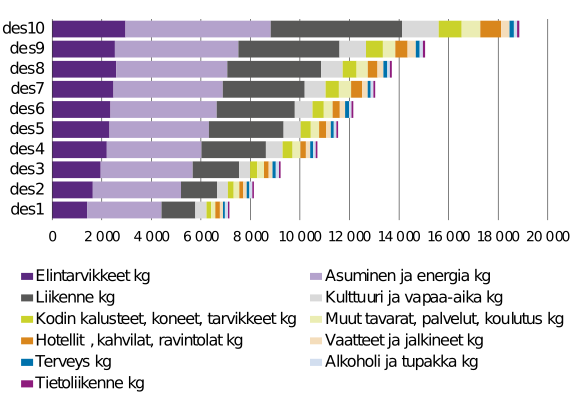
Or is it? Then why cars specifically? Right now there's no such thing as a personal carbon budget, but there's a whole bunch of things that contribute to the pie. The status quo is that if you're rich, you can consume more (income vs consumption): http://www.stat.fi/tietotrendit/media/uploads/tt2018/nurmela...
So far we've been very much accepting that some people produce more emissions than others. Should that change? I think that is something we should address before we ask if one should be allowed to choose to live in the Alps in a place where getting by without a car isn't feasible. In any case, private transportation in that region is not killing the planet. And for that matter, motorsport isn't either. I don't think we need to plan around those things, there are significantly more pressing areas to consider.
I personally think online car rental is very adequate for this. Locally, there's a number of very affordable services (usually there's tiers of membership fees that gives you steep discounts) that do this and I know many people that don't own cars but instead use this service somewhat regularly. Especially the flexibility of being able to pick up any type of car at a whim is very useful.
Come to Europe to the cities where one actually finds a job and then try to use the public transportation for that 1h 30m commute time, easily done in 30m with a car.
If you are lucky enough to live in suburbs with a job that works for you and good connection, then all the best.
Just don't assume it actually scales for everyone, specially when the closest bus stop requires 15m walking for a bus that only comes around every 30m, just to get to the next connection point.
> You can pick your housing and location based on not owning a car
If all I ever wanted from life was to go to work and back to my apartment, via a grocery store.
As a matter of fact, I can't choose where my friends and relatives live, and I'd probably have to drop some of my hobbies too if I were to live without a car.
Yeah, well, I did things the other way around and picked my job around not having a commute. That means remote, I work from my apartment.
I still have a car, but I drive much less than those who commute by car every day. It might be sitting unused in the lot for weeks (I have my feet & bicycle for grocery store trips). But when I need it, I need it, the public infra and ridesharing simply isn't there. (But I occasionally give rides and haul stuff for people who don't own a car, hey, isn't that exactly what we need?)
As far as global warming is concerned.. well, one glance at the statistics shows that my car ownership couldn't matter less. For example, if you take the top polluters (China & USA) and compare to my country (Finland), and break it down by sector, you'll find that our transportation's contribution to CO2 emissions in the world is a fraction of nothing.
As far as domestic energy consumption goes, we've cold winters, and heating is the biggest drain. There's a lot that could be done to improve the energy efficiency of older homes without spending too much money but the will isn't there. The only way we get heat efficient buildings reliably is via regulation that applies to new buildings.
Things people do generally become a problem only at scale. If the scale isn't there, there's no problem. There is no global law, everything we regulate is regional. The consequences of regulating a speck of noise in the statistics does not matter; regulating a major contributor does.
I can go on a camping trip and light an open fire in the woods, no problem. My neighbor can do so too, no problem. If all the 1.3 billion people in India started doing it, we'd probably have to do something about it.
This applies to pretty much everything you can do. In Californian drought, it may be occasionally necessary to restrict the use of water for watering lawns or washing cars, but here we don't give a shit because we aren't running out of clean water. In areas with expensive desalination, all water use is rather consequential.
There are low density regions where it's ok to heat your home by burning wood, it will never cause an air quality issue and the planet won't die as long as the world's population is not concentrated in these areas doing the same thing (then it would not be a low density region).
There are high density cities where they're starting to reroute traffic around it and collect tolls from those who insist on driving through, and there are low density areas where it doesn't matter.
There are areas where little to no energy is spent on heating homes, and then there are areas like Finland with cold winters and a lot of home heating.
The attributes are absolutely relevant, we need to put things into perspective and attack problems where the scale is an issue. Planet earth doesn't care that you're pure of heart, or that you breathe less CO2 than your neighbor, it cares about the absolute quantity of greenhouse gases that are shot into the atmosphere. That is not solved by fighting the fight where the quantity is relatively zero. And yes, that means the world is unfair, and you may be subject to more restrictions depending on where you happened to be born, or where you chose to move. Holding everyone on the planet to the same standard was never a thing (unfortunately the globalists don't seem to understand this and we're occasionally suffering the consequences of regulation made by & for people a thousand miles south of us, in a different climate, thanks EU).
> Instead we should heavily invest in high-speed trains.
This is ideal for obvious reasons. If only cities and governments (especially in the U.S.) would see the value. But alas it seems like only some countries can pull it off.
Also, most EV batteries today are highly recyclable and with fewer moving parts they can last much longer than ICE cars.
I love investment in trains but in the USA, small improvements to investment wouldn't be close to enough. We need EVs because the political will is simply not there for any infrastructure spending. Its either EVs or more emissions, sad state of affairs.
That's incredibly fascinating. It seems counter-intuitive that a random placement would be superior to a more regular one. Does this merely optimize for minimal length of the datalines?
> Does this merely optimize for minimal length of the datalines?
That's how it used to be 25 years ago. It's probably still a factor in the cost function, but the biggest part is timing. Of course, timing and length are closely related.
> It seems counter-intuitive that a random placement would be superior to a more regular one.
It's not necessarily superior if you want to have optimal timing for all paths between all cells. But you don't need that: only a few percent of all paths are actually timing critical. Those determine the maximum clock speed. The others have enough slack such that it doesn't matter that they are placed tens of microns too far.
Random placement (at an ever lower level of detail) is also better to avoid crosstalk. If you'd place a bunch of driver cells in a nicely aligned stack and make those wires go a nicely aligned stack of receiving flip-flops with parallel wires in between, you'd get the mother of all crosstalk problems.
Chips themselves aren't actually very regular in terms of their layout -- not all tracks are connected the same way, parts are partitioned across different clocking areas, some parts of the chip contain things like memory resources while others do not, etc. You don't actually have a perfectly symmetrical die. FPGAs for example are quite "heterogenous" in the device resources they contain (clocks, DSPs, memory, registers) and they are scattered in many places over the chip. (Note that FPGA resources are fixed while ASIC layouts are not, but both of them use simulated annealing/analytic placement algorithms in the design phase for automatically laying out digital logic among the chip. Both of these problems, while complex, do ultimately aim to solve the optimization problem of minimizing wire-length -- among many other timing/clocking constraints.)



I don't intend to spoil the enthusiasm here, but wouldn't supporting welfare hence be a more effective measure than investing in fancy tech? That latter only increases the deterrants which seem hard to increase any further to begin with.