It's cases like this that make it so easy to be skeptical about global warming. There is a fair amount of real, verifiable evidence that global warming is real, human-caused, and problematic, but none of it is dramatic enough to make a good story. Endangered polar bears, Hurricane Katrina, and out-of-control Malaria epidemics are a much easier way to get people's attention.
Unfortunately, in the quest for a good story, the activists may give their critics so much scientific firepower as to eventually lose the political battle. It's happened with other environmental problems, and it looks poised to happen again.
Evidence of anthropogenic warming is real, verifiable, and weak. Evidence that it is problematic, or that scientists are even remotely able to predict its magnitude and effect is nonexistent.
But the costs of prevention are 100% real and enormous.
One common argument for drastic public policy initiatives is the attempt by some folks to seize the moral high ground with "humans are terrible at long term planning". Yes, they are terrible at long term planning, because humans are really terrible at predicting the future, e.g., predicting the size and magnitude of AGW.
It's simply not true that preventing a worst case scenario is worth any price. Coming up with imaginary worst case scenarios 50 or 100 years from now is as easy as pie. That's not valid risk assessment.
Typically, AGW[1] proponents only argue from the expected value of our investment in preventing global warming. Since the purported worst case scenario is the extermination of humanity, the upside is our survival. Essentially, the expected value is infinite, so the net present value is infinite, so we should be willing to spend all our money to prevent even a possibility of AGW killing us off.
Since no one knows the risk, even to within several orders of magnitude, your guess is as good as mine. Your opinion on AGW policy comes down to something entire aside from the science, namely, your moral view of, and problem-solving assumptions about, humankind as a whole.
AGW is not currently acute[2]. I choose to believe that in a hypothetical (and vanishingly unlikely) case where it becomes acute, humans would weather it.
[1] There is currently no good way to describe the for and against on this issue. Almost every knowledgeable person believes in the theoretical model of AGW. Most people believe there has been some AGW. The true division is between people who believe it's been proven that AGW is alarming and those who don't. "AGW skeptics" is not really an appropriate term.
[2] Don't say it is. That's preposterous. AGW itself is weakly shown. Regional climate changes have not been scientifically linked to weak AGW. Regional climate change is the rule, including changes that melt ice and extinguish species.
That is the key phrase for me. You're sharing your opinion, which sounds pretty plausible, but hey, why should I take it over anyone else's?
That's where science comes in. It's messy, biased and often temporarily wrong, but it's the best process we've got for eventually getting to proven truths. This is a massively important subject, if you're right we're letting a lot of suffering elsewhere be neglected because of the resources we're putting into addressing AGW. Put together a paper detailing your models, assumptions and facts, or at the least promote somebody else's work.
Bjorn Lomborg is the closest person I can think of to your position, but he's got a pretty nuanced take on the likely effects, and he's gone to a lot of trouble to quantify the costs:
http://www.lomborg.com/
I want helpful references and links, material we can use to figure this out. Opinions on their own don't move anything forward. Debates with numbers and facts like these between the Economist and Will Eschenbach enlighten me a lot more:
"Evidence that it is problematic ... is nonexistent."
Wow. What's amazing to me about this rant is how the debate has moved over the last 10 years from "it's not happening" to "it's not a big deal".
So, our massively complex ecosystem is changing in ways that our scientists don't fully understand and it's not a big deal? The ecosystem so complex that scientists have a hard time using the world's fastest supercomputers to try to model it. These real, verifiable changes to OUR ONLY ecosystem are not a big deal even though nobody knows the outcome?
Your position is that playing russian roulette with our grandkids future is worth it because the price of action is overwhelmingly expensive (or infinite). But that's wrong, it's not that expensive. The European economies that have reduced their emissions according to the Kyoto protocol have been doing fine. Reducing the world's carbon emissions is easy, cheap and prudent.
I suspect that reducing our emissions is actually not just cheap but cost negative. You invest in energy saving infrastructure, like insulation, solar hot water, public transport, more efficient appliances, lights, cars etc.
Increase the usage of renewable resources, like solar, hydro and wind.
And do R&D.
Just wait for the next down turn and instead of cutting interest rates have the plans ready to do the investment. We probably have 4 to 10 years to do some good planning.
At present, it depends on the strategy taken, ad of course it will depend on the technologies developed. There are actually many many technologies which, at present, will save you money in the long run (and the run doesn't even need to be that long.)
The main barriers to adoption are laziness, cost of capital, consumer behavior (not purchasing LED lights because they 'seem' too expensive), and most importantly, lack of education.
Page 4 of this paper has a great graph where they examine costs and cost abatement for a variety of 'green' strategies. Hybrid cars are the most expensive!
Exactly - I think the "enormous costs" argument is another fake argument. It's not as if these investments are just sunk, they are used to build infrastructure.
When was the last time our scientists fully understood anything as broad as climate change or "OUR ONLY ecosystem"?
When mankind started to change the world through agriculture, deforestation and industrialisation, that's when we started to play russian roulette if you find that analogy useful.
We didn't know what it would do to our ecosystems but we did it because life back then was horrible and because we could. One bad crop and people were starting to die from starvation. Life is better now so we were right to take that risk.
It makes no sense to be alarmist about this basic disposition of mankind to take risks it doesn't fully understand.
> But the costs of prevention are 100% real and enormous.
We don't know everything about climate. But we also don't know the return on investment for R&D in generation and consumption of power.
Are you so sure that buying hybrid cars instead of F100's, insulating some buildings, and converting some power station
to combined cycle would be an enormous cost?
> AGW is not currently acute[2]. I choose to believe that in a hypothetical (and vanishingly unlikely) case where it becomes acute, humans would weather it.
Perhaps. Perhaps I would weather it, and so would you. Some future two year old in Bangladesh maybe not. On the other hand lots of them don't weather their first 5 years of life anyway, so we don't value those humans much. Why start now?
> Your opinion on AGW policy comes down to something entire aside from the science, namely, your moral view of, and problem-solving assumptions about, humankind as a whole.
Totally true, although we generally argue as though we care about human lives.
>Perhaps I would weather it, and so would you. Some future two year old in Bangladesh maybe not. On the other hand lots of them don't weather their first 5 years of life anyway, so we don't value those humans much. Why start now?
The question becomes are those future two year olds in Bangladesh better served by a future in which the planet diverts massive resources into green tech or in to other social and technological advances? Resources to make these advances are, in fact, limited, and choices must be made.
The correct choices are not at all clear, and not at all simple.
I think humans are pretty much incapable of doing long-term science and coming to rational conclusions on any kind of climate or environmental issues. If any money is involved at all it gets politicized and science goes right out the window.
Plus, time scales of even 10 or 20 years are too long to really enter our decision making process in any meaningful way. Essentially we will do whatever we want until there is an immediate crisis, and then we will deal with it to the best of our ability. Maybe that means mass deaths or extinction, or maybe the consequences will be manageable.
I have long wondered if there is a good solution this this problem: given that politicians serve some short term length, say 2-6 years, before running for re-election and given that major policy changes can not be enacted overnight nor in one piece, is there any way we can get forward-thinking legislation into law?
It seems that any major legislation should require an informed, rational public - something I do not believe to be possible. What solution is there, other than benevolent dictator (which is not a true solution)?
The idea that this is an impossible problem to tackle is just more FUD spread by the skeptics. It is very doable, we've successfully done it in the past with other chemicals such as ozone. It will not destroy the economy. It WILL cause some extremely profitable industries to be less profitable which is why we still haven't done anything about it. If the horse buggy industry had been a massive multi-billion dollar influential industry they might still be around to the detriment of us all.
Overall I agree, but there is another side to it: you can't win on ideology with science.
There are lots of ideas/facts (e.g.: evolution, free trade, vaccines, etc) which science has a huge pile of evidence to support but still face a lot of resistance because of ideology, conflicts with political interests or plain dumbness. Global warming is just another one of these ideas.
The complaints about inaccuracy of the "activists" are so hard to swallow when the skeptics have been throwing every dirty trick in the book to successfully derail any progress for decades now.
"Gore made a mistake on the mosquitoes, what an idiot! and he's fat! har har har! dirty fucking hippies!."
Our grandkids will look upon these people as monsters.
I'm not sure why there is such a big climate-skeptic strain here on HN.
With basically any argument, the skeptical position should be your default one. The person presenting the argument should be the one charged with convincing you of their point. It doesn't work the other way around.
So, the fact that there are raving hordes of neo-religious freaks claiming that climate change science is bunk does not mean that those supporting the assertion that we are doing irreparable harm to our planet are absolved of all responsibility to actually prove that.
OK, I understand that opinion here leans towards the skeptic crowd, and I used the word 'fucking' in my comment so maybe that's why I was downvoted so harshly.
But why upvote this comment so much? It doesn't make any sense.
The "person presenting the argument" are the scientists that have published hundreds of peer reviewed papers on global warming science. Apparently they're not doing a good enough job of convincing some people, but they're not trying to get people to blindly agree with them, their doing science! What more are they supposed to do to prove it?
"scientists that have published hundreds of peer reviewed papers" - As anyone who has tried to get their grant money will tell you, most of those papers are institutionally funded, creating selection bias for the results. Those scientists in the community who put forth a hypothesis challenging AGW are ostracized, and, in some cases, actively targeted for their beliefs - the recent email archive revelations show a fairly consistent thread with regards to that.
Environmental Science has become (and perhaps always has been) politicized. It's not the pure world like relativity, or quantum/particle physics, where there is a passionate desire (and even support, and funding) to find something that might contradict established beliefs/theories.
I suspect there is actually a hierarchy of science beliefs that looks like:
    Political         Environmental Science
    Less Political    Evolutionary Science
    Apolitical        Particle Physics
(Apologies to the 2% of HN that questions genomes/fossil records. :-)
Used to be you could trust scientists to be pure - alas no more.
So one email from over 10 years ago from one scientist without the full context of what was going on and all of environmental science is discredited? For ever?
Who is really being political here?
Luckily, science will not stop because you say it should.
You are missing my point - if anything, I am almost a pure-play scientific hypothesis/experiment/observations/results fanatic. I cringe every time I hear scientific naysayer attack the institution of science.
But, with that said, I am much more skeptical about environmental science than I would be about topics that are somewhat less politicized, such as Eötvös torsion balance experiments - and even _they_ turned out to have suspect results in hindsight.
And it wasn't the email regarding the "hiding" of data I was referring to - it was the several _hundred_ where the various scientists discussed how to discredit or otherwise shut down those who stood in opposition to the popular environmental theories.
I'm all for setting up the experiment and letting the results speak for themselves.
Experimental results can't speak for themselves. They are experiments. Only people can speak and weave stories, and only stories will move a population to action. This is the reality of communicating with human beings.
Marketing is the practical application of the science of sociology.
Really? Are you referring to the recently leaked emails from the CRU? Because, at the risk of pointing out the obvious, emails aren't peer-reviewed literature.
Also, the nice thing about the peer-reviewed literature is that it is published. Anybody can read it and point out inherent flaws. Indeed, if you can identify a serious problem in a paper, and back your discovery with facts, you'll have no problem getting your counter-point published. There are literally tens of thousands of examples of precisely this happening available for your perusal, in the peer-reviewed literature!
It's not like major polluters, such as oil companies, don't have the bankroll to fund scientists to demonstrate that the claims about climate change are false. Their continued silence is like the dog that didn't bark in Conan-Doyle's "Silver Blaze"
The emails showed that a group of very influencial scientists were going to great lengths to prevent critical review and access to data.
I am unable to judge the impact of that kind of obstruction on their actual scientific argument. It could well be that the significance of the so called climategate is way overblown.
But it's definately not confidence inspiring behaviour by scientists who have so much to gain from a global warming panic.
Again, maybe I have misunderstood, but I'm under the impression that nearly all of the data in question is publicly available elsewhere (from original sources, as the CRU hasn't generated that much data itself, it relies on organisations the world over to pass their data on). A figure of about 2% has been cited for data that wasn't available elsewhere, but I am not aware of the validity of this figure - we'll have to await the results of the current review to know the real figure. Furthermore, the current claim is that that remaining undisclosed data is not undisclosed for nefarious purposes, but simply because it is data collected by commercial entities that have not granted the CRU the right to redistribute the data. That's another thing for which we will have to wait for the review to know the real story.
As for preventing critical review, I am unaware of any such activity. Do you have a citation?
What I am expressing is my general perception of the intentions conveyed in the published CRU emails. In order to provide citations I would have to go back and re-read them to collect all the bits and pieces that led me to my conclusions. I'm too busy with other things to do that.
One thing I consider preventing critical review is the lies about the original temperature readings that were thrown away in the 80s. The only plausible reason for lying about that is to make it easier for them to defend their own conclusions and make it more difficult for critics to check for errors.
But as I said many times before, I'm not one of those who claim to have found some kind of unambiguous smoking gun in those emails or code comments. Not about the science proper anyway. It seems to me that there is an attempt to hide something but I'm not quite sure what that is and whether it's of major consequence to the science itself.
The data available is insufficient to reproduce the work of climate change research centers, which is the whole point of any criticism and the motivation behind FOIA requests that scientists illegally acted to obstruct.
It is impossible to prove that climate change will occur and is man made. The only way to do that would be to do the experiment: find a planet, pump lots of C02 into its atmosphere and measure the result. Of course you would have to do this a number of times with different planets using some as controls.
However science can estimate from small scale experiments and theoretical calculations a probability that global warming is man-made and its likely effects. Even if the probability of a catastrophe is small, say 5%, it is still worth spending a small percent of GDP to prevent or to ameliorate it. It's like if you own a house you would be an idiot not to spend good money on fire insurance even though the probability of your house burning down is very small.
There's a difference between reasonable and unreasonable skepticism. A couple years ago there was a big debate about climate change on the xkcd forum. Fortunately, there was someone with some experience in the field itself.
I'm skeptical that it's possible for six billion people to make fast and measurable changes in atmospheric composition and land use without endangering the hydrology of the planet, and creating hard-to-predict ripples on the food and water supply.
As such, I advocate policies that attempt to reduce the rate of these changes when possible, until those changes are quite well understood.
I don't worry about "Earth" at all. I worry about food and water security, as well as the enormous waste of resources that will occur if the hydrology of a continent undergoes rapid change and leaves cities, farms and other infrastructure placed inappropriately for the changed climate.
I view this as a conservative and skeptical position.
I find it confusing, and somewhat offensive, that I'm asked by those who advocate unfettered change to prove that their change is deadly, when in most other cases, the person advocating mass change is instead asked to prove that it's safe. It seems particularly problematic, because I'm not advocating a complete halt to the change, but rather a decrease in the derivative of the rate of change.
And malaria was only eliminated from the Soviet Union and large areas of Europe in the 1950s, after the advent of DDT.
This is an important fact that is only mentioned in this one sentence. The banning of DDT lead to millions of deaths in tropical areas (an "unintended consequence"). Limits on CO2 emissions and the resulting impact on energy production, manufacturing, and agriculture may well have unforeseen consequences, which will, like the DDT ban, probably affect developing nations more than anyone else.
DDT is still legally used to the quantity of 4000+ tons a years. I fail to understand how it was "banned", as it's still widely used in countries like India and several African countries. What actually happened was a bunch of guidelines were established for its use, which any sovereign nation can ignore with little consequences. The fact that the west decided to outright ban the stuff isn't that big of a deal given the fact that there aren't terribly many Malaria deaths in the United States or Norway.
And those restrictions were put in place for good reason: For DDT to be effective in wide areas (rather than targeted spraying indoors) you essentially need something potent enough to disrupt the entire Entomological portion of the eco-system, which works its way up to small mammals, which can eventually impact certain key predators.
One infamous example this occurred in Borneo in the 1950s. The WHO responded to a malaria outbreak on the island by spraying DDT. It abated the malaria problem but completely disrupted insect life which lead to numerous problems culminating in roofs collapsing from an overpopulation of thatch-eating caterpillars, along with killing of mammalian predators that ate lizards (which ate DDT-laden insects). This caused an overpopulation of rats which started spreading typhoid and plague. The rat problem was ultimately solved by airdropping cats.
which any sovereign nation can ignore with little consequences
This is contrary to fact, because a) African nations are dependent on foreign aid, and donor organizations both will not fund DDT and will quietly threaten other funding if you choose to spray it and b) the prospect of African agricultural exports being barred due to "contamination" by DDT residues acts as another de-facto ban on DDT, since it threatens crippling economic sanctions for using it.
(Oddly enough, the crop most often at "risk" is tobacco -- because God forbid your cigarettes have harmful chemicals in them. There is an absolutely priceless quote from a chemist saying that he's be more concerned that you got nicotine in his DDT than getting DDT in your nicotine.)
Is there any nation that has had aid withheld explicitly because of their violations of DDT use? India shirks WHO regulations like crazy (including but not limited to those pertaining to DDT) but received billions in aid during 90s, before they were a nuclear power. And it certainly hasn't slowed down their position in global trade. Heck, their human slavery problem furrowed lots of brows but never amounted to any sanctions that I'm aware of.
What I'm trying to say here is if the hammer is going to come down on your country, it's likely doing things waaaay worse than revamping its ecosystem with pesticides.
That quote pertains to acquiring funding exclusively for programs that will use DDT, and basically says that donors will be reluctant to fund something that involves spraying DDT. Unless the only people who bother to give any money to these programs are misinformed bleeding-heart environmentalists, I'm not sure how much of a barrier that is. Nothing is stopping say, the Cato Institute from starting a DDT spraying initiative to fight malaria.
But various factors, chiefly the persistence of DDT's toxic image in the West and the disproportionate weight that American decisions carry worldwide, have conspired to make it essentially unavailable to most malarial nations. With the exception of South Africa and a few others, African countries depend heavily on donors to pay for malaria control. But at the moment, there is only one country in the world getting donor money to finance the use of DDT: Eritrea, which gets money for its program from the World Bank with the understanding that it will look for alternatives. Major donors, including the United States Agency for International Development, or Usaid, have not financed any use of DDT, and global health institutions like W.H.O. and its malaria program, Roll Back Malaria, actively discourage countries from using it.
Somehow I doubt that Malaria ever was the same big problem in Europe as it was in Africa. Wasn't Malaria the main thing impeding Europeans in Africa? They should have been used to Malaria if it had been so common in Europe.
If Malaria was in Europe, perhaps it was at a much smaller scale?
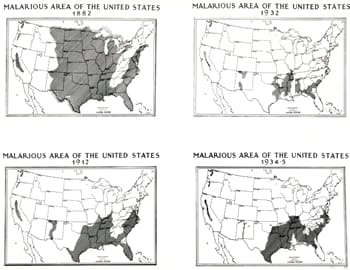
Malaria used to be as big a problem in over 60% of the continental United States, and the south of Europe, as it is in sub-Saharan Africa. It was stopped with widespread mosquito habitat destruction and chemical abatement.
Here is a map the CDC produced which displays, in graphic detail, how these efforts succeeded.
There is, currently, no significant portion of the continental United States in which malaria is a major health conern. If there was, we would start spraying absolutely anything required to kill it, because Americans don't let their kids die to avoid pissing off the environmental lobby.
> because Americans don't let their kids die to avoid pissing off the environmental lobby.
Don't point that at everyone. I'm an American, and a father-to-be. I would rather deal with the issue in a way that is morally responsible, than just "do whatever it takes to prevent any harm from coming to my child."
I'm an American, a father of two, and about as far to the opposite end of the political spectrum from Patrick as you can get, and if we're voting, I'm with him. Kill the damned mosquitos. I've had a kid in the hospital for something very serious before.
It's not as simple as "kill the mosquitos." What if "kill the mosquitos" meant "burn down all the forest and destroy all of the wetlands." Are you about to destroy the world to save your child?
It says a lot about me that I don't even consider this to be a difficult question: I would burn every forest, pave every wetland, and dance over every eggshell to save one African kid I have never met.
That said, it is a false choice. Look at the CDC graphs: we've already annihilated malaria on two continents. North America and Europe strike me as pretty livable. I'm quite willing to do that everywhere.
That sounds a bit silly though - as you said, a false choice. Surely you wouldn't want to pave over the whole continent. There are other ways to save the children than to destroy everything. It's also a question if humans have to expand everywhere.
If it all is such a no-brainer for you, I wonder what other choices you make in your life to save lives in 3rd world countries? For example CO2 consumption? To be honest, I don't buy your no-brainer attitude.
I have to consider whether killing mosquitos creates a world where I'll eventually have to teach my kids to painlessly kill themselves, a la The Road, but apart from that for my own family it's an absolute no brainer.
I don't know the backgrounds, but I thought that essentially having DDT in the food chain is undesirable.
Would you spray your backyard with DDT to save an African kid? Granted, if it was the only way, maybe, but overall I personally would rather not (then I would rather put up a tent for the African kid and relocate it to my DDT free backyard).
Actually, window screens were as important as chemical abatement. That's why installed screens are required in much of the US for a new house to receive a "habitation permit" (in quotes because different jurisdictions use different words). And I remember an article years ago, that providing window and door screens for Africans would substantially improve their health, but nobody was interested in doing or funding it because it wasn't flashy enough.
Interesting, but somehow I doubt that spraying did the trick. Maybe it was destruction of the habitats. I suppose with spraying you would have to keep spraying, which I think isn't happening? Isn't DDT outlawed now?
Perhaps changes in farming also contribute (are humans the only animals that pass on Malaria, or would cows work, too?).
Also I think if I were a father, I would weigh pros and cons. Mosquitos are bad, toxic chemicals are bad, too. It might vary from situation to situation which one is the greater risk.
It's amazing what a little fact checking can do for your perspective.
After watching 'An Inconvenient Truth', I was quite affected by the supposed plight of the Polar Bears. So I did a bit of research, and I found out two fascinating facts:
1. Polar Bear populations have increased massively over recent years.
2. Polar Bears as a species are older than the last time the Arctic Ocean was free of ice.
At that point, I began to suspect that I was being sold something.
The fact that this guy is an epidemiologist doesn't impress me worth a nilly bit. What I do know is that some of Gore's science is spotty, but that malaria may indeed be affected by any sort of climate pattern changes. I've done only a bit of traveling in my life, but I think it can hardly be disputed that there are more mosquitoes in Florida than there are in NY, and more in NY than there are in California.
The question then is: will global warming increase the primary factor and secondary factors that contribute to mosquito breeding? Those factors are clearly water/humidity first, and warmth second. California has few mosquitoes because it's cold when it's wet and it's dry when it's warm, and Florida has a lot because it's got warmth and water aplenty.
So then, the answer is complicated. Some places will see an increase in malaria prevalence and some places will see a decrease, due to the varying effects of climate change. California is set to be drier and warmer, so we shouldn't have any increase.
But that's the twist. Some places are poised to become wetter and warmer, as opposed to drier and warmer. Thus, places that don't normally experience it will experience it (or at least be plagued by mosquitoes). The authorities in those places won't be prepared for it. So either way you play it, global warming will cause some issues.
"Some places will see an increase in malaria prevalence and some places will see a decrease, due to the varying effects of climate change. California is set to be drier and warmer, so we shouldn't have any increase."
I figured I'd do some fact checking, for no other reason than that's what a lot of this thread is about:
Cumulative Mosquito West Nile Infections by State:
   New York: 100
   California: 1056
   Florida:  3
Population of New York is approximately twice that of California, so, on a per capita basis, Mosquito Infections of West Nile Virus are five (5) times more prevalent in California.
Florida has almost _no_ west nile infections (though they have a lot of mosquitos)
We need to be cautious about conflating disease and insect prevalence, as tempting as that may be.
I nearly died of malaria in the middle-east, but never got it in Kenya and Somalia when I lived there.
You don't need DDT or any poisons to get rid of mosquitoes, we used frogs and fish. Any puddle of sitting water was filled with sand as quickly as possible. And any largish natural body of water got fresh-water fish and frogs introduced to it. No questions.
In Kenya (Mombasa) and south Somalia, even sea-water fish worked for us. I used to take off my Sarong and catch little fish for our wells.
Like his claim about the people he is attacking, it felt like his arguments were a little empty. He certainly had some facts about the actual movement of malaria, but most of the piece was dedicated to attacking specific climate-change proponents on one small issue. He even went as far as to claim that everything Dr. Epstein and co. published is a myth with the only evidence being one article on which the author is now correcting.
In truth, the science is never in. We’re not pollsters or policy-makers. We proceed by question, observation, hypothesis, and testing by experiment. We are still re-testing Einstein’s theory of relativity! So I’m happy to be a sceptic. That is how science works.
I think if you were to go out and try to claim that relativity wasn't true and still needed to be tested you wouldn't get much attention from the rest of the scientific community. Science is about finding evidence that verifies or falsifies a claim, but once that has been done multiple times (as it has with relativity) people find that it is much easier to just accept is as true until they find evidence to contradict it. I think it is a bad comparison.
He even went as far as to claim that everything Dr. Epstein and co. published is a myth with the only evidence being one article on which the author is now correcting.
No he didn't. He claimed that Epstein publishes primarily opinion pieces in scientific journals, which are then cited by activists as if they are actual research.
> I imagine he focuses on the actual movement of malaria because he is a medical entomologist and didn't want to make claims he was uncertain of
Which didn't stop him from making claims that his nomination to the IPCC would have been blocked by other countries and insinuating that some conspiracy caused his nomination to be mysteriously lost. Honestly, I was a lot more sympathetic to his arguments until I got to that part of the article.
"I think if you were to go out and try to claim that relativity wasn't true and still needed to be tested you wouldn't get much attention from the rest of the scientific community."
In fact, the opposite. Challenges to relativity not only get attention from the scientific community, they are _encouraged and funded_ - the community would be beside itself in glee (and someone would probably pick up a Serious Cred) if someone could disprove elements of relativity.
The challenge, of course, is coming up with new and interesting ways to disprove relativity.
Science is constantly testing ideas, but until we get contrary evidence we tend to go with the model that fits the data. Right now we still haven't figured out why galaxies are accelerating faster than they should and we are actively exploring that, but there are plenty of phenomena that GR explains very well. You can't go around claiming that GR simply doesn't exist because the data is there, but you could argue that it needs revisions.
Climate change seems to still be a very binary argument. There are some people arguing about how much is man made, but there are still those arguing about whether it exists at all.
I think in that way it doesn't make a good comparison.
The findings of classical mechanics have also been verified multiple times, before being contradicted by the findings of relativistic physics. It's a pivotal part of science to remain skeptic and continuously challenge the status quo.
He certainly had some facts about the actual movement of malaria, but most of the piece was dedicated to attacking specific climate-change proponents on one small issue.
He has a nice line in rhetoric. I especially liked global warming ‘sceptics’ and pointing that a true scientist is always a skeptic (his spelling is legit BTW)
Basically the bulk of the article says malaria is better characterized as a disease of poverty than as a disease of warming. It seems to me that this is the best analysis based on our knowledge. Are there any reputable scientists who hold an different position?


Unfortunately, in the quest for a good story, the activists may give their critics so much scientific firepower as to eventually lose the political battle. It's happened with other environmental problems, and it looks poised to happen again.