Some sensible advice here, but also ignoring all debt is not a good idea. I used to have a similarly black-and-white view, but now I realise that debt is simply another trade-off to be considered.
Remember, your life is precious. Don't live your 20s and 30s as an ascetic just so you can retire to a golf course in your 50s. I spend a lot now (but not beyond my means) because these are some of the best years of my life, and I know that there's a very significant probability (not guaranteed, but large) that my earning potential will continue to increase for the next 10 years at least (I'm 28).
I have made an informed, calculated decision to evolve my spending like this. My utility function is simply that $100 is worth more to me now that it will be when I'm 35. Ergo, borrowing (limited) money can be a net utility positive.
> I spend a lot now (but not beyond my means) because these are some of the best years of my life,
I agree with the second part of the statement, but not with the first one. In my life, there is almost nothing that could be further improved by spending more (or a lot of) money on. Currently, my biggest expenses are rent (allows me to live in London and have a very good job) and food (I buy the best, mainly because I believe that bad food will tax my body in ways that will only become apparent in several decades - but I eat home-cooked food as often as possible, so it's quite cheap). Other than that, I spend very little. I enjoy reading (books are cheap, so is internet), good conversation (again quite cheap, no need to spend 100s in bars), nature (parks are free), dance and sports (climbing, running, bodyweight training, skiing and surfing - the last two are a bit more expensive, but you don't need to buy your equipment if you're not doing it that often). If I lived in a smaller town, I would probably have a used car to travel in the countryside. I'm probably really lucky, but I really don't see the appeal of most of the more expensive stuff/experiences.
I agree with most of what you say; different people have different tastes though.
Like you I spend most of my money on rent (I also live in London) and food - in the case of rent, probably 50% of that is paying for location. I moved recently to be closer to work, and now I walk to work in 25 minutes rather than spending 45 minutes+ on the tube. This costs me several hundred a month, and it's worth every penny. It gets me back 30-60 minutes a day of time, I get extra exercise, and I get to enjoy being outside in the sun. It has literally made a significant difference to my happiness.
Outside food and rent, the other main expenditure for me is travel - I have friends around the world, and enjoy exploring new places, so I spend a few thousand a year at least on travel. I could certainly cut back some of that by staying at cheaper locations, but that's a trade-off I'm willing to make.
I think the difference between myself and a lot of consumers these days is that I spend primarily on experiences, not posessions.
  I really don't see the appeal of most of the more
  expensive stuff/experiences.
I live near London. If I decide to travel into central London to meet some friends from school, I can easily spend £15 on a national rail return train ticket, £4 on tube travel, drink three pints of beer at £3 a pint, and buy some bar food for say £8. Then you you've spent £36.
Needless to say, if I want to keep to the same budget I lived on as a student, I would not be meeting my friends in London very often!
If you're not taking 3-5% of your monthly income and just blowing it on something fun (it doesn't have to be material things, trips, fancy dinners, and financially helping friends have the same effect here), you're missing out on life. It's a conscious decision which may not maximize your earnings across your entire life, but I've found that it significantly increases your enjoyment of your entire life.
I like the earning potential argument, and I also consider the useful life of the products I purchase: A canoe bought now has a long lifespan, and provides several years of enjoyment that will be lost if I wait to purchase the same thing. This argument does not work quite as well for something that depreciates, or deteriorates quickly, but paying more for immediate use of something isn't always crazy.
10 years is not a long-term view. Try 50 years. Your ability to make $100 now is must more guaranteed than your ability to make $100 when you're in your 70s. A lot can happen between now and then. You could suffer a debilitating illness or become disabled. Your currently bankable skills may no longer be in demand. If you're 28, chances are you have about 10, maybe 20 years left of barely increasing eating potential, followed by a pretty steep drop-off.
I, for one, don't want to be in my 70s thinking, boy, if I only saved a little when I was younger, I wouldn't be eating dog food right now and choosing between my arthritis medication and rent.
I've noticed that people on the poorer side of the spectrum have made peace with the fact that there are (many) circumstances outside of their control that they are simply unable to address. They don't try by buying the rafts of expensive insurances that middle class people often insist on mostly because they simply can't. Its almost a zen thing.
It costs time and money not just to acquire things, but to hold onto them once you have them as well.
Health insurance for starters. Poor people will likely have a (mostly less than sufficient) government option that they pay little for, hoping that they don't get sick.
Then comes the mandatory insurances of "ownerships". Mortgage insurance to cover loan default, required property insurance for that home, auto insurance (full coverage also required by your lender on a new car) etc.
Fearful insurances like disability insurance to cover the bills if they should become unable to work (wouldn't want to lose all my stuff). Life insurance so the kids have a comfortable life at the level they've become accustom to in the even of death etc.
There may also be liability insurances connected with their line of work.
Middle class people have a lot of insurances that often take a significant portion of their monthly budget.
I drive a $450 car so I have the absolute minimum insurance on it required by law. Even after only one year of not paying for full comprehensive, I will save money if it gets stolen or burns to the ground and I walk away. (I do have high third party - so if I hit a Porsche, damage to it and people is covered). I pay $300/year for the car insurance I have.
I currently don't have any kids, so I've opted out of Life Insurance at work, instead getting more money into my bank account. In all honestly my savings account would cover my funeral expenses, so why would I want my family to get $250k in the event of my death? It's not going to make them happier.
I also opted out of the health insurance at work, so I get a bigger paycheck. I'm 32, fit and strong, and I can count on one hand the number of times I've been to a doctor in my life. Obviously this circumstance will change as I get older and have kids, and I'll re-work my approach.
EDIT: I live in Canada - basic health care is more than good enough.
Just a counter-point to your no health insurance view. I opted for health insurance while I was a healthy early 20s guy in grad school. $110/month, and 2 months later I needed my gallbladder removed. The surgery would've cost me $15k out of pocket. So with my premiums and copays I ended up paying a total of $2k for the surgery (effectively) and saved about $13k. At that age and employment status (stipend and free school with a research assistant position, but that wasn't much) I would've been fucked. As it was I lost nearly a month of academic progress that I had to make up because of the excruciating pain and isnomnia it induced. As a healthy 20-something male, the savings covered my insurance premiums through the rest of my 20s. And in that time I had other injuries [1] whose treatments (surgery or PT), again, dwarfed the cost of the insurance I continue to carry.
[1] I've had 2 infections since I was 14: food poisoning and an ear infection, every medical thing I've needed is the result of injury or organs gone mad. You just can't predict these things, a good immune system does not prevent you from needing medical care.
I paid cash to have my gall bladder removed. It as 1500 Euros. I really don't know why the same procedure would cost 10x as much where you live (assuming a simplistic conversion rate, which is not correct, so maybe 8x) compared to where I live. And nowadays that's not even an option any more because we all have mandatory health insurance with deductibles that are mostly designed to keep you paying for everything unless something major happens.
This was in the US. It's not cheap here for medical care, and there's really nothing that we get that's an improvement to justify the costs compared to the EU or Canada or, really, most other developed countries.
Also, this was 8 years ago. The numbers stuck with me because I was trying to explain why, a couple years later, I was paying out of pocket from my (at the time) meager salary for health insurance to my coworkers. They had grecy's attitude. And then one of the idiots broke his ankle jumping down some stairs. His parents bailed him out financially for that cost, which was small in comparison, and he failed to learn the lesson: Debt for unexpected medical costs is not worth the short term savings of skippig health insurance (in the US).
The reason I paid cash was very simple: because of a nasty little slip-up during my immigration into Canada I ended up un-insured (you have three months to apply for OHIP but being in the heat of a launching start-up I totally missed out of it). Many years later, on a short trip to NL I got hit with the gall bladder issue and I was rather pleasantly surprised that it was as cheap as it was.
An infographic [1] comparing the cost across states. Those high cost ones seem absurd to me. But I've read my EOBs on every surgery I've had. One hospital charged something like $200-300 for the stitches (maybe 20 stitches used) . Not stitching, the stitches. The personnel costs were listed separately. US medical costs are broken.
Obviously I would never wish a freak traumatic accident or sudden debilitating illness on anyone, but should one happen to you, please post back here about how those slightly bigger monthly paychecks worked out for you.
Anecdote: my brother, who IIRC was unemployed at the time, chose not to purchase even a catastrophic plan, under the theory that he was perfectly healthy so why should he?
Then one day, out of the blue, horribly sick, with intense abdominal pain, almost unable to walk, he had to be taken to the emergency room to have his appendix removed. The bill was something like $17K and he paid all of it out of pocket. He was in his 30s and I think a reasonable catastrophic policy would have cost a couple hundred $ a month and would have, in this case, saved him $12K or thereabouts in hospital bills.
This was just for an appendix, something more serious could have wiped him out financially. It's crazy not to have at least a catastrophic health insurance policy at any age.
$12k is $200/month for 5 years, so if costs of that scale happen less often then that your brother is still saving money. Something more catastrophic could have happened bankrupting him or nothing could have happened saving him large amounts of money.
It's risky to not have at least a catastrophic health insurance, but it is also quite expensive to have it.
I agree except for life insurance. Most life insurance (at least a whole life policy) is a way to pass on wealth tax free, rather than a real insurance policy.
You're assuming that passing on wealth is a good thing, implying that it will make your kids happier.
In all honestly, when my parents pass, I genuinely hope they've spent every cent of what they earned in their lives and my brother, sister and I wind up with nothing more than photo albums. They worked their entire lives for that money and I want them to spend and enjoy that money.
I would like the same for my parents. But I choose to keep my employers life insurance because it's cheap (about $100/year) and between it and my savings will more than cover both my sister's and my parents' current debt (mortgages). Should I die suddenly, they won't be happy but the cost to me is negligible and the benefit to them is great. Once alleviated of the debt and annual expense they'll all be able to retire a little bit earlier or a little more comfortably. Sure I don't get anything out of it, I'm dead, and the money won't bring me back. But it will bring them some financial peace.
Now, if it were more expensive I might have a different view on it. I certainly have no intention of buying more life insurance until I end up with actual financial responsibilities (spouse, kids) that would more obviously need the money in my absence.
EDIT: Word choice, I slept better last night than I have in months, but it's still not enough. Sleep deprivation wrecks my ability to write.
Saving is so much easier than earning, and it’s a habit that once built will pay you back for the rest of your life.
There's a weird cultural meme that's convinced the middle class that the road to wealth is saving. The road to wealth is earning. This is just kind of an obvious thing, but I guess there are benefits to convincing people who will never earn enough to be wealthy that there are attainable ways to go about it. I'll tell you this much, if buying an iPad makes you broke, then not buying that iPad sure ain't gonna' make you rich.
This meme is just kind of annoying as it relates to the middle class, but it's downright dangerous when applied to the poor. It's useless to apply ideals of thrift to people making minimum wage, a level of earning at which no amount of saving can cover even predictable periodic expenses.
Investing $4000/month (which is what I do on a salary barely over $100k while living by myself in a 1 bedroom in the East Village, NYC and going out for every meal) at 3% will get you $1 million in 17 years. That means you'll be a millionaire by the time you're 40 if you start doing this right after graduating college.
3% happens to be the rate that stocks have historically appreciated above inflation, so by doing this you'll be a millionaire in today's money.
EDIT: For the poor, there are many structural problems that lead to a cycle of poverty, but it is possible to escape even that with very good money management. I dated a girl whose parents came to America on a raft, with a fifth-grade education. They slept outside the 7/11 where they worked at first (didn't have to spend any money on rent), and ended up owning a large portion of their town by the time they were in their 50s.
In short, don't knock thrift. Yes, earning more is always great, but savings combined with compound interest is magical.
That's great, but I hope you'll appreciate that earning $100k+ on a single income in your early twenties without kids isn't exactly the median household I'm talking about. As you point out, you've still got plenty of money remaining to live in one of the most desirable neighborhoods in the country while eating out for every meal.
Sure, but the article specifically mentions couples making $211k/year combined ($160k euros) spending it all. People making $30k/year obviously can't save as much as me, but they could save something. I saved money even when I was in college, working only in the summers and paying for food/housing myself. I think I made like $10k/summer. Of course, my lifestyle was much less extravagant than it is now - I never ate out and lived with many roommates.
"They slept outside the 7/11 where they worked at first (didn't have to spend any money on rent), and ended up owning a large portion of their town by the time they were in their 50s."
I'm assuming that they weren't still working at 7/11 in their 50s.
Median income in the United States is ~$50k/yr pretax[1], so saving $4000/month is unrealistic for the majority of people in this country (since they would have to be saving every cent they earn without paying taxes, housing expenses, food expenses, healthcare, etc).
"Investing $4000/month (which is what I do on a salary barely over $100k while living by myself in a 1 bedroom in the East Village, NYC and going out for every meal) at 3% will get you $1 million in 17 years."
Might want to consider that inflation averages about 2.5-3% annually... So effectively you're treading water there in terms of investment (though saving is good).
There are pressures from both the earn and the spend side, but the surest path to misery is living above your means. Dickens had it pretty much nailed with, "Annual income twenty pounds, annual expenditure nineteen pounds nineteen and six, result happiness. Annual income twenty pounds, annual expenditure twenty pounds nought and six, result misery."
That's half the road, which is the OP's point. We all know tons of people who earn a ton of money, but they never get rich or free because they keep ratcheting up their spending.
The road to wealth is spending dramatically less than you make in an ongoing way.
"Mr Micawber's famous, and oft-quoted, recipe for happiness:
"Annual income twenty pounds, annual expenditure nineteen [pounds] nineteen [shillings] and six [pence], result happiness. Annual income twenty pounds, annual expenditure twenty pounds ought and six, result misery."
During my 2 year drive from Alaska to Argentina, it took almost the entire trip for me to learn this lesson. At first in Mexico (and Central America in general) I genuinely thought people were just lazy and I would think "Why don't you get a job". The years rolled on, my Spanish improved, and I had many great conversations about this topic.
Finally, a great friend in Argentina explained the situation to me. It's all about debt. In the developed world, when we want something shiny (say, an iPhone), we walk into the shop, sign a piece of paper and are showing it off to our friends 20 minutes later at the bar. It's not a completely conscious thought that we'll be paying it off for the next 24-48 months while we mindlessly go to work everyday.
In the developing or undeveloped world, nobody can get credit, so when you want an iPhone, you have to save up for it and buy it outright. So you get a solid job, and start saving the ~$700 for an iPhone. Who in their right mind is going to continue going to work day in, day out for 6-12 months just to buy an iPhone that will be obsolete in a year anyway?
More realistically, after a week or three, you quit your job, and hang out with your friends & family, having celebrations and generally enjoying your time.
And so it is that "poor" people have so much more time to enjoy their lives, rather than going to work to pay off things they never needed in the first place.
I'm getting tired of all this "live debt free!" nonsense. There's good debt and bad debt, and people like this should learn the difference before giving financial advice.
OK, well look around. Do you know a lot of people (is it possibly even most of the people you know) who have 2 or more car loans, and at least one home loan?
That's the "norm". That's what "everyone" does (everyone who is in a first world country and has a decent job).
Is that somehow "smart debt"? Really? What's so smart about it?
It is smart for whomever loaned that money out ... they get back free money paid consistently over the years. How is it smart, in 90% of the cases, for the borrowers?
Our culture tends not to see this in the same way fish don't see water.
> Is that somehow "smart debt"? Really? What's so smart about it?
Regarding a mortgage and 2 car loans, I'd like to offer a defense of why it's smart / good debt.
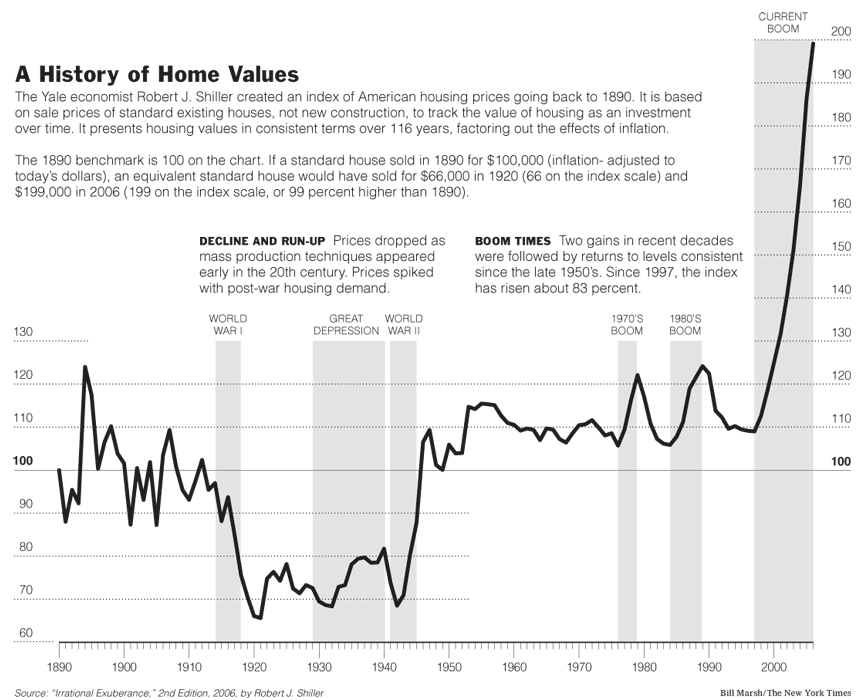
The primary reason that your mortgage is considered "good debt" is because the asset you purchase with that debt (your house) will typically appreciate faster than the interest you pay. I'm not including black swan events like the 2008 crisis. When you eventually sell, you'll be in the black.
Regarding car loans, the only type of "smart" car loan is 0% financing. A 0% loan lets you keep your money in your pocket for longer (and in that time, you can invest it however you see fit). 0% loans can be found depending on when you see the dealer. End of the month? Quota wasn't reached yet? Perfect time to negotiate.
I'm certain jaquesm's point is that lots of people get in over their head with their purchases, especially large purchases like homes and vehicles. However, DontBeADick's point has some validity: Taking on debt can allow you to realize further gains than you would have otherwise seen (basic leverage).
"The primary reason that your mortgage is considered "good debt" is because the asset you purchase with that debt (your house) will typically appreciate faster than the interest you pay."
Any money manager will tell you that what you just said is false. Excepting a few cities, when you look at the data and adjust for inflation, owning a house is not a particularly good investment ( http://files.foreclosureradar.com/images/foreclosuretruth/Hi... ). Add in that the average home loan lasts about 6ish years before folks sell/refi, the fact that interest/fees are front-loaded into the first 5 years of the loan, and that avg. annual maintenance on a house (NOT improvements) tend to average about 1% of the value of the home per year, it gets worse.
What it CAN be (if you're disciplined and lucky) is leverage and liquidity. Example: I have my house paid off. I get a mortgage on it, essentially getting a loan at 4% for $700k. Now I have $700k that I can make work for me-- a worthwhile idea if I can find a way to make more than 4% on that $700k via other investments (which are not remotely risk-free, but can pay off). Of course, what most people do when they re-fi their house is self-indulgent stuff-- buying a vacation home, a boat, home improvements that don't pay for themselves, etc.
Most people don't usually get two car loans just because that's what other people do or because it seems smart/cool. They do it because both people living in the same household need a personal car to get to work. Granted that maybe they could leave their white collar high paying jobs, find some other job at the groceries store in the street and trash the car loan. But the salary difference doesn't pay off. Also, for a lot of people public transportation doesn't pay off either.
As for a mortgage, as others have explained in this thread, it could be a smart debt given the right conditions. For example, if I had a bank loan to buy a house with the similar value to the one I currently rent, I would be paying a smaller amount of money to the bank than what currently is being transferred to my landlord monthly. I could live forever without a mortgage, but in 30 years time would find that I had spent a lot more then if I did.
It's not all 'several loans = bad money management vs no loans = good money management' sadly.
The average US household has $15k in credit card debt. A mortgage can be a sound investment, but paying over 10% APR on credit card debt is almost always a bad decision.
It's still terrifying, but according to your link $15k is the average indebted household credit card debt. The average credit card debt is about half that because only half of households have any credit card debt.
A mortgage can be an extremely good investment, and a 0% car loan is essentially free money if you were going to buy the car anyway. My point is that there's no one-size-fits-all financial advice, and trying to promote the hip, rebellious "debt-free" lifestyle rather than educating people about debt really isn't doing them any favors.
Getting people to be more debt free would - in my circle of family and acquintances - do absolute wonders for their quality of life as perceived through their own eyes indicated by the level of bitching that I'm confronted with. Hence the post, it's not aimed at people like yourselves that are smart enough to figure this all out for themselves and that are capable of deciding between investing in a 7% average ROI annually real estate fund (read that small print), the impact of inflation and paying off a 4.1% mortgage.
If you can do that great.
But if you're about to finance your second new car (0% is not free money, that means that you're paying more for the car than you should have to because I can always get a better deal paying cash than someone that takes a 0% loan, and that's an indication that you don't understand this stuff nearly as well as you claim) or if you plan on getting a third credit card to pay off the previous one and you wonder where all your money goes then this post is for you.
My experience with average folks tells me that "live debt free" is really good advice. I'd wager that most people don't take any consideration of the cost of interest, and thus it'd be super beneficial to just eliminate debt.
It's sorta a UI problem. The simpler, the better for the average person. "Live debt free" is painfully simple and it'd be a great start for most people.
I'm all for debt if used responsibly. Getting a mortgage can - depending on your personal financial situation and the market conditions - be a good decision. But paying it off versus buying a bunch of gadgets or a new car should be a no-brainer. Unless you have a guaranteed ROI on some investment plan.
It doesn't need to be guaranteed, it just needs to be better expected value, with a volatility you're willing to accept.
Risk, like debt, is not always a bad thing, as long as you're informed and understanding of it.
As Daniel Kahneman said in 'Thinking, Fast and Slow', people ought to take more opportunities with risky outcomes with positive expected values - some you will lose, but over your life, taking a large number of these risks will result in a positive outcome.
(Obviously, only take risks where the negative outcome is one you can get through, i.e. it won't kill you, or leave you completely penniless etc.)
In any kind of gambling, including investing, variance is the killer. Unless you're making extremely small bets compared to your total bankroll, the inevitable down-swing will end you. The "take risky opportunities" advice is only valid if you can afford the worst possible outcome and still keep going.
I personally am much more likely to follow anonymous investment advice. Do you have any tips on how I could re-mortgage my house or get some cheap loans to buy gadgets or invest?
I think I've worked out the concept of leverage, but thank you for the attempt at eduction. On a similar note I could make similar comments about risk versus reward and the fact that very few greater-than-inflation strategies will come with any guarantees. Sure, you can use leveraging to buy 5 rental properties instead of only one or two cash. But that's not what the article talks about.
It's not about how to allot your surplus millions, but about dealing responsibly with the income and the debt that most ordinary, middle class people have.
There can be totally valid reasons for not getting rid of your mortgage even if you have the opportunity - if you have something better to do with the money. If you are paying 3.5% on your mortgage but you can invest somewhere with a return greater than 3.5% after tax, why would you pay down your mortgage?
Dave Ramsey, who, for lack of a better term, one might describe as a "personal finance turn-around guru and radio personality", poses the question you ask in a different way. I paraphrase: "If you owned your house outright, would you go out and get a mortgage on it so that you could invest in the stock market?".
Financial management is about much more than maximizing returns. It's also about managing risk. For most people who have assets that they will depend on in the future, managing risk grows in importance as they grow in age. Taking on debt (a mortgage) in order to make speculative investments is a high-risk endeavor.
I didn't mention anything about the stock market. I said if you can invest somewhere with a return greater than 3.5% after tax.
Implicit in that was that the investment is risk-free i.e. it's a government bond or something. But it could be a risky investment, if the risk-return trade-off is high enough.
If I had the opportunity to invest at a 10% rate of return with a stdev of 5% then absolutely, I'd remortgage my house at 4% to do that!
3.5% is not risk free. with interest rates this low, that kind of investment cannot be offered risk free. government bonds that have such roi are not going to be safe either.
1) It is difficult to take a house away from you if you are worried about "bail-in" type scenarios.
2) Paying off your mortgage is a guaranteed investment (there is no default risk) and so it should be compared with long term investing in very high quality government bonds when looking at rates of return, rather than what you can achieve more broadly.
3) It eliminates any future call risk, where your broader investments tank and it becomes difficult to meet your fixed mortgage obligation without liquidating investments at fire-sale prices.
4) It is perfectly hedged against future housing costs, which you will probably always need.
5) This is controversial, but if you believe, as I do, that a fractionally reserved monetary system is immoral, paying off your mortgage (and all the rest of your debt) is as hard a blow as you can land against it.
Yeah, I broadly agree that all of these are valid things to consider, particularly if you are quite risk averse.
I take issue with (4) because if you have a mortgage you are already perfectly hedged against future housing costs. If you have a floating rate mortgage you are exposed to interest rates, but you can hedge against that by fixing your mortgage.
I think a blanket "debt is bad" approach is naive, just as much as a "risk is bad" approach is naive. All other things being equal, you would rather not have any risk or any debt. But for the right price, you should be willing to take on both. What 'the right price' is will depend on many things, like your stage of life, your income, your safety nets (the state, your family) etc. If you take a "debt is bad" approach then you are saying that the right price is infinity, which doesn't seem sensible.
Regarding #4, no you are not. If housing prices tank, you are levered the wrong way, as millions of underwater homeowners have discovered. Owning your house outright, somewhat paradoxically, makes it less awful if prices decline.
I agree that "debt is bad" is simplistic, but good debt, in my mind, is self liquidating debt taken on for productive enterprise. Mortgages are not self liquidating, and consumer credit is of course much, much worse. Mortgages at least have the benefit of good rates and tax advantages, although the size of them can often make the practical cash-flow ramifications dicey.
You are right, of course: at some rate of return, a sure thing at 3% becomes less attractive than an alternative investment. And you have to look at your broader investment basket to put together the appropriate mix of risk and returns. If paying off your mortgage involves say 20% of you net worth, that's different than 90% of it. So, as always, it depends.
I do like the thought experiment where you ask yourself "If I had my house paid off, would I take out a mortgage to make this investment?"
There's also the option of spending a bit of that "free" money to live a life worth living instead of spending all of your free money paying something down which only offers benefits to your life later.
You might not be alive later. Don't put everything off until then.
For all the people who are saying "there is good debt and bad debt" and stuff about not paying off your mortgage early: what you say makes mathematical sense, but there is also something to be said for achieving a certain level of simplicity in ones arrangements.
For example, I paid off my student loans before my car and my credit cards, way back when I had my own brush with debt servitude. The student loans were the lowest interest of the bunch, but they were also the smallest by that point. I would have spent less overall by paying off the credit card first, but I was able to pay off the student loan immediately. Eliminating it completely helped me on an emotional level stay engaged in my debt reduction. A mile marker, an "easy win".
Most people don't have the patience or willpower to work their finances in the most optimal way. Borrowing at X percent to invest at X+Y percent makes no sense for people who have difficulty remembering to pay bills on time; the late fees will destroy them. And the solution is not "just pay the bills on time", because that's already supposed to be done.
Better to live life understanding what you're capable of. I freelance because I know I'm not capable of getting into an office at 8am for more than three days in a row (actually, it's any set time), and most employers would prefer you to do it 365 days in a row. We already tried "get me up earlier" and that didn't work. Time for new solutions to the problem.
He tends to scare normal people off with his incredibly aggressive cost reductions. Living on 8k a year is certainly something one can do to retire very early, but you can't have anything close to a 'normal' lifestyle on that.
Money Mustache or Root of Good both have much more palatable levels of self-deprivation for most folks - they emphasize spending carefully, and living within your needs rather than your means.
I run into this all the time as I bootstrap my company. I have a deep temptation to try to do everything myself. And, a lot of times, I will do so. But, I have to keep reminding myself that there's way more value in outsourcing things. I have enough extra capital to do so, so there's no reason not to. But, it's a mental challenge to allow myself to drain the bank account, as I instead feel comfortable spending enormous time tinkering with things on the side. Trying to do all the code myself only takes more time. And time is more than money in this business.
One things I don't see mentioned is the use of a mortgage as kind of a forced savings plan. For a bunch of reasons, it is really hard for people to plan/save for the future. That's why there is thousands of years of parables and social convention exhorting people to save and not be in debt (i.e. if it was easy to do, everyone would do it). Buying a larger-than-strictly-necessary house with a mortgage is a way to start applying current money to a need in the future. By making a mortgage payment, they aren't otherwise spending that money on more frivolous items. In 30 years time they'll at least have something tangible, instead of fleeting memories of vacations. Whether that trade of as an individual is worth it is debatable, but on a societal level, it probably is.
I think there is a similar, more short-term story with IRS refunds. People could have their paycheck deductions arranged so that their "refund" was nothing. But if it comes out "unvoluntarily", then they are excited to get it back in a lump sum, even if this is the mathematically sub-optimal solution.
By the time you pay off the mortgage you will have paid 3-4 times the value of the property because of the interest. So on a $400k house you will have put $1.2mil - $1.6mil into the savings account, but you'll only have a ~$500k property to show for it (IF the house appreciates, which it hopefully does, fingers crossed). That's a seriously inefficient way to save.
You get to use the property for that entire time rather than having to wait until you can pay for it in cash, however. Your alternative to paying a mortgage isn't living in a home for free. It's paying rent or being homeless. If your rent is $2,500 a month, you need to subtract about $900k from that amount you're talking about putting in your savings account because it'll be going to your landlord instead.
Im talking what you would otherwise pay in rent for a house of the same type and quality. As both a homeowner and landlord of properties in that price range, I can tell you that those numbers arent far off. If you're trying to compare taking a mortgage on a 400k home to renting a property that would sell for considerably less, you aren't talking about the effects of taking on debt, you're talking about the effects of downgrading your lifestyle.
You're missing the point that you are also paying the principal.
He didn't say 'extra' just paying 3 to 4 times. And that 4.5% can be improved upon but only if you go variable rate, if you lock it down for longer it can get quite a bit higher (or if you are considered a higher risk client, such as someone who is self employed).
>You're missing the point that you are also paying the principal.
Just so everyone is on the same page. The original 30 year, $500k loan that Domenic_S is proposing, at 4.5% interest has a monthly payment of $2533.43. After 360 of those payments (30 years * 12 months per year), all the principal and interest will have been paid off.
"Maybe it is because I don’t allow any advertising at all into my life..."
...How does he manage this? Advertising and marketing have become a major, major, nearly pathological personal issue for me, to such an extent that I sometimes fantasize, on the train on the way to work, for example, about the ability to temporarily turn off my ability to read.
No TV, no radio, a pretty heavy assortment of ad blockers for my browsers and I refuse to visit people that won't switch off their TV when they have guests or I leave if they don't. Yes, that's rude. No, I don't care. If TV is more interesting than real life people then the real life people have the option to go elsewhere.
Out of curiosity, do you not watch TV series or movies (on a monitor), or is it just cable TV that you don't watch? What about popular music, news, video games and other cultural expressions that all subtly promote materialism?
Movies from the net, popular music: what my friends recommend + a collection I built up over a lifetime of buying CDs and LPs, news: nu.nl (no ads there with adblock+ghostery+some tweaks), don't play video games and I don't know what other cultural expressions that promote materialism would be, specifics would help here. Product placement in movies is hard to avoid but super easy to spot, I make a point of not buying anything advertised in that way if I come across it.
It's actually not that hard. I very rarely see advertising, and I didn't even make a conscious effort to do it.
I don't have a TV, I don't listen to the radio, I don't read magazines or newspapers, I pay a subscription for all the streaming services I use and I use ad-blockers when browsing the internet.
None of these are conscious choices to avoid advertisements - I would do all of them even if they didn't have that pleasant side effect.
The only time I see advertisements is when I take public transport - the underground in London is full of them, but they're pretty easy to tune out.
You sound much like me w/regard to advertising and not seeing any of it. This has probably saved me $100K or more over the years simply by not being enticed to buy/lease new cars. I have a 2000 truck and a 1997 Miata, both bought used and kept well-maintained, and I'm perfectly happy with them. I'm not sure if that would be the case, the happy part that is, if I was constantly exposed to new-car-porn. I see beautiful new or newish cars all around me, and not just in the "nice" areas, in a city with a below-average income profile. It's hard to fathom how people both will, and can spend so much money, on very expensive, depreciating assets, most likely using borrowed money.
Advertising and its emotional manipulations have become extremely powerful, and between TV and the internet, most people are probably exposed to more minutes of it per day than ever before. If you can't fight its power, avoiding it entirely is a sound strategy.
I'm tired of seeing "people who are in debt waste their money" or "people who are in debt live beyond their means" as the default explanation for indebtedness.
I'm in debt. I have debt for a car, furniture, and medical expenses. (despite the fact that most of my furniture was acquired for little cost, and insurance covers most of my medical expenses) I also have a new MacBook Pro (I'm a developer), much to the chagrin of my baby boomer parents, who also think I should drink less Starbucks coffee. There's not a lot of understanding amongst the older generation that rent is high, food is expensive, and that's where most of the money goes, which makes it hard to pay off the debts. Starbucks represents about 1% of my income, the MacBook will be under 2% of my income over the 3 years I'll probably have it, and I'll make back probably 40% of that when I sell it.
One thing I heard once that has stuck with me: When you earn a dollar, you pay 30-40% tax on it, but when you save a dollar, you keep the whole thing. It pays to push on both the revenue side and the expense side, but one pro of putting effort into expenses is you keep 100% of the reward.
A lot of talk about mortgages here. I think as long as you do the math and let that guide your decisions, you'll come out ahead.
Take this year, for example. I happen to have a mortgage that I could pay off completely later this year without penalties. I've been saving to do just that, and parking the balance in the market until the day comes to pull the trigger. But what's this? I'm up 11.6% on the year thus far. It's hard to come up with an argument for not letting it ride a few more months and watching to see what happens.
Granted, there's always risk in the market, and using the fund today would net me a cool 4% risk free. But still...
It's my understanding that institutional money has been leaving the stock market while less sophisticated investors have been moving their money into the market (on average). If I were you, I'd be afraid of being the last one standing when the music stops, but then again, I have a history of being overly conservative (to my detriment).
Edited to add: If you aren't aware of what's happening with quantitative easing winding down, then do yourself a favor and read up on it.
Paying down a mortgage is probably the safest, guaranteed bet. Not everyone can get lucky on stocks or bear the risk of being unlucky. If there was an available investment opportunity with a higher risk-adjusted rate of return than my mortgage interest rate, I wouldn't want to pay down my mortgage either.
If I got all the money back I lost gambling on index funds and other "low risk" investments, I'd probably be able to pay mine off today.
Take a look at the historical returns of the stock market. Using the S&P 500 as an index, if you did the same in 2007 riding through 2008 you would have lost 37% of your money.
You could very well continue to ride the wave up, but there is a non-zero risk that it all comes crashing back down again, and that needs to be considered in your equation.
Humanity is driven by sexual pressure, and a big factor in that is social status.
Most of the time people don't make purchases with their neocortex, but rather with their "reptilian", so analysis about their lives are out of the question.
"Annual income twenty pounds, annual expenditure nineteen pounds nineteen shillings and six pence, result happiness. Annual income twenty pounds, annual expenditure twenty pounds and six pence, result misery." Charles Dickens, in "David Copperfield", published in 1850.
The notion of living within your means is not a new one. It's something that ought to be taught all the way through school. It's that important.
If you pay off mortgage you need some plan for the extra money every month. If you save and invest it that is one thing, but if you just spend more freely (waste it), you are not better off. Economically, the best way is to not buy too much house, and invest all extra money into equities (index funds) over 20-30 years. If there is no extra money to invest, then you have bought too much house.
This is the best advice I've seen in this thread. A great thing about having a mortgage for many people is the forced savings of paying down the principal, but you want to maximize that virtue of home ownership by not over-buying - which brings with it proportionally higher taxes, utility costs, maintenance costs. Buy the smallest cheapest house that doesn't suck, and make sure you have auto-invest transfers to a brokerage account set up to get that excess out of your grubby paws. Mostly you'll just spend it on crap. If you do want something important (e.g. a car), you can buy it cash, but it's painful to pull a big chunk money out. That's what you want.
> someone explained to me in a very serious tone of voice that getting rid of your mortgage is stupid because it is a deductible, better to wait with paying it off when you sell the house in 25 years
All else being equal, if you can deduct that from your taxes and spend the money on something else - like, say, index funds - you're going to be better off financially, no?
Exactly. I'm always confused when someone suggests that paying off a mortgage is stupid. Sure, 5% return on mortgage money borrowed at 3% is profitable. But there are many assumptions here: how sure is that spread? Can you pay your mortgage each month if the market tanks? How large is the spread when investment is no longer hypothetical and within some risk tolerance? How much tax are you paying on gains?
To be clear: I do not mean to imply that GP is making such a bold and unconsidered claim. Just that I've been hearing them a lot lately.
Was just thinking the same thing. Keeping the mortgage and investing on index funds is the same thing as "leveraging up" your investments. AKA, it's the same as saying "let's borrow 1k from the bank at 3.5% and put it into the SP500".
Taking the mortgage was the thing that leveraged you to begin with. Investing in the market rather than paying it off at an advanced rate merely serves to not further reduce your leverage.
You have to consider the rent-vs-buy situation of that particular market in order to really evaluate the decision of whether or not taking a mortgage is the right thing to do.
Bingo. For my recent move I made a spreadsheet to calculate the financial impact of rent vs. buy. I had to guess at a lot of factors, but in the end it was a no brainer. Do the calculation!
Cost to Buy: estimated lost investment returns on down payment (after taxes), estimated lost returns on monthly payment (cumulative), financing costs after tax deduction, real-estate taxes after deduction, insurance, HOA fees, utilities, maintenance, estimated increase in value, cost to sell. Compare this against rent and utilities over the same time span, factoring in likely increases in both rent and utilities.
The utilities will be on both sides of that example so you don't need to factor them in until you start improving a property that you've bought with insulation and such.
>The utilities will be on both sides of that example
In a "perfectly efficient" economic world it would seem almost all of those categories like taxes, insurance, mortgage interest, and maintenance are really on both side of the equation. The landlord will still have to pay taxes, etc., and pass them along to his renters. In essence, buying a house seems like it would be a getting rid of the middle man situation in the cases where you don't need the special advantages of short term usage that renting presents. Buying a house would just be a special situation of becoming a landlord and renting to yourself.
So I'm wondering what specific instances there are where renting makes more long term sense than buying. I can think of a couple:
- The unsophisticated landlord. A little old widow or someone who has inherited a rental property, and isn't charging the market rate. Is there a good way to identify these people, and get a cut of the increase in rent that they could be getting? Maybe they don't know how to advertise or evaluate market comparables? Or is there a way to identify them and get a commission for sending savy renters their way (saving the renters money)?
- Rent Control. I'm not sure how this works in practice (or in theory for that matter). I'd think that this would reduce the availability of rental units, driving up the cost eventually. If you were renting at the onset of rent control, you got lucky, but for someone newly looking for a place, you maybe don't get the benefit?
- Property tax ploys. In some jurisdictions, I'm under the impression that property taxes aren't adjusted to the current market prices (or there is a large time lag). Therefore those property owners have a tax advantage not available to new entrants to the market, so they can afford to compete on rents. The business opportunity here would seem to be identifying people in this situation, and convincing them to move to lower cost location and renting out their current homes.
What other market inefficiencies are there which would tip the scales toward renting? Is there a business opportunity in allowing people to rent houses that private parties want to sell? What I mean is a service, where a renter goes out and finds any house for sale on the market they'd like to rent, then I'd step in and arrange the financing, the property management, etc.. They'd pay monthly rent and wouldn't have the burden of home ownership, but they would have housing options that wouldn't normally be available. Are there already companies that do this?
Well you also have to pay taxes on your gains, and there is risk involved. You could lose all of the money you put into index funds, you will not lose any money you spend on paying off your mortgage early.
The author mixes the notions of debt and over-consumption. These aren't even close to being the same thing. There are very valid and financially beneficial reasons to take on debt.


Remember, your life is precious. Don't live your 20s and 30s as an ascetic just so you can retire to a golf course in your 50s. I spend a lot now (but not beyond my means) because these are some of the best years of my life, and I know that there's a very significant probability (not guaranteed, but large) that my earning potential will continue to increase for the next 10 years at least (I'm 28).
I have made an informed, calculated decision to evolve my spending like this. My utility function is simply that $100 is worth more to me now that it will be when I'm 35. Ergo, borrowing (limited) money can be a net utility positive.