My understanding is that before the development of observation satellites in the 1960s, radio echos from the Moon were used to detect nuclear explosions (testing or military use) from the far side of the Earth. Even if direct observations were not possible / were limited, so long as the Moon was observable both over the test site and a US-friendly (not necessarily US-based) receiving station, such signals could be detected.
The Arecibo’s site origins trace back to the 1950s, when Cornell University proposed its construction to the Department of Defense’s Advanced Research Projects Agency (ARPA), which is today known as the Defense Advanced Research Projects Agency (DARPA). A desire to better understand the composition of the ionosphere and how it might impact objects passing through, including ballistic missile reentry vehicles carrying nuclear warheads, was a key reason for its construction. At the time, ARPA was in charge of a broad ballistic missile defense program known as Project Defender. It was believed that nuclear warheads would produce a distinct signature when reentering the atmosphere, making it possible to distinguish them from decoys, so long as that signature could be quickly identified and categorized. The plan was to use the Arecibo Telescope to help gather general, but still valuable information about the ionosphere in support of this effort.
Moon bounce was quite the thing as a ham radio operator in the 1960s and 1970s when I got started. I was trying to put together my own system for the world's first EME bounce on 220Mhz back then but was eventually beat out as life, and my first job out of school, got in the way.
What a useful tool that saves me time. My weekend project this week was literally just writing a canon for modular synth that used a moon bounce for the second voice. I figured I could compose it with a delay set to 2.7sec, and then play with the clock via Maths for a performance- but their plugin sounds like this is more complex and interesting.
Lunar bounce canons could become an entire form arising from that 2.7sec constraint.
What they are beaming at the moon are not mechanical sound waves (which obviously won't cross the vacuum that separates earth and moon) but radio waves (= electro magnetic radiation)
Since we are talking about audio waves at both input and output of the demonstration ...there is presumably a conversion of audio waves to radio waves -- possibly using some form of modulation like AM or FM to encode the audio information.
Assuming it is FM modulated, given that the return signal has all kinds of doppler effects due to relative velocities ... we can't simply tune into the base frequency of the FM Modulation carrier wave ... but need to correct it with each passing minute maybe.
And the frequency modulation encoded on top of the carrier wave should also be scaled back proportionally based on doppler correction.
Once we do that though...why wouldn't the echo sound identical to the origibal?
I didn't quite follow why there is still a change in pitch of the audio between input and output.
Did they simply skip the second step of error correction described above and are showing the resulting distortion in recovered audio after FM demodulation?
They're using single sideband. Effectively their audio is just being shifted up to the moon frequency and back down again. (or, alternatively, like AM but with no carrier or secondary image)
The amount of doppler depends on what frequency they are at and where the moon is. One can set an offset between RX and TX frequency, but one doesn't have to.
From the title I thought it might be about using lasers against lunar retroreflectors, passive arrangements of precise mirrors that (usually) reflect light back to its source.
You can skip the elevation if you don't mind being limited to working when the moon is near the horizon. You don't need to deal with polarization if the far side can handle it.
I've successfully used moon bounce one way, with my signal from California on a simple 8el yagi being heard by a big station in Italy. -- using a digital mode, of course, getting phone through requires a BIG station on both sides since there is about 250dB of path loss.
I haven't managed a two way contact because there is some broadband noise on 2m in the same direction that the moon rises that raises my noise floor in that direction by more than 10dB.
I've made a fair number of contacts via meteor scatter, however.
Did you connect with the Italy station before the EME to see if they could hear you, or did you just broadcast out into the void hoping for a listener somewhere else?
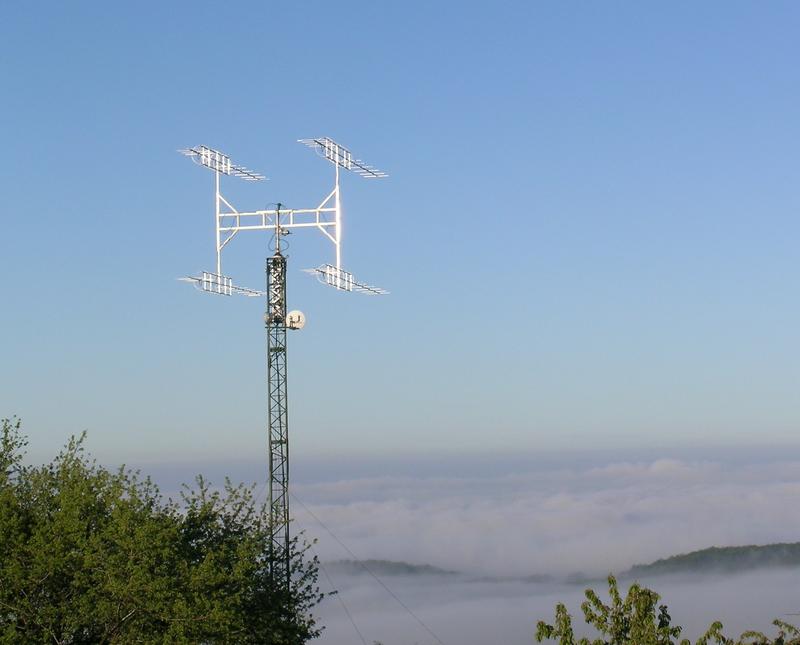
The latter! Then I got a signal report back online from I3MEK (who apparently has a fairly impressive looking quad antenna array: https://cdn-bio.qrz.com/k/i3mek/Dscn1593B.jpg ). I've also been heard via the EME path from Texas.
If I ever manage to squash my noise problem, I may bother trying to schedule some contacts as it's not unusual to do so for EME. But right now I don't want to waste people's time when I know that I'm deaf.
(It's really obvious that I'm deaf too, because I can just rotate the antenna and watch the noise floor drop).
But in short, you use a modulation technique where your short messages are sent very quickly, e.g. in 72ms. You then transmit in burts 15 seconds long, repeating your 72ms message over and over again. Hopefully a meteor zips by, if it does far away stations will get a signal from you.
Parties take turns transmitting in either even or odd timeslots and listening in the other. Communication goes pretty slowly but it goes. Every morning around sunrise the part of the earth you are on is facing into the earths orbit and there are a few meteors. It works better during showers.
The receiver for these modes is computationally expensive: there is no time for a fixed synchronization pattern like most digital communications methods use, so instead the rx side does a brute force search.
My first meteor scatter contacts were with a high gain vertical omni, but a directional antenna works much better.
The geometry of a meteor scatter path allow contacts that go about 2000 km but 1000km is easier and more common.
Participation is a limiting factor, when I'm working msk144 outside of a meteor shower I may only get one or two contact in a day or none at all. And it's not unusual to for a normal exchange (which is just CQ MYCALL MYGRID; MYCALL THEIRCALL THEIRGRID; THEIRCALL MYCALL ROGER; MYCALL THEIRCALL BESTREGARDS) to take an hour-- depending on the luck of the falling rocks.
I remember wondering way back when (60s or 70s?) why the heck did radio astronomy get so much funding - so much money was poured in.
Only later was it revealed that once in a blue moon (heh), things were aligned so that the US could use bounces off the moon to detect and analyze a certain class of Soviet radars.
Those periods of use for the radio telescopes in question were booked well in advance.
To be honest I am beginning to doubt my own understanding of the plot, I never read the book but watched the tv show with my wife and my recollection was just the moon itself would magnify the signal


The Arecibo’s site origins trace back to the 1950s, when Cornell University proposed its construction to the Department of Defense’s Advanced Research Projects Agency (ARPA), which is today known as the Defense Advanced Research Projects Agency (DARPA). A desire to better understand the composition of the ionosphere and how it might impact objects passing through, including ballistic missile reentry vehicles carrying nuclear warheads, was a key reason for its construction. At the time, ARPA was in charge of a broad ballistic missile defense program known as Project Defender. It was believed that nuclear warheads would produce a distinct signature when reentering the atmosphere, making it possible to distinguish them from decoys, so long as that signature could be quickly identified and categorized. The plan was to use the Arecibo Telescope to help gather general, but still valuable information about the ionosphere in support of this effort.
<https://www.twz.com/37898/collapsed-arecibo-radio-telescope-...>