I've been waiting for an upgrade to my M1 and I still haven't seen one worth spending that much money on. I'd rather just sink that into upgrading my Windows tower.
CPUs got good enough for most applications a decade ago, it is hard to talk about upgrades being “worth spending money on” without specific workload info.
Single core performance went from 2300 with the M1 to 3800 with the M4. That is a huge improvement for my workflow (large TypeScript mono repositories) which is dependent a lot of single core performance (even with parallel builds, because one rarely re-builds everything, rather hot reloads.)
I picked the Ars article because they showed real-world performance like encoding. Geekbench scores are difficult to impossible to equate to real-world results. There are ways to measure it properly, but most sites seem to just do Geekbench or something else like it and call it a day. Single-core performance isn't this universal thing. What's your actual workload like? I'm all over the Ryzen x3D CPUs because they have proven massive performance improvements for things I care about like Factorio. Some site reporting "yeah, single and multi-core scores are 20% better" doesn't mean anything. 20% better at what exactly?
I will say that my M1 Mac runs Factorio like an absolute dream. There is an ARM native port now and it’s really good. It something like doubled UPS over the old Intel binary.
One of the big advantages the M chips have is the insanely fast integrated memory, since it’s all right on the die. It’s much closer to ultra high spec GPU ram than PC ram.
My M1 studio has 200GB/sec of memory bandwidth. Extant DDR5 modules are under 50GB/sec
The X3D chips have an absolutely ridiculous amount of L3 cache, so when your workload fits largely in L3 they have far, far more memory bandwidth than any other option on the market. That's the case pretty often, especially for games, hence the workload specificity. The X3D cache system means some workloads are 50% faster and some are 20% slower, so workload really does matter.
These statements are orthogonal though i.e. 2300->3800 is still less than 20% per generation (17% per if you use the exact single core numbers for the M1 vs M4 iPad). That might be meaningful for your workload but it also means 20-30 percent per generation is quite a bit off.
That wasn't the question, they did improve tremendously over the last 4 because the were basically not doing anything 4 years prior to that...
To be fair desktop Macs these days are just laptops without a screen so it's not that surprising. Of course they are significantly more power efficient but also much slower than high end AMD/Intel chips (if you don't care about heat/power usage that much like a lot of desktop users).
Also even on mobile 165H seems to be not that far from M3 e.g. 10-20% worse battery life, slightly slower single core but faster multi-core. Not ideal but considering where Intel was when M1 came out not that bad either.
Apple gives 115 W as the peak draw of the lowest power Mac Studio model (10 core M1 Max) https://support.apple.com/en-us/10202) and 295 W for the highest power (M2 Ultra 24 Core).
I believe 38 W is what you see under your personal "full utilization workload" but it's just that's not comparable to "peak workload" numbers. To be honest the peak numbers are relatively useless anyways, you'll never hit them unless you go do something akin to running purpose written CPU and a GPU benchmark at the same time, specifically designed to utilize all of the hardware capabilities at once rather than do something useful with them. The idle and typical wattage numbers are much more useful and much lower.
Also keep in mind some CPU models (even of the same family) are pushed to e.g. double the wattage for a 25% multicore gain or the like. It doesn't mean the CPU family is complete shit for power efficiency it just means there was a market for a SKU which wasn't very concerned with power consumption.
All that said the M* line is definitely still better efficiency/Watt but I concur with qwytw the difference between Intel and Apple now vs 4 years ago is massively improved and the gap isn't as anywhere near as big as you've been listing.
I am sorry I have to say this out loud. But seriously? We expect 20% per generation? When the word generation used to mean 2 years in CPU terms because that was what Moore's law or Intel's tick tock dictate.
Even ignoring the word generation, For the past 20 years how many times did we see a successful uArch bringing 20% IPC improvement over the current leading IPC?
Where did that 20-30% per gen coming from.
The worst part about Apple, its media is that it seems we have a whole generation of people who were never interested in CPU performance suddenly coming up with these expectation and figures.
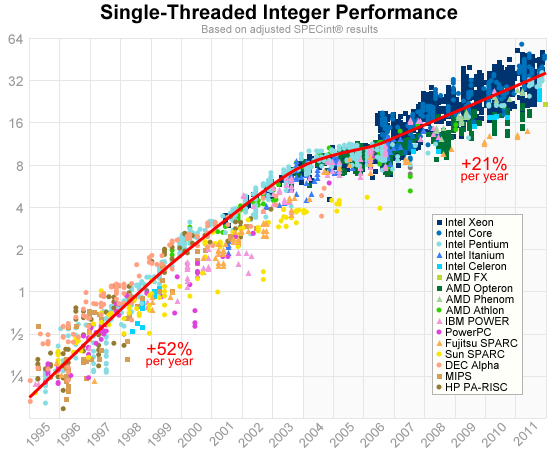
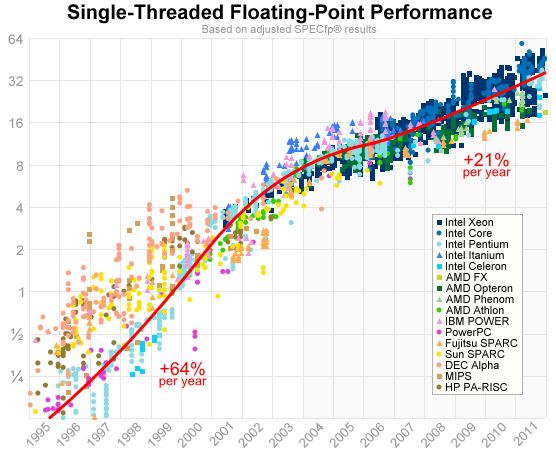
On the contrary, _not_ expecting at least 20% per year (more for generations farther apart) is actually only a recent take for CPUs [1][2] which formed in what I like to call "the great stagnation" of the mid 2010s where AMD bombed, ARM was still a low performance mobile play, and Intel didn't have any stiff competition. After that things have started to pick up a little again now that there is innovation on said fronts [3]
I remember there was even a period Moore's law was commonly conflated with "a doubling in performance every 2 years" (implies people being used to an increase of at least 41% per year) instead of a doubling in transistor count. Because Intel's tick-tock model started ~5 years prior to the great stagnation people commonly claimed it's the end of Moore's law and that's why we have tick-tock's now. Of course these days it's common knowledge that Moore's law (the actual transistor count version) has been holding steady all these years still and that the performance lull wasn't related to hitting and innate technical scaling barriers.
Marketing departments are definitely going to be marketing departments but they aren't the origin of the idea CPUs can have more than minor increments in performance each year.
Are those numbers in absolute performance inclusive of clock speed improvement or IPC ( Instruction per Clock ) ? I am inclined to think [1] and [2] are the first and not the latter.



I've been waiting for an upgrade to my M1 and I still haven't seen one worth spending that much money on. I'd rather just sink that into upgrading my Windows tower.