The reality is that they kinda do, people with expensive cosmetics are viewed as being better players by their teammates and opponents. The significance of this can be hard to measure, but in most games it's bigger than a small stat boost that would be immediately seen as p2w
So the less skilled players with expensive cosmetics get their abilities over-estimated while the skilled players in the base skins get their abilities under-estimated. That sounds like a win for the skilled players in the base skins to me. Better to be under-estimated than over-estimated.
While I get the impression that many of those visual bling payables available today seem to give more of a disadvantage than an advantage, back in the days of 1.6 CS I caught myself in real life considering the contrast between what I wore and the environment I was passing through. Not because I was expecting to get shot at (I certainly wasn't), but because at the time it was so much of a routine consideration for me. Yes, visuals can be a competitive factor.
Underlining this comment — Ubisoft games, such as Division or Breakpoint, allow purchase of national camo designs.
If these had no “gameplay” effect or “competitive advantage” based on environment, why do nation states spend money developing them and equip troops differently based on biome?
And why have some games had to patch their PvP to “outline” opposing players with a visibility border in the patches that follow certain “cosmetics”?
A more subtle advantage can arise from hitboxes in both hitscan and projectile games with customizers or cosmetics that change the mesh. There’s a reason some games are predominantly female characters in close fit gear.
Finally, even games that insist no gameplay or competitive advantage, are fully aware of “the meta”.
In Fallout 76, for example, PvP players learned to hotkey the “Nuka-Cola” drinks with special benefits. In a for money store, Bethesda allows you to purchase a robot junk collector that gathers Nuka-Colas for free. Rationale is it is just a QoL (quality of life) benefit, but in reality, it allows stockpiling a combat advantage to last longer in combat than the opponent. Same store also allows you to purchase “repair kits” for weapons and “bubble gum” that suppresses the survival mechanism around eating/drinking for an hour of game play.
Again, Bethesda’s claim is QoL not pay-to-win, but weapons repairable mid-battle away from one’s base certainly affects winning, and level of hunger/thirst affects damage multipliers and action point refresh (aka ‘mana’).
Look “good”? Come on. If not having the Pickle Rick decal for your car makes you play worse it has nothing to do with looking “good”. Perhaps look “like I own this exclusive cosmetic”, which applies to offline as well, don’t you think?
The real problem is that loot boxes are gambling, and are addictive, period. It triggers something in otherwise rational people, especially children, that makes it feel good to spend money on mostly non-gameplay-altering cosmetics.
At some level it probably does. Even in Rocket League, which is more cosmetic than most, if your teammates are passing to you more than they would have with the default skin, then you'll do better.
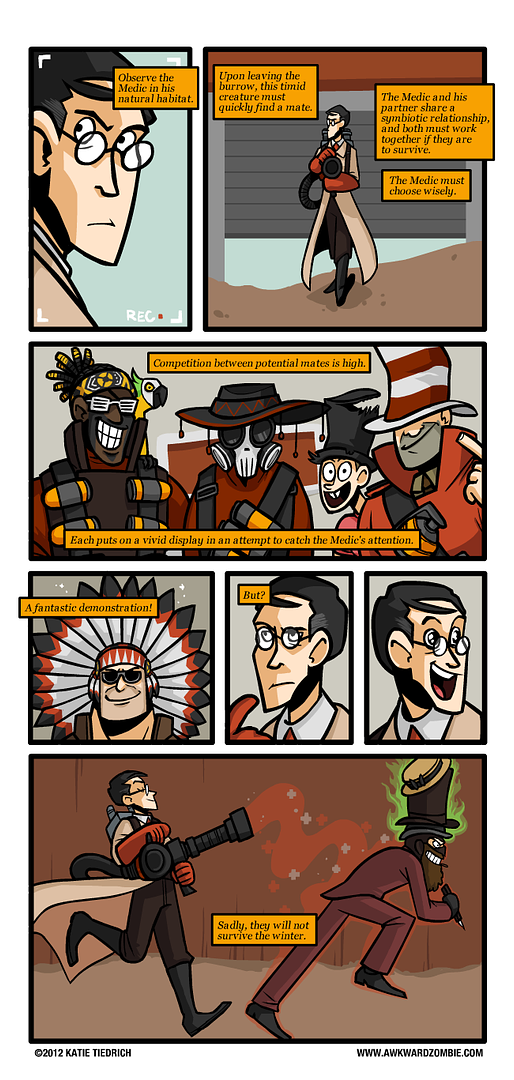
As a medic in team fortress 2, I usually pocket and ubercharge the players with cosmetics. It's an important team resource, and the odds of someone with a "default" skin making good use of it are fairly low. Much like plumage for a bird it's a reliable signal of "virility" - if you're invested enough in the game to own a $200 hat and a coordinated outfit then you've probably played it long enough for me to trust you sight-unseen.
If you're a pro player with the default skin, you're gonna have a bad fucking time, because you're last priority for heals, you're not getting an ubercharge, etc. That is gameplay-affecting even if the cosmetic itself is not.
This is the first really good example I've seen of cosmetics having a gameplay effect. I hate that it's true, but I really appreciate you mentioning it -- signalling of skill is super valuable, and if cosmetics are a reliable enough signal, that's interesting.
If you make all skins and cosmetics available to everyone then you're back to square 1 and people will use some other heuristic to decide who they should pass to. I think this is actually an argument for paid cosmetics, it would improve gameplay for the people who spend the most time playing the game by allowing them to identify other people who also dedicate a lot of time and money to the game.
Oh I totally agree that the system right now is majorly screwed up. Loot boxes are absolutely gambling (why else would the odds be legally required to be disclosed in some jurisdictions?)
And of course it's a vanity component (at least for me, though other posters have raised other factors). Everyone's different with different preferences and as long as there's not a problematic spending aspect I think it's fine...but this links back to the gambling issue. Personally I only buy cosmetics in a few games I play a lot and that don't use loot box mechanics.
Why? Why is competitive advantage the only thing that matters?
OP is just ranting about people who pay more getting a better experience, making paying such a central part of gaming. They just hate this, which I agree with, although I know others don't.
In a way, getting a better experience just for being able and willing to pay more is a basic feature of our society. Why should we expect videogames, being as expensive and lucrative, to be radically different from the rest of society?
I'll just continue appreciating those games who are, those who actually work more like art. If I ever decide to try a F2P loot-box generator-style game, it generally puts me off quickly.
> Why? Why is competitive advantage the only thing that matters?
Because it determines whether free players can still compete with paying customers.
There's no problem with a paid weapon skin that just looks cool since everyone is still on a level playing field. If that paid skin gives the user double damage then you've created 2 classes of players and one of them is superior. In such cases, the only reason free players even exist is to serve as fodder for your paying customers. They're there to get wrecked.
> Why? Why is competitive advantage the only thing that matters?
Because unlike the real world, we expect games to be inherently fair and meritocratic. In a competitive game, we expect that no matter how somebody looks or what they may say, the only thing that matters is their ability to perform. This is comparable to why people get upset about, say, the speed-enhancing swimwear for the Olympic games but don't have any problem with that swimwear existing.
One of the central functions of games is to level the playing field, or at least to reduce the dimensionality to such a degree that it is possible to be focused on all influencing factors in a game within the confines of that game. A closed-system, when we're usually all stuck playing in an open-system. Since all real-world closed-systems actually exist within an open-system, of course there could be external influences, but gamers generally have an expectation that attempts will be made to make a game as self-contained and closed as is possible. Pay-to-win games break this contract to make those unwilling to pay into unwitting tools for the enjoyment of the paying customer. They are open-systems under the guise of being closed-systems.
Granted, the category referred to as "Games" now includes many different things, including "Experiences" that aren't really games at all. And there are so many games today that it's pretty easy to find games that are actually games at their core. But there's also plenty of games that are marketed as games but turn out to be significantly about art / fashion to such a degree that they can no longer really be classified as games.
I've got call out Roblox for playing the meta-game here in a way that all gamers frustrated by pay-to-win will appreciate. It takes the idea of a closed system being broken into an open system, and makes that (making F2P games) into a closed system that breaks into an open system: you get to pay-to-win at creating pay-to-win games. A beautiful pyramid scheme that even your 11-yo child can enjoy being exploited within!
IMHO when a game centres around competitive play, and said game also allows you to buy competitive advantage for real money, that is a problem. A situation like this is called "pay to win" and is tempting enough for some game companies to ruin their game with.