from what I've seen, there's a lot of "obscurity" to this; there are many seemingly arbitrary choices all over the place.
In the end most encryption algorithms boil down to doing 'random' (arbitrary, hard to justify why) things to data and then undoing them exactly in order to decrypt.
the math is all incredibly abstract but not all that complex, the high level of abstraction does make it quite difficult to grasp.
What's worse is that I fear there are incentives (mostly political/security interests) to keep the field small and to keep many people far away from this very practical use for all these beautiful, elegant, simple (but extremely abstract) mathematics (refering to the entire cryptography field).
> What's worse is that I fear there are incentives (mostly political/security interests) to keep the field small and to keep many people far away from this very practical use for all these beautiful, elegant, simple (but extremely abstract) mathematics (refering to the entire cryptography field).
I mean, everything you want to learn about crypto is available online, in libraries, in textbooks. Including differential cryptoanalysis, the theory behind these mathematical forms (Galois Field makes things _EASIER_, not harder actually. That's why CRC-checks and Reed-Solomon codes were based off of Galois Fields, and AES being based on GF(2^8) is to take advantage of those same properties).
--------
What has happened is that the "old generation" of programmers is dying out / retiring. And they aren't passing on their knowledge to the new generation. The "old generation" of programmers were high-math, abstract algebra and more, while "new generation" programmers just never bothered to learn this stuff.
What has happened is that the "old generation" of programmers is dying out / retiring. And they aren't passing on their knowledge to the new generation. The "old generation" of programmers were high-math, abstract algebra and more, while "new generation" programmers just never bothered to learn this stuff.
There may be some survivorship bias here. Even in the 1990s, business-grade programmers (the ones who, quite frankly, aren't inclined to learn difficult subjects) either went into management or did something else, although the timeframe and ageism are more aggressive these days due to the infantilization and humiliation (e.g., Agile Scrum) that engineers face today.
Research-grade programmers were the minority, even then, although this problem is a lot worse today due to the near nonexistence of R&D jobs.
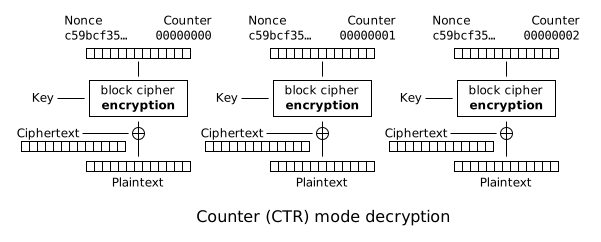
Not all decryption is doing exactly the same things in reverse. For example, with CTR mode (and thus GCM mode, which is CTR plus GMAC), you call the /encryption/ routine regardless of whether you're encrypting or decrypting data. This means in an embedded environment you can save die space because your program doesn't need the e.g. AES decryption routines too.
I doubt there is any concerted effort to keep the field small. That would be like saying tech companies don't want people learning how to code so that they can maintain an advantage.
If anything, governments and companies are encouraging people to study cryptography so that they are able to hire more experts in the future.
Now, once you get gatekeeper organizations and special licensing organizations like contractors licensing or beauticians licensing, those are examples of groups trying to keep the pool of experts small.
> What's worse is that I fear there are incentives (mostly political/security interests)
Nah its mostly just a mix of laziness, rigor, and salesfolk.
Most people don't want nor can properly design a hash algorithm (which works well). Public ones like SHA have received so much scrutiny, they are extremely well vetted...and then there's the mostly valid attitude of "never roll your own crypto" - Don't, not in production or anything that could become production. Unless you are a group of highly skilled cross domain career cryptographers/mathematicians...
Which leads to the last bit, people build whole business out of selling "security products" out of publically available crypto, then make the argument you shouldn't do it yourself, buy theirs. Which sometimes makes sense - often it is a shill/marketing ploy. Rarely do these products provide much on top of the core freely available code...and they probably shouldn't, or else there is probably untrustworthy nonsense inside.
So yeah, don't assume malice where first incompetence is possible.
This seems pretty silly, as there is extensive (one might say tedious) detail on why the decisions in a hash function or block cipher were made; your challenge is that you have to do a literature search to collect all the reasons --- but that's science for you.
> from what I've seen, there's a lot of "obscurity" to this; there are many seemingly arbitrary choices all over the place.
When is a (7-/pk/win)zip compression algo not an encryption algorithm?
Do the use of certain mathematical functions make it an encryption algo?
I've always found the use of prime numbers in some encryption algo's to be a red herring, namely because in theory there are an infinite number of primes, but in practice your computing device can only use 1 from a finite number of primes otherwise it would take too long to encrypt something.
With this in mind, do primes actually make it easier to decrypt encrypted data?
>What's worse is that I fear there are incentives (mostly political/security interests) to keep the field small
Discussions like this ie communication poke light into those dark crevices of intellectuality.
Yes in "Galois Field" arithmetic. But GF(2^8) (or whatever) arithmetic is only in AES and a few other ciphers/hash functions. SHA-256 looks like an XOR / Add / Rotate kinda cipher.


In the end most encryption algorithms boil down to doing 'random' (arbitrary, hard to justify why) things to data and then undoing them exactly in order to decrypt.
the math is all incredibly abstract but not all that complex, the high level of abstraction does make it quite difficult to grasp.
What's worse is that I fear there are incentives (mostly political/security interests) to keep the field small and to keep many people far away from this very practical use for all these beautiful, elegant, simple (but extremely abstract) mathematics (refering to the entire cryptography field).