It’s humbling to see a state machine implemented using coroutines. I program professionally since about 6 years ago but have only recently appreciated generators and coroutines.
I’m working through learn.unity.com for fun and because, in my estimation, there is an upcoming boom in real time interfaces for real work. All the people playing video games have mastered skills that aren’t being taken full advantage of. Anyways, coroutines in Unity can be used to do interesting things over time while attached to the game loop.
My point, despite my digression, is just how there are still basic/intermediate topics I have only been able to appreciate recently. Humbling.
Every now and again as I play RTS (and other) games I imagine how the interface could be used in for business, engineering or marketing. There’s potential, IMO.
The test (as I imagine it now) is making work fun enough that my 13 year old self would want to do work.
At any rate, ideas are cheap. Prototypes and implementation are what matters.
We’re speaking publically but I would like to know what you imagine about when you think about this topic?
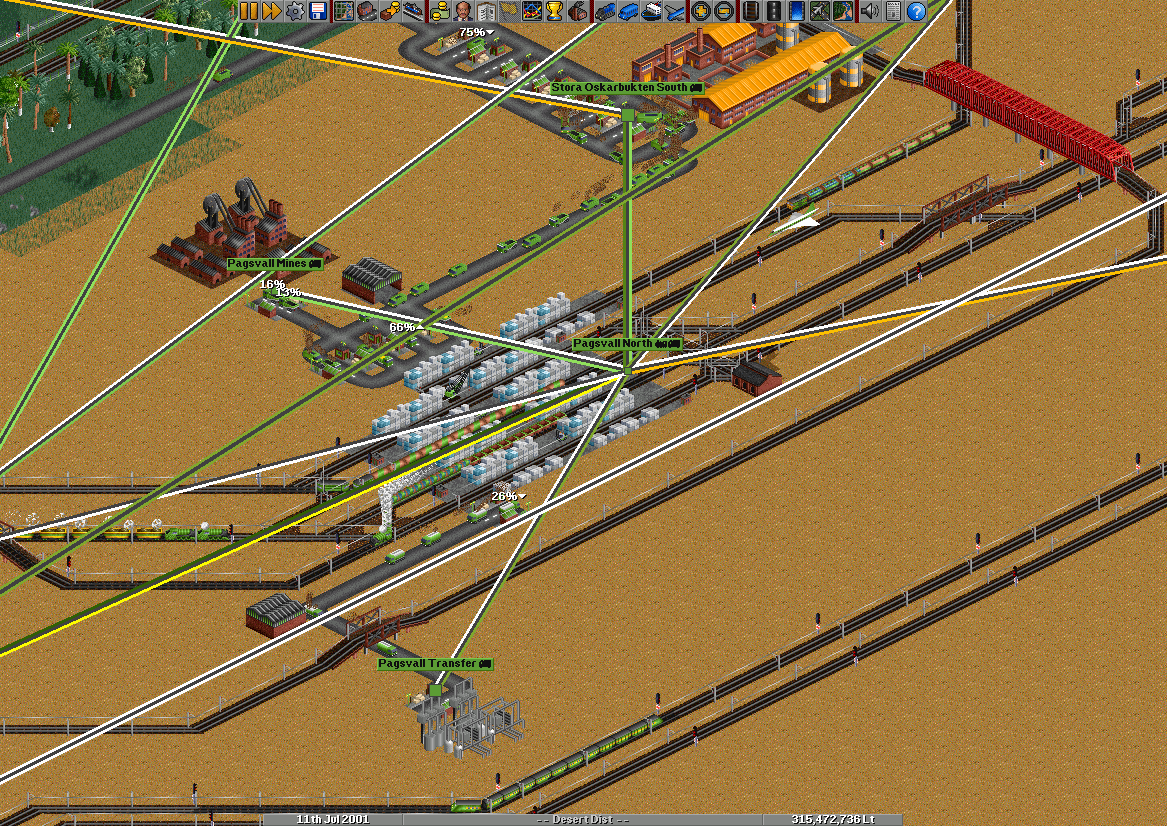
I sometimes wonder what it would take to visualise the state of a system in a game engine such as OpenTTD[1]. Then I remember the video of VMware's VMWorld 2017 event keynote speech[2] where they did such a poor example of VR - cubes representing virtual machines which you could virtually throw into the trash to delete them, or pick them up and move them to another host to use VMotion. It was a poor combination of low quality uninspired use of graphics and 3D space, and individually managing servers one at a time for things VMware DRS will do (load balancing moving of VMs between hosts) and things you don't want to be doing by hand (individually provisioning and removing servers).
I'm not convinced that a game engine is capable of showing enough information compared to flat text, tables of numbers, graphs, and things made as web pages or documents where you can scroll down several pages. In a game engine, the things you aren't looking at end up far away, smaller, easier to miss. Text usually has to be bigger to be readable. How do you bring things to attention without just replicating a web browser showing a page of stats in a game engine? How do you make "work" possible without replicating a right click menu in-game, or a popup Quake style command line?
How do you envisage an RTS game interface doing work - what kind of work, and how does the interface help with it?
> "The test (as I imagine it now) is making work fun enough that my 13 year old self would want to do work."
A game you have to play for 6+ hours continuously, cannot quit, cannot pause, cannot undo/retry, almost cannot die or lose, has no story, no end to get to, and is a repetitive grind?
You should also try to groc Unity's animation controller. It's a state machine with non-discrete transitions (primarily for animation blending). Neat stuff.




I’m working through learn.unity.com for fun and because, in my estimation, there is an upcoming boom in real time interfaces for real work. All the people playing video games have mastered skills that aren’t being taken full advantage of. Anyways, coroutines in Unity can be used to do interesting things over time while attached to the game loop.
My point, despite my digression, is just how there are still basic/intermediate topics I have only been able to appreciate recently. Humbling.