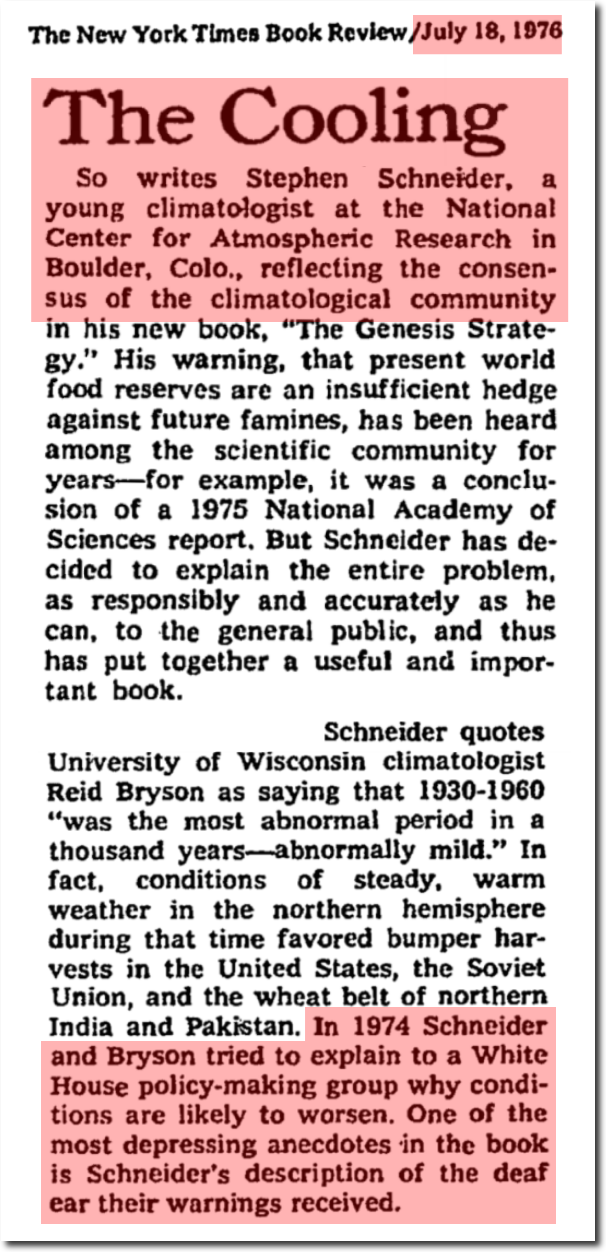
Is it really true that the scientific concensus was in favor of ice age in the 70s? I have heard people say this before but I have never seen the historical evidence.
In 1974 and 1975, Time and Newsweek respectively ran articles proposing a global cooling trend. These articles were (loosely) based on a couple of papers that found that if fine-particulate atmospheric aerosols continued to increase the way they were, they could reflect away enough sunlight to cause surface cooling. (And in fact, exactly that was happening during the 70s.)
However, the Clean Air Act and other similar efforts around the world reduced the amount of particulate aerosols in the air. The amount of CO2 kept climbing though, so the warming model won.
The consensus among published climate science papers at the time was predicting an overall warming trend.
But then Dennis Miller said that scientists believed in an ice age in the 70s, and a bunch of suckers fell for it.
Also for reference on the history of climate science:
Here is a paper [1] from James Hansen in Science magazine, in 1981, that warns of crisis-level warming. From the abstract --
> In the 21st century, we will see "creation of drought-prone regions in North America and central Asia, erosion of the West Antarctic ice sheet with a consequent worldwide rise in sea level, and opening of the fabled Northwest Passage."
For whatever it's worth, this also appeared on the NYTimes front page in 1981. That's just one publication. Throughout the 1980s there were broad-based studies, mandated by Congress, that indicated the scope of the warming problem. See [2], from 1983.
By contrast, I don't think the possible cooling effect ever received broad support, it was more of a hypothesis.
> the Clean Air Act and other similar efforts around the world reduced the amount of particulate aerosols in the air.
You just found a solution to global warming. Since you agree that particulate aerosols in the air were going to cause an ice age and the Clean Air Act would fix that, then the Clean Air Act is what has contributed more than anything else to global warming. Repeal the Clean Air Act, reintroduce those old aerosols, and the problem is solved. The global cooling certainty cancels out the global warming certainty and normalcy is achieved.
It's rubbish that science predicted an ice age in the 70s. The vast majority of peer reviewed studies predicted a rise in global temperatures due to a rise in CO2.
There were a few studies that predicted an incoming ice age, but they were by far the minority. And these studies were based on predictions of the composition of the atmosphere which did not pan out, where the CO2 predictions have been on point.
CO2 atmospheric levels are way below what was predicted because huge amounts of CO2 was absorbed by the oceans. This has wrecked havoc on the oceans, but the point is that the predictions of atmospheric levels were absolutely wrong because they did not account for the ocean absorption effect.
No, it’s not. There were a small number of scientists that wrote about possibilities of global cooling, but vast majority of scientists were concerned with warming.
It’s _nearly_ an urban myth. Some people did say we were due an ice age, but in the “within the next few millennia” range of accuracy, not ‘any day now’. Basically, it’s a good story, but that’s all.
"Meteorologists disagree about the cause and extent of the cooling trend, as well as over its specific impact on local weather conditions. But they are almost unanimous in the view that the trend will reduce agricultural productivity for the rest of the century. ... If the climatic change is as profound as some of the pessimists fear, the resulting famines could be catastrophic. ``A major climatic change would force economic and social adjustments on a worldwide scale,'' warns a recent report by the National Academy of Sciences, ``because the global patterns of food production and population that have evolved are implicitly dependent on the climate of the present century.''" -- Newsweek, April 28, 1975
Not just Newsweek, but Time, the New York Times, and other outlets reported on it.
Elementary school children were taught it. I was one of them.
I read now that meteorologists (this is before "climatologist" was a real thing) were divided on whether there was cooling or warming. (But it seems that they were mostly in agreement that something catastrophic was going to happen!)
This global cooling episode does not teach us that there was a scientific consensus on cooling in the 70s, or that climate research since then is equally unfounded. However, it is a really interesting story.
Meteorologists are not, and have never been, scientists. Their opinion on climate is no more valid than any other lay persons. It is like equating the physicists and engineers who develop new MRI machines with the technicians who press the button at the imaging center. Time and Newsweek are not scientific sources. Your whole post is just nonsense.
I remember two occasions in the seventies that climate cooling was reported. Both times it was presented as something of "here's a bit of a crazy idea" for the last spot of the news. I don't remember any of the pop science programmes that I used to watch avidly back then ever covering it, though every series had one or two slots for some crazy or outlier idea... Sometimes to see potential, sometimes to debunk.
In the early 80s I picked up one of the "coming ice age" paperbacks, remaindered down to pennies, in the same category as Von Danekin's Chariots of the Gods and his Egyptian aliens. It was absolute garbage, but that's beside the point here. I probably still have it at the back of a bookshelf. Yet already by the early 80s climate heating was coming up in conjunction with acid rain and ozone depletion - they were a holy trinity that often seemed to come together, and they were starting to crop up regularly. Ultimately reporting of all increased throughout the decade, leading to action on ozone and acid rain, and formation of IPCC, at the end of the decade but also the start of the industry moves to oppose via disinformation and obfuscation - the tobacco playbook. Like the Bush administration effort to rebrand climate heating as climate crisis - as that sounds benign and normal.
So I'm old enough, and I doubt your tale - perhaps some sources were reporting it poorly, perhaps the US bought into some climate cooling cult in a way that was completely and entirely unseen here in Europe.
It was a political concensus. And that political concensus is still strong today. Our (Australian) politics are infested with it. It is like another reality with them.
I appreciate having a link to a known pseudo science resource, but that article is referencing non-anthropogenic climate change - specifically that there are relatively mild temperature cycles measured in the spans of hundreds of years. Dropping a couple of degrees would (and in relatively recent history has) significantly impacted crop failure rates.
However that is kind of moot, because human driven climate change has been pushing temperatures up faster than any natural temperature reduction has ever achieved. Even if we would otherwise be experience a reduction in average global temperature it doesn't matter because human driven warming would overcome that.