Early adopter here, initial 2012 Oculus Rift Kickstarter backer, I own all the headsets. My excitement has all but died down in regards to the current generation of VR. Mostly, I find the hardware cumbersome and clunky and the games to be too same-y (teleportation galore) or unpolished.
The absolute best experience I had in VR was playing Half-Life 2 back in 2013, with terrible resolution and tracking, but it was so immersive I could barely contain myself.
Now though, that I'm no longer wowed just by "being there", the act of strapping into VR is so cumbersome, the software is buggy at times, the cable is annoying, the headset is heavy, hot, doesn't work well with glasses etc.
However, I'm still as excited for VR as I was in the beginning in regards to the technology. Give me a lighter headset, 100% wireless and great handtracking and finally some long, immersive games (can be ports, that's fine for me) and I'm ready to shell out money again.
As it stands today though, my VR hype is on hibernation until the next gen rolls around.
Valve are the ones who have dropped the ball. They had all the cards lined up. Killer IP that would make people buy hardware if used correctly (HL3, Portal 3). Probably the best tech currently available (Vive). The biggest PC gaming storefront (Steam). Their own OS. Each and every one of these components, with the exception of Steam, was neglected. They had the future of PC gaming right there ready to grab... and did essentially nothing with it. It may not be too late but I think Valve needs an organisational restructuring if they want to pick up their pieces. If they don't it's very likely that they loose most of their revenue in the next 10 years, because even Steam needs killer exclusive content, i.e. content that cannot be licensed on another online platform, which soon will only be Valve games.
It's beginning to appear clear that FPS is VR's pipe dream. The locomotion part seems non-trivial to solve and dissonance between the virtual and real world renders VR FPS completely unplayable for a large amount of gamers (it can make you feel incredibly uncomfortable, can also cause motion sickness.)
HL3 and Portal 3 would be incredibly difficult to implement well in the VR space, and I feel this is something that Valve understands much better than many others.
What would excite me about VR is a game like Morrowind. While it is first person, it's not exactly a shooter. The only teleportation is fast travel, but that could even use a World of Warcraft style where instead of teleporting you just ride the animal to get there.
Put me in a foreign world with several varied environments. Let me explore it without artificial restrictions. The combat could be minimized with most potential enemies being non-aggressive by default (a change to Morrowind's mud crabs or cliff racers). For this style of game I would even expect to still have to use a controller both for combat but also for inventory management, etc.
This is a real issue, and was my exact experience with VR. I know VR devs are aware, and have addressed it in some ways. But, idk. I was ready to plop down the cash for a Vive, but decided against it after a test run.
You know it goes away right? For all the hate in this thread, I am still in love with my vive. The motion sickness is a problem at first, but your body eventually adapts- took about 2 weeks for me, now I never get motion sick what-so-ever.
IMO these franchises have one big advantage: They are in a science fantasy setting that has already introduced the concept of teleportation. So there is already precedent for teleporting around the map, making locomotion unnecessary.
Portals main mechanic is movement, portals are created to enable new venues of movement. If portals were simply point at somewhere and click to teleport there the game would hardly be portal anymore and probably not fun at all.
Yes, I have played Portal and think that there is still enough movement involved to be problematic for VR as it's done now.
Sure, you could invent a teleportation-specific genre, but I think it'd be quite the niche.
Have Valve/etc gone after the hardcore F1/racing market? I have various friends who follow F1 closely and generally have money to spend. Surely VR works well for seated-racing games.
I visited the Valve offices about two years ago, and almost 2/3rds of the company was working on VR. I think right now they're aware that the current iteration of hardware isn't good enough for the common consumer, and in addition there's no real AAA content out for it. VR really needs it's own Breath of the Wild kinda game to go along with the hardware if they want it to sell. I suspect what we'll see is a new version of the Vive released alongside a major AAA title by Valve at some point, but being Valve they want to ensure that they release it when it's done, not when the timing is right.
You say that like it's easy. Like they didn't try or are not trying.
The truth is, you don't know what they tried, and failed. You don't know what resources they got at their disposal. Especially considering all the stuff they are doing right now and how hard the competition is.
And worst, given the exceptional track record of Valve, you choose to believe in a theory ignoring it.
Your comment read like you are just disappointed to not have your pony yet and want to blame one of the best pony breeder for your frustration.
I suspect the loose management style of Valve has this effect. Great ideas, no one to drive them home. Something that works great for keeping your employees happy, but works only as long as you have a dominating market position.
There might be another way of looking at this in that perhaps with a distributed management style the costs become more apparent. With a centralised style you can take a "five year plan" style approach and swallow all the upfront costs but where you have a bunch of separate cost centres each with their own P&L it's harder to find one single personality to drive things forward.
It might seem that I'm saying that if they had a more centralised style they might have made more progress but I don't think that's the case since when we look around at other more driven companies we aren't seeing too many breakthroughs either.
There are two fields where I know for a fact VR has made significant inroads in the last few years they being Gaming and Design Visualisation. The latter being where a VR rig is a worthwhile business expense. The former being my PS 4 where there seems to be plenty of content available, but the €600 price-tag is just a little out of my reach...
I'm a well-paid (some would say over-paid) professional and I'm quibbling about the cost of the rig and I just wonder are we at a point where the economics stack up for widespread adoption of the technology? Not just in terms of the gear but the R&D costs for game developers, such as Valve, with a questionable rate of return ..
Who says that the future of gaming is VR?
For me the future of computing including gaming is AR.
VR is just an halfway technology that can't do any of the things that AR can.
And I don't think that an halfway tech can ever be the future.
Self driving car are the future of automobile. Self driving is not even halfway to GAI, yet it is the future.
People taking this VR/AR stance don't understand at all what goes into such tech. Like somebody spitting on the explosion engine because "that's only a halfway technology" and refusing to drive anything but flying cars.
AR, or more appropriately Mixed Reality, is rumoured to see the light in 2019, so it's less than 2 years.
VR is simply pointless as of now and the sale figures reflect this dire reality.
Your comparison with the ICE is completely wrong.
A more accurate one would be to go on a ship vomiting everything in your stomach when currently you can go by car across a bridge taking more time and in less than 2 years there will be a ship that doesn't make you vomit.
It makes little sense to say that AR will render VR pointless. They have fundamentally different purposes - AR (as stated in the name) adds your existing reality, while VR replaces it entirely. If you're playing a game, AR would put a monster in your living room, while VR would put you in a completely virtual environment.
Also, what do you mean AR is rumoured to see the light? AR already exists; see Hololens, META, and others. Magic Leap has developed interesting prototypes but has failed to develop any unique practical consumer implementation.
Hololens, Meta and the others are only Dev kits with general consensus for a consumer version in 2019.
I would like to see any reliable source for your Magic Leap statement.
As far as I know the rumours currently put a Magic Leap dev kit announcement by the end of this year.
And there is already a product equivalent that has been successfully demoed to the board on February.
And as for your first point you can do VR with an AR device, you can't do the opposite.
And the AR part is the most important experience that will permit you to bring your device everywhere.
With VR you will be confined to a room without any movement possibilities in an uncontrolled environment.
Magic Leap is certainly capable of releasing a dev kit, but it will not feature most of the technologies present in their prototypes.
Yes, AR and VR can be combined into a single device, and that will most likely be the way to mainstream commercial success in the future, but at present, current headsets offer an incomparable experience in terms of immersion and pure enjoyment. Have you tried the Vive or Oculus with touch controllers? Being tethered to a gaming PC allows for much higher graphical performance than a mobile device.
I see no reason for such animosity towards VR. Saying that current VR devices are pointless because VR will be later combined with AR devices is like saying the Palm Pilot was pointless because its functionality would be later included with smartphones.
(I would argue that the end-goal of VR is actually quite divergent from AR; the future of VR would be the Matrix, where your mind itself is in a completely simulated environment. In the mean time, we make do with the Vive.)
Similar experience here. I was an early adopter, 2012 rift backer and a major proponent of the technology. I jumped on the VR band wagon hard, and now, am shocked by my own disinterest in the space. Simply put - no game has really kept my interest. Most feel unpolished, and very limited. What you gain in VR immersion, you lose in gameplay. Either the immersion needs to be PERFECT, or the gameplay needs to be much, much better.
As I see it, there are some technical (even physiological?) hurdles, that they need to overcome.
1) "Teleport to move" is horrible, and sucks the feeling of immersion right out of the VR experience. Sadly, true "walking" with horizontal movement without accompanying angular momentum causes nausea in most people - hence teleporting as a solution. This as I understand it is a physiological system that is at odds with the VR world and while not everyone experiences it most do.
2) The resolution. It's hard to feel immersed in the world when it's so blurry. This is especially true for VR. VRs selling point IS immersion which IMO is an all-or-nothing experience. A blurry view detracts from feeling immersed in the world.
> Sadly, true "walking" with horizontal movement without accompanying angular momentum causes nausea in most people - hence teleporting as a solution. This as I understand it is a physiological system that is at odds with the VR world and while not everyone experiences it most do.
While true, it is also true that of these most people who will (at first!) experience simulator sickness, the vast majority can adapt fairly quickly and "get their VR legs".
Is this anecdotal or does research saying this exist? I know this is conventional wisdom but I've wondered about how true it actually is after seeing a few counterexamples.
No, it is NOT the same thing as sea-sickness. I do not get sea sick, never have. I also don't get car sick if I'm a passenger reading a book or something. Never have. But turning, specifically TURNING, in VR, induces nausea.
When Oculus was first released (dev) games allowed for "free walking" FPS games which invoke a specific kind of nausea that is different from roller coaster style movement. It's the reason why almost all games are teleportation based now... Because this problem as I understand it affects the majority of people, even those who don't experience the other VR nausea which IS similar to sea sickness. This turning / angular momentum nausea does not attenuate with time. It's a huge problem with VR, and one which there is no solution for currently other than the poor "teleportion" movement mechanism.
Not entirely sure about how trustworthy it was but I think I've seen some kind of a study that claimed it affects something like 30% of people. Doesn't really matter if it's majority or just 30% though, still too much to ignore and not all games are able to offer multiple locomotion options.
Also depends on where you draw the line. I've never gotten sick from VR personally but the movement can still sometimes feel weird to me.
Brilliant game, but that was part of the mechanics of the game. Sentinel was a very singular game. I don't think I've ever heard of anything quite like it ...
I have a Vive, and have surprised myself with how little I play it.
The game Fantastic Contraption was illuminating for me. I had played many tens of hours of the original. In VR I was amazed at how it looked and felt. Solving the first couple challenges was a lot of fun - just watching the machines run was great.
I started to realize a flaw though. A machine I could build in seconds by stretching my fingers a few inches across a keyboard and mouse took ten or twenty times as long in VR, and involved squatting, walking, grabbing, holding, etc.
There's a Perry Bible Fellowship comic of a child in a VR suit, clutching his simulated wounds while saying "Cool!" That comic is similar to my experience. Do we really want to experience things like this? (Tedium or pain)
I think the devs of Fantastic Contraption acknowledged this partially, and several months after releasing the game they added the ability to rescale and move the world, so you could play even while sitting.
> There's a Perry Bible Fellowship comic of a child in a VR suit, clutching his simulated wounds while saying "Cool!"
You made me find this website (thanks for the implicit recommendation) and go through every single comic (they're not that many), and there is no such comic on this site as of now.
Thanks! Also, I'm confused. Why did this one not show up when I read the entire comic back-to-back (by starting at the most recent one and going back)?
Same for me, though a huge factor in my "re-entry" threshold is resolution.
I really do enjoy VR when I get around to playing it, but all I have is presence, but in a world that not particularly beautiful.
My favorite VR title is Elite: Dangerous, but while it's absolutely beautiful outside of VR, in VR it's rather....blurry. When in-VR had the detail of out-of-VR, the presence may be more meaningful. (But that'll be a while).
I wonder where the issue lies; is 1080×1200 per eye just not high enough (considering the wide FOV)? Or is it the optics? I used to play E:D on somewhat of a potato machine, and it was pretty sharp on a standard monitor, with relatively low resolution.
It's a lot closer to your face. Your conical vision is seeing like an order of magnitude fewer pixels as when it's looking at the same resolution screen but 18" away.
Yes, 1080x1200 per eye is nowhere close to high enough. I mean, sit back, look in the direction of your monitor, and estimate how large(small) part of your total view area is taken by it (for me it seems less than 1/9 for a quite large screen and 1/25 for a laptop). You'd need 1080x1200 for that central area alone.
is 1080×1200 per eye just not high enough (considering the wide FOV)?
But that's more pixels than your retina has photoreceptors when you consider full colour (6M but it takes several of them working together to form a "pixel" equivalent)
The difference is that your eyes have much higher "resolution" in the centre of your view compared to the peripheral vision. But your eyes move all the time, so unless you can move the screen as fast as your eyes moves, a VR headset needs to have that highest resolution across your entire field of view.
As one of the issues with VR has been (still is to an extent) the "screen door effect" which means being able to see the gaps between the individual pixels of the displays I think it's safe to say it's the low resolution.
E:D Has always had VR issues. I think one of the tricks I've used is to downsample the game itself while upsampling the final render in SteamVR. I don't remember if it was like that or the opposite.
My favorite games have been Climbey, Lone Echo and Vivecraft.
I can't speak from ever using a proper current headset like Vive or Oculus, but I have done some (very short-term) experimenting with Google Cardboard sets and Oculus/Vive emulation software that pipes the display over the local network to the phone-headset.
With some of that porting/emulation software I was able to play some SteamVR and other games. As a control I just used an Xbox 360 USB controller and the results surprised me.
Now working with a G Cardboard set isn't fun for very long, but the way that a few games translated was surprisingly good, as long as you're happy to not have the full experience. I found the headset was a lot of fun as a change of perspective.
The games I recall in particular being pretty good were GTA V and Skyrim (though I think Skyrim had a little bit of a perspective offset issue, but I didn't really tweak it). For native VR apps I tried ADR1FT (http://store.steampowered.com/app/300060/ADR1FT/) which was pretty good as well.
I imagine trying this with a proper headset work work far better and be more comfortable than my experience, but like I said I haven't worked with one.
A conclusion I made though was that I really didn't mind using the controller as I would on a console.
Those are not VR headset, they are AR headset with a front camera as the "mixed reality" in the product name implies.
MS would never invest in VR given all the heavy investments in AR.
And I think that it is indeed the correct choice.
As someone who owns both of these devices you are incorrect. They are fundamentally VR goggles with cameras in the goggles allowing them to be self tracking. Microsoft's MR branding is confusing but it is a mistake to think of these goggles as AR.
I guess that you are not using them correctly then:
"Where mixed reality wants to make a point of differentiation is in offering a system of front-mounted cameras that can give you either real world objects in your virtual world, or virtual objects in the real world."
There is at present no way to get imagery or spatial data about the room from the low cost MR headsets. The HoloLens can do it but not the low cost headsets. The video in the article you linked does support these points, as all it discusses making available about the room in VR is a "subtle boundary grid" which is not room scan or visual photo of the room, it's the boundary region traced out manually by moving the headset when initially turning on the headset in a new physical room.
I do understand that's a surprising answer and not the answer you want or think should be correct, but these are best thought of as VR headsets with MR branding.
The real thing holding back the Vive though is not any of that. It's the small room. Every game has to operate from a very tiny room, and most game creators have not been able to do that effectively.
If we can figure out how to make game worlds bigger, perhaps even with AR, then we will probably have a lot more interesting things to do.
The next generation of SteamVR Tracking 2.0 (it seems that 'Lighthouse' is no longer the preferred name) is bringing the long-promised support for tracking setups using more than two base stations, making large-area tracking a reality. (The first headset we see using it may be an LG HMD, around the end of this year.) https://uploadvr.com/steamvr-tracking-2/https://steamcommunity.com/games/steamvrtracking/announcemen... The problem is that it seems most users aren't able (and willing) to find even enough free space for even the maximum tracked volume of the current Lighthouse system for their VR setups. (And the new base stations aren't compatible with the existing HTC Vives ...) So large-area VR seems set to arrive soon, but to only a minority of even PC VR setups for the immediately foreseeable.
I wonder if you could set up a large VR room in someone's yard. My yard is much bigger than any room in my house, and I have friends who have more than an acre to spare. That could really open up a lot of possibilities in terms of game design.
Granted, people who live in cities won't have that option, so the market is still somewhat limited.
Unfortunately Lighthouse doesn't work at outdoor daytime light levels, it seems. There are also other practical considerations like safety and so on. That said, an outdoor setup would presumably work at night or twilight, and could indeed be great under the right circumstances. There would be another problem with using outdoor space to create large play areas, though: finding very stable mounting points for all the sensors, especially ones that would have to be directly overhead of the play area rather than just off to one side or corner.
The article is long-winded, and a bit patronizing(1), but it seems to generally be saying that "VR is going to drop off in popularity in the near future, and may never become popular again".
I don't think this will be the case.
A few decades ago, you could experience VR of a similar nature as you can today ... if you happened to have an in with a nearby university research lab, with a setup space with carefully calibrated sensors, hundreds of thousands of dollars of computers, projectors, and other equipment.
Now-a-days, you can experience that VR with about $2,000 worth of computer + headset, and about as much setup difficulty as a home theater system. This is _massively_ more accessible than it was.
It's certainly not perfect. $2,000 is still a lot of money, and 550 grams is a lot of weight to put on your face.
But, even if it's not a smashing consumer success at the moment, the number of developers, artists, and other creatives who have access to the tools of VR development, and the size of the potential audience, are several orders of magnitude larger than they were just a decade ago.
And, really, if the biggest complaints about VR headsets are that they're too heavy, too expensive, and they look dorky, then I'd say VR's already won, one way or another. Technology has had this weird habit of getting smaller and cheaper.
The hype may cool off, but I don't think there's going to be much slowing of developer behavior or consumer behavior in the near future, and new headset models coming out will just slowly ramp up enthusiasm.
(1) but seriously, this author is really really concerned about how un-cool the headset makes you look, as if people staring intently at a movie screen, or play, or classical music concert are that much more photogenic.
I run a VR/AR-focused VC firm (Presence Capital). We've done 30+ investments in this space, so you can say that we believe in the long-term potential of VR. Even given that, we're bearish on how quickly there will be a profitable/sustainable VR consumer business and have advised most of our portfolio companies targeting consumers to keep burn low.
That being said, this article and most of the comments here are taking a singular worldview: consumer-focused VR for a western market. VR is a tool, not an industry. Context on use is required to assess traction.
VR for B2B or enterprises can make money today and doesn't require mass-consumer adoption. If you make someone 10x more effective at their job (tools for sales people: OssoVR) or onboard employees faster (training: STRIVR), you can overcome the cost and rough edges on the hardware and have an ROI to justify the cost of the system.
In Asia (and increasingly in the west), VR-arcades are going to be how most consumers first experience high-end PC VR. Culturally, people there are already used to going to internet cafe's to use computers by the hour and seek out 3rd spaces. VR-by-the-hour rooms fit this mold. Additionally, the short length of most VR experiences makes it easy to have a 15-20 minute session and not be disappointed by the lack of content. IMAX is starting to open multiple VR centers and the word within the industry is that the VR Zones opened by Namco in Tokyo are currently profitable.
> this article and most of the comments here are taking a singular worldview: consumer-focused VR for a western market
Even narrower than that: game VR; on HMDs without (usable) cameras; using particular software stacks.
The usual way I use my Vive, is on an old laptop with integrated graphics, doing ducktaped-on camera-passthrough AR, at 30 fps, in coffeehouses and conference rooms... Let's just say that many people are so focused on the gaming market, that they're unable to see anything else.
I've been through the mass adoption of PC's, the internet and web, cell phones, tablets and touch phones, and now here's consumer VR/AR. I've kind of given up hope of seeing intelligent analysis in the popular press during transitions.
Still, I was surprised by just how bad this article was. Isn't TC based in SV? I'd have thought the author could find people to do a sanity check. Misconceptions like drawing a hard VR vs AR distinction suggests that didn't happen. One can certainly make an argument for a slow takeoff. Even for a very slow and multi-phase one. But this article wasn't that. Perhaps I've just been unlucky to see this post before HN buries it.
> Let's just say that many people are so focused on the gaming market, that they're unable to see anything else.
This really annoys me. Actually I just want a good HMD that can replace any standard monitor. A lot of people complain about working in a plane or on a bus because other people can see their screen. People complain about working in open offices where they constantly have other peoples' faces moving in their field of view, distracting them from their screens. People try to build screen walls and wear isolating headphones to shield them from these distractions. People complain that they can't work outside in nice weather because of the glare..
I complain about my laptop because the screen is too small and it's impossible to have an ergonomic posture -- if it's at the right level for typing, the screen is too low and I get neck pain. If the screen is at a comfortable level, it's very difficult to type on. Even when the screen is at a comfortable level, it's annoyingly small for some things. I complain about big screens because they're heavy, take up a lot of desk space, are expensive, and aren't very portable.
There's so many issues that could potentially be solved with a HMD.. but everyone's just completely fixated on immersion in gaming and movies. sigh
A HMD could be a small, lightweight monitor I can keep in my backpack and use to get a desktop-like experience (plus some exclusive benefits) with a few minor disadvantages.
Varjo is working on a foveated display - a panel-plus-microdisplay combo. "Retina"-ish resolution. The development risk isn't small, and it would be expensive. But you could drive it with current hardware. Fingers crossed.
Maybe. But even that seems too much focused on VR and brings a host of issues with it (it looks like it needs special software; I don't think it can replace any standard display).
I think something like the Avegant Glyph is a lot more promising for my needs. But that thing works at 720p; I'd say bump it up to 1080p and I might buy it. It's also got a fatal design flaw that allows dust to get behind the lens and it's basically impossible to remove.. without sending the device back to the manufacturer. And the Glyph too is focused a little too much on multimedia; the inclusion of headphones is an obvious giveaway, as are all the comparisons to a big TV.. ten feet away.
Notice that the Glyph isn't fixated on immersing you; it doesn't try to fill your entire field of view. It's just a screen in a head-mount (plus headphones, which I don't want). There's some space around the eyepiece so you can see and find the coffee cup by your laptop. This means it doesn't run in to the same resolution issue that immersion-focused VR has to deal with. Thus piece in front of your eyes is also smaller than the usual VR box that tries to cover all the space around your face balls.
I borrowed a friend's Microsoft Hololens and it basically delivers this. I had a giant floating Microsoft Edge window, playing YouTube, in my dining room. It's able to map out the area you're in, so the Edge window remained in my dining room after I left. Combined with a keyboard I could see it completely replacing my laptop.
However, the field of view is incredibly small and you look like an idiot wearing one. Maybe 10 years from now we'll get there.
It's absolutely correct to draw an hard line between VR and AR.
The first one is just a limited technology that has seen some attention just because AR is still not ready today.
AR is the bright future, VR is just a gloomy present.
The 'singular worldview' is the multibillion dollar market that consumer represents and that makes people put large sums into VC funds. A $100M market that consists of niche applications is far less interesting. The hype was astronomical, so the resultant backlash is of course well-deserved.
Depends on the type of training. Walmart is using VR to simulate Black Friday scenarios in which a fully-immersive environment would be more useful than an overlay.
Several AR companies are working on just-in-time knowledge to allow people to do tasks without prior knowledge. We've invested in that area and I wrote on the topic here:
Maybe Google glasses make sense for training but I don't think Amitt's VC firm invested in Google recently. In my view, that long, informative comment (which I enjoyed) was an ad for his investments.
I think I've seen google glass style things in pictures of car manufacture workers. AR glass type option sounds like pretty awesome tech for manufacture or work that is outdoors.
> but I don't think Amitt's VC firm invested in Google recently.
Since I sense this is the perfect time to offer a half-baked eulogy, let me offer my half-baked theory:
I think it was McLuhan who said that each new medium begins by imitating the old. e.g - The first television programs were basically radio broadcasts with an image of a talking head. It took a while for tv to break out and capitalize on the features of the new medium.
VR was always going to be measured by gaming. But its well-documented problem was that a very large subsection of games (1st person) have a considerable barf factor for a considerable section of the customer base.
So VR may have had great future potential for new avenues in gaming, but it was hamstrung by its weakenesses for existing games.
People got too caught up with possibilites to objectively look at how sucky it was right now.
It would be like if the first TV programs were barely audible but they had images.
VR thus far has been a bit of a step back. Devs have for a long time been under the impression that tech > gameplay (which is dumb when you think about it), and now a lot of devs are under the impression that doing something in VR excuses games not getting the basics right. The fun part is the studios who are used throwing 100 artists at a job pumping out the highest detail models, but that doesn't work so well, so they're either gonna go back to the basics or keep floundering.
The best games I've played in VR have been ports, and they're just as enjoyable without VR and you aren't hot and sweaty after 5 minutes.
Really have to complain about 'Out of Ammo' on that one. It had a really great gimmick. It's a tower defense where you can become your towers + units and shoot the enemy with superhero speed and accuracy. That part was really fun.
It was also one of the worst tower defense games I've ever played. Enemies coming from all sides, rngs that made certain levels unbeatable if you got unlucky with the tower drops, and wide open areas that meant you couldn't really create bottlenecks.
For all the potential it had, they really needed someone better at game design.
-----
My biggest issue though is that we haven't seen any long form VR games. Everything decent is more or less like an arcade. One room where you do everything, and you run out of unique stuff to do pretty quickly.
VR will have its breakthrough as soon as it makes porn available in a way that makes you feel like being "there" or involved. Simple as that. Technology is driven by war and porn.
I've been trying to keep up with that - I'm not really a big consumer in that area, but I agree with you that it will drive the market for VR.
So far, I've found that there is a lot of content being created and it seems like a lot of newer stuff is being shot in a way that is either natively VR or can be converted (I assume using a fisheye lens of some kind). Some of the big players in the industry have obviously put some effort behind it, but I'm not really sure what the adoption rate has actually been like.
I wonder if PornHub has released any metrics on viewership of their VR category. It seems like a bad idea to check at work, but I'll go check their blog tonight if I think about it.
Today, porn is 90% visual input. There will soon be devices capable of tactile input (for lack of a better term), but I don't think that will be the real breakover point for VR because there won't be a non-porn/non-sexual use them.
There seems to be a trade-off between immersion and casual-ness of the game, and I'm not sure people are that dedicated to immersion to want to trade-it off long-term:
- Wanting to slouch on the couch without it affecting your gameplay
- Wanting to pick up your cup of tea or soda in slow moments in the game
- Wanting to hear & see if other members of the family have got home
- Not wanting to look like an idiot with a thing on your head making strange in-game movements
- Feeling antisocial because as you only have one head-set others in the room can't see what you're doing (making it feel antisocial to go into that world)
We're pretty good at getting "immersed" in things without VR, so I wonder if the immersion gains just aren't worth the social & convenience costs (as well as the real costs) to most people. A little like even if GOT was on at the local IMAX, the vast majority of people would probably still watch it on their smaller screens at home. Maybe even on their tiny phones and iPads...
> - Wanting to slouch on the couch without it affecting your gameplay
You can easily play some games sitting, but still you can't do no exercise. That's a plus: a friend I played frequently with has lost more weight playing than with any other method. (for most people exercising isn't useful for losing weight but it has many benefits for the brain)
> - Wanting to pick up your cup of tea or soda in slow moments in the game
I've done that. With a bottle or a cup with a straw. The vive camera makes it easy.
> - Wanting to hear & see if other members of the family have got home
It depends on which headset are you using and how much noise people makes coming home. I usually do hear them.
> - Not wanting to look like an idiot with a thing on your head making strange in-game movements
> - Feeling antisocial because as you only have one head-set others in the room can't see what you're doing (making it feel antisocial to go into that world)
People _can_ see what are you doing with a correctly positioned screen. In any case those problems are temporary and sounds easy to solve. I'm not very social myself but I want to make a SteamVR "intercommunicator" to talk with people IRL without losing immersion (or maybe even making it more immersive).
- I already do a lot of sitting VR when tired/feet hurt. You're not gonna play the same game but a lot of the best experiences (cockpit based) are better sitting anyway.
- I do that aswell but arguably it's more precarious. I advise investing in a tumbler/thermos :)
- I exclusively use open headphones, the ones on the oculus are too and I can hear if someone is even standing in the corridor looking at me from the accoustic change. Closed headphones make me feel very uncomfortable and antisocial anyway.
- Heh, I'm playing, don't care about my appearance.
- On this point especially I must strongly disagree. Nothing has brought people around my gaming setup more than a VR HMD. And every game I played properly showed the player's view in a separate window and handled audio mirroring perfectly. Some games even allow for different spectator cameras, or smoothed up motions.
We lack the deep games we're accustomed to in traditional gaming. For myself and many, one of the best experience has been Doom 3 BFG VR. Tells you how desperately we need a proper "full" game with good mc support. Once those start coming out I expect the whole experience to be vastly different.
I don't really understand why they play up the current state of AR. To me, it seems that AR is a fundamentally harder problem than VR. To do AR right, you need to solve all the problems of VR, then make the headset transparent, make the entire system portable, and give it the ability to understand the world around the user.
Pokemon GO is a cited example of the success of AR, but literally all the AR does is render your Pokemon over the camera feed, using the gyro to keep it mostly in the same orientation. It does nothing to make it feel like it's actually in the world. It moves as your perspective moves, and its perceived scale changes wildly. That doesn't even deserve to be called AR.
Most players also seem to turn the AR off, too, so it seems weird to attribute success to the concept. It's a gimmick that makes for cool concept videos like the one pictured in the article, but it's not nearly as interesting in reality.
I hadn't thought of that aspect as being AR, but I suppose that's true. It's just very limited.
The recent Sword Art Online movie spends quite a bit of time imagining what a world with ubiquitous, sophisticated AR could be like. While obviously unrealistic, that movie felt inspiring.
I think this is the key. Ingress was a successful AR game, and the geolocation was the only AR, no shoddy camera overlay. I think you can draw a parallel to traditional video games, in that games with a general understanding of maps, and not much small-scale definition(MUDs, Civilisation, even 8-bit platforms with no sub-pixel movement) tended to achieve a greater level of achieved complexity by glossing over small details, in the same way that Ingress/Pokemon Go only placed the locations in a general geographic area.
1. The experience itself is there and "real" in a way it hasn't been before. The issues seem to be those of the hardware being too big, expensive and wired. All things that are rapidly being improved on in general computing and crucially not just niche VR (for example the awesome display advances driven by mobile phones are pulled into VR headsets).
2. We're definitely still in the "figuring things out" on the software side. An absolutely fascinating video is this walkthrough of all the UX attempts that a developer tried for getting guns to work and feel good in VR.
And everything with VR is this way - there's a half dozen different movement methods with different quirks that people are trying, there's tons of optimization and framerate and interactions attempts. Heck even the controllers are seeing a rapid evolution (stick like the HTC Vive -> Oculus Touch -> Knuckle Controllers).
I've been saying for several years that VR was the next 3D TV. I got a lot of hate messages for that. One "thought leader" threatened to ban me from his blog. I wasn't wrong.
I've tried most of the VR headsets from Jaron Lanier's original rig to the HTC Vibe. Over that range, the tracking is far better, the resolution is somewhat better, the headset clunkyness is slightly better, and there's still no killer app. It's great for FPS games. Rollercoaster sims are fun once or twice. There are virtual worlds; Second Life and High Fidelity support VR headsets. But virtual worlds never caught on, even though today they could run in a browser. Then what?
Augmented reality has potential, but the alignment with the real world has to be very good, it has to work in the real world, not rooms prepped for it, and it has to cost a lot less. Those are technical problems that can be solved. Then you could play Pokemon Go, so there's a killer app ready to roll. Whether the borghead thing will fly socially remains to be seen. Remember the glasshole problem.
Here comes the "I told you so" crowd. The main difference to 3D TV is that 3D TV barely added anything of value to the customer. VR actually does offer a lot of value, but is bogged down by its current technical limitations.
> But virtual worlds never caught on
Maybe in its odd-ball Second Life version, but WoW and Minecraft would like a word with that statement.
I would say that value is also a function of price and ease-of-use, both of which VR currently sucks at. Still, put a VR headset onto someone and have them compare it to 3D TV, I guarantee that everyone will say that VR is way more impressive, immersive etc. Does that mean that they'll buy it? No, because it's pricey, bulky and cumbersome, but the core value proposition is there and it is bigger than just "here look, fixed angle stereoscopy".
Back when mobile phones were new, people made disparaging comments when eg a businessman would take a call in public. And there was a trope in comedy where people would pretend to take a call just to show off the fact they had a phone.
Having a mobile phone was something to make fun of. If you had one you were a yuppee, who'd be using it to shout down the phone to buy and sell stocks. It was funny how quickly that perception changed once they began to take off among the general population.
I mean, none of the existing devices for VR were ever expected to be massive consumer successes. The Android standalone HMDs coming out Q4 this year are going to be the first VR devices I'd personally consider as possibly being appealing to the mass market.
My personal criteria for a device one could consider a referendum on VR if it fails in the market:
- It needs to be at a price point akin to a tablet computer
- It needs to be able to run for more than an hour without overheating
- It needs full 6dof head tracking and ideally 6dof controller tracking with motion to photon latency comparable to vive/rift
- It needs to be comfortable to wear for an hour for most people
- It needs to deliver a graphical experience on par with something like a PS2 or PS3
- It needs to be portable and wireless so it can be passed around and shown off to others easily
- Most importantly, it needs to be simple to set up and use. Ie, no external computer, no wires, no mounting of sensors on walls, no need to plug or unplug devices before/after use, etc.
Personally I do not think "simple to set up and use" is the most important part there: it's the price.
I would love to play around with VR, but I'm not going to shell out $600+ for such a device when I don't know how much software it'll have in the future.
At the time of writing this comment, I found out that the Oculus is $400, which is quite a bit better (I thought it was $600-$900 still). But I still don't know what future game/app support looks like for it. My gut says it is in a downward trend, so I won't be buying into it until I see them being more popular among e.g. Youtubers etc.
It's pretty popular, and there are daily reports of new players in the industry approaching VR (Today it's Dave Jones of GTA fame)
There's nothing to imply a downward trend, but everything to imply an upward one.
At previous price points I could see cost being more of a factor, but at 400$ I'd say anyone not interested is probably not going to be (in PC headsets at least). They can't really get much cheaper than that (one of the Windows ones is 300$). And the next generation is 2 years out so it's not like there's a fear of getting outdated hardware. And to top that the sale at 400$ has driven the number of users up significantly so there's currently a fresh influx of new users to setttle in with.
The only thing I see changing is the cost of a VR-ready PC going down, but only if resolutions don't increase at a pace that nullifies cheaper performance
Don't you think the resolution needs to increase? Current machines are capable of 1080p at best, but it doesn't feel that great to be honest. I reckon with gen 2 hardware the recommended PC specs will be bumped up to the point where it costs about the same as it does today.
I might even be convinced to shell out $600 for it, but to me the price is actually $600 + a high-end gaming PC, since I like most people these days just have a laptop with mediocre graphics. PlayStation VR looks interesting from that point of view but I haven't really heard good things about it.
Again, that is going to solve itself with no action needed from the VR industry - yesterday's high-end gaming PC is today's budget machine, so within a few years the basic PCs and consoles that everyone has will have the power to run decent VR headsets.
PSVR is fantastic. It is not quite to the level of Rift and Vive in some areas (tracking accuracy, mostly). But it's still really good! I will add it is in my opinion superior in some areas too (comfort/design, optics).
It's pretty sad to me that there's more excitement for Snapchat filters than for VR. Also, I'm getting absolutely fed up with the term "social". People are attention junkies, that's what it is. It's not "social". They're hooked on likes and instant gratification.
Hell if you are a lurker it's not even social, some people just scroll through without ever contributing. The addiction is in the continued novelty of a new headline, comment or post every few moments.
Although I can see why once you do begin to invest and contribute you can begin to really solidify the addiction and start to integrate it into your personality and sense of self.
I don't use Snapchat or VR and even I am more interested in the filters. They are funny and the friction to try it out is literally zero. The tech itself is cool as well.
Aren't they? I didn't have a mac a decade ago, and I never really used photo booth since I got one anyway.
But I think snapchat has face-altering features as in 3D modifications while photo booth only changed the image itself or maybe identified "head is at x,y" at most.
Snapchat can modify your head, make interactive animations and all that jazz. Do note that I never really used snapchat, but these are my impressions from the few times someone pointed it at me.
I don't think it's sad, VR just doesn't provide a compelling enough experience for many to be excited over it currently. I think for it to work next round, it must have as close to photo realism as possible, it's what we expect when looking around. I do agree with the sentiment about 'social', an internet wide replace-all with 'narcissism' would be great.
It is easy to become jaded by the monetary or social aspects. But the technology in Snapchat is pretty staggering really. I felt a sense of wonder when I first saw filters that I have not felt about any technology for years. But it is just a toy for kids, obviously.
I think VR might need something akin to the arcade halls of early video games to get people interested - a place where people can try the tech, but as a much more well-rounded experience, if someone went ahead and created something people actually wanted to try, but maybe couldn't afford, I think there'd be a market for this. Just not yet in the personal consumer market. Not yet.
We've got a VR arcade in Ballard. It made me realize I definitely couldn't own one at home due to space limitations, but I like heading to the arcade every now and then. They have padded booths and booze.
I went to a VR arcade. It was the best setup for VR I can imagine: Big, spacious clean booths, great hardware, knowledgeable instructors (one per booth) to get you up and running and guide you through the different experiences. I feel like I got the best experience VR has to offer. It was fun for the 30 minutes I tried it, but after that I felt no compulsion to come back and do it again (nor, obviously, to get one for my home). I had my entire family in there, including three young boys, and despite having fun, neither of them have been particularly interested in VR since.
I spent 5 years building a company in this space in the 90's, and eventually gave up. I know people still in the space, true believers of a sort I could not emulate (having people working for you focuses the mind on actually making money pretty well, at least for me). I stayed out of this cycle because honestly it doesn't look to me like anything significant has changed. Yes, the technology is better, but fundamentally the problem is not the technology, it's the applications and the fact that a significant portion of consumers only spend time in front of a powerful computer at work (and many don't even do that anymore).
One more generation of hardware might get us there, if we can somehow keep Moore's law going.
I suspect VR may go away again (although it's lasted longer than i thought it would). When it comes back for the third round, it's more likely to stick. Enough people have been exposed to it this round, that I think there may be compelling content when it comes back. And ten years better hardware would help a lot.
After injuring the muscles in my back and shoulders, the only thing I've wanted VR for wasn't even the VR itself, but just an HMD for computing while laying down. It's hard to imagine how difficult it is just to sit or stand at a desk till you injure the muscles that keep everything upright.
The next step ideally would be a keyboard that comes with special gloves, or a pair of finger tip RFIDs or blutooths, one for each hand, that can be detected by some sensor on the keyboard, which can be used to calculate finger position in relation to the keyboard and display a virtual version of that on the bottom of the screen. These couple of peripherals shouldn't be too expensive to implement and bring to market I imagine.
Touch typing is great and all, and I don't really look at the keyboard while typing directly, but for some odd reason, just seeing my hands barely in the bottom of my vision box makes all the difference in my ability to type accurately. I turn the lights off and I can't type for shit. Maybe it has to do with re-orienting my hands to the keyboard. As I type this I notice every once in a while after pausing that I briefly look down at the keyboard and then back up.
Anyways, that was a small tangent, but VR should really focus on certain accessibility aspects going forward.
I too found that I needed to see the keys. But while there are glove startups, and Leap Motion hand tracking can be usable, it's much easier to just see the keyboard.
I use camera-passthrough AR on a Vive, with a ducktaped-on camera. The Vive's own camera is too low resolution (it's both fisheye, and bandwidth limited to 6?? x 4?? pixels). Other people have mounted a camera above the keyboard, and inserted only the keyboard image into their otherwise VR environment.
Another option is to get an AR HMD. There's Hololens. And a "like Google Cardboard, but for AR" kickstarter? I've not been following the area.
I've heard, but not tried, that one can make some use of seeing down past your nose on the Rift.
So I've not found keyboard use a problem. But the low angular resolution has been.
I get something like 40 lines of readable text without having to move my head. The Rift/Vive panels are low-resolution per eye, and are PenTile (so it's really even less), and you're only able to use the center third or half. That's not much realestate. But, if you're ok with that, you can do RDP... there are youtube videos. I've heard people who commonly work in small terminal windows can be happy.
The new Windows VR HMDs (available now as developer versions) are said to be higher resolution, with perhaps poorer optics, but I've not tried them yet.
AR HMD's have narrower fields of view, and thus higher angular resolution. So Hololens et al might be an alternative, but I've not tried that.
Depending on your constraints, another option might a projector - projecting on a ceiling, wall, or suspended screen.
Incidentally, I've noticed this same thing when trying to touch-type with a VR headset on. Even though I consider myself pretty good at touch typing, and even fairly accurate at touch-typing with my eyes closed, it's very difficult to type while in VR.
Similarly, when I'm wearing a headset and I need to grab something off my desk quickly, and don't want to take off the headset, it can result in a lot of fumbling around. Interestingly enough, I find it helps to close my eyes, and I actually find things more quickly and accurately.
So, even just a bit of video passthrough of the keyboard, or an in-VR visual excuse for why the keyboard & your hands are occluded from view, might be enough to solve touch-typing in VR.
Everyone is focused on at home gaming, but the real market for VR is in attractions - mainly theme parks. Six Flags has been able to take really old and new rides and turn them into completely different experiences with essentially just a cell phone.
You also have a LOT of haunts popping up that are VR escape rooms. Universal Orlando used it in one of their upcharge experiences during Halloween Horror Nights last year.
There are also some fitness programs starting out that use vr as a way to help motivate people who would normally not want to work out.
So yes, at home vr never really took off. I don't think anyone honestly believed it would at the current price point/computer requirements.
> Everyone is focused on at home gaming, but the real market for VR is in attractions - mainly theme parks.
That's a tiny market that doesn't come close to justifying the current levels of investment though. When billions of dollars are being injected then you need mass market adoption, either home or business.
Don't underestimate how large of a market the amusement industry is.
> United States: Nearly 30,000 attractions (theme and amusement parks, attractions, water parks, family entertainment centers, zoos, aquariums, science centers, museums, and resorts) produced a total nationwide economic impact of $219 billion in 2011.
(The figures there are a couple years outdated. Last few years have seen record numbers.)
If investors want to keep blowing money trying to force tech into the home, so be it.
Ninja edit: Not trying to say you're wrong by any means though. The amount of money being thrown at putting VR into the home is insane and in my opinion just outright stupid. Way better to spend that same money in an industry that's already accepting of the same tech.
VR is very nice, when it's in the booth, and they already set it up, and they have a working game already, and there is only one person a head of me in line, and I can only experience it for a couple minutes because someone else is behind me waiting.
Try to play a vr game at home with two other people and one device.
When I was a kid, sometimes friends would hang out at someone's house, and one person would play a single-player video game, and the others would watch, comment, offer advice, and generally hang out. Even though it was a single-player experience, with eyes glued on screen, it was "social".
More recently, I saw a group of friends set up, with couches outside the tracking area, and watch each other taking turns at Job Simulator, Accounting VR, or Space Pirate trainer. They just had fun watching, socializing, and taking their turn. Panopticon and Keep Talking and Nobody Explodes also offer interesting, asymmetric gameplay.
This is exactly the sort of 'social' experience we are trying to achieve with our game (http://lateforworkgame.com). The VR player controls a giant gorilla and faces off against up to four local friends controlling tanks and planes.
A badly written, badly argued, and boringly long article that boils down to "I don't like VR, I lack the imagination to come up with any use-case besides (western) consumer entertainment, so it is useless and therefore dead."
No mention of Hololens, which is unfortunate - and shows how poorly researched this verbal diarrhea actually is.
I own a GearVR, and have played with a Vive, Oculus, and PS4 VR. Of those, the only real immersive experience I've had was playing Minecraft on the GearVR. Yes, the resolution is low, but Minecraft is pretty low-resolution to begin with.
The key seems to be the lack of wires and freedom of movement. I have a SteelSeries bluetooth controller, and I sat in a swivel chair to play.
I agree with the article on the whole - there is no compelling use case for VR as it exists today, or as it will exist in the near future. Higher resolution will make some uses better (e.g. porn), but it's still going to be very limited-use.
I can't wait to get my hands on a HoloLens. I think AR is going to be a killer tech, though I don't think it will really hit "mainstream" until direct retinal projection or a similar technology is widely available. It's still not socially acceptable to wear an HMD in public.
Always not a fan of VR. The biggest issue here: Why do I need them. The media and some evangelists are selling VR like it is THE new interface for everything and anything, but they cannot really even convince people with their own demo out of the scope of some basic gaming and prototyping.
The whole headset too big and uncomfortable point is true, but it comes next at failing to sell the technology to the mess with a legit reason. Yes it is cooler and more immersive, but does this advantage outweigh that much that I should ditch my smartphone and embrace the hype? I am afraid this would come to AI as well, while the media is fear-mongering over human being taken over by terminators-like robots, people out there might just not feel there is a need of democratization of AI at all.
> Millions of Americans donned a wacky-looking headset to get a glimpse of a different reality this week. No, not a virtual reality headset — these people were looking up at the sky through protective goggles to witness a total eclipse of the sun which cut a shadowy swathe across middle America.
Oh my.
I'm sure you know the old saying: when you read a news report about something you happen to be an expert in, you'll likely find that they got it very wrong. And then you'll wonder what else they get wrong.
I'm an eclipse veteran, and I certainly hope millions of people did not wear protective goggles to witness the total eclipse. Because they wouldn't have seen a thing.
You need eye protection for any partial eclipse, including the partial phases before and after totality. But not during totality. The solar corona is only about as bright as a full moon, and "eclipse glasses" would block it out completely.
Water under the bridge now, at least until the next total eclipse! But when a writer leads off a news piece with something so far from the mark, why should I believe anything they write?
Maybe I'm being overly judgmental. After all, the eclipse comment was supposed to be just a clever lead-in for the article. But it was so wrong I just didn't have the patience to read the rest of the piece.
You discredited the article because it said people used protective glasses to watch the eclipse?
I'm not an "eclipse veteran", I don't know anything about it, but my feed was nothing but eclipse glasses for three whole days. I would say people wore glasses.
Yes, I did dismiss the article after that first paragraph, and as I mentioned probably unfairly on my part.
Sorry, it was just a real peeve of mine in the weeks leading up to this eclipse to see so much misinformation spread by the news media. It was the same thing that happened in the 1979 eclipse that I got to see in all its glory.
It was really sad to see so many people denied that experience because of unjustified fear, when it's possible to view a total eclipse in complete safety as I did. And the same thing happened again this year.
This astronomer's experience in 1979 was all too typical:
OK, enough of my eclipse gripes. Just explaining why this put me off from the rest of the article.
By way of contrast, if that opening paragraph had mentioned that all the people who used eclipse glasses during totality missed the whole thing because of misinformation and fear, now that would have caught my attention and led me to believe that the author might have some good insights in other areas too.
I've wondered why this isn't a market niche. Some news stories are easily anticipated. People die, so papers write obits ahead of time. Water mains break, and TV news... starts from scratch, showing boring pictures of water while making inane comments. Why isn't it a thing, that say film students, go out and interview water main people, and create fun graphics, and then when a main inevitably breaks, offer media outlets "you can be inane and boring and wrong, or pay us $$ for this content package"?
If you are an eclipse veteran (what does it mean btw) then you should know that you need the protective glasses to enjoy the eclipse in all the phases.
You don't need them just during the total phase, but if you don't use them before I can't imagine what you are able to see in that phase.
The article is absolutely correct.
There were millions of Americans looking at the sky through protective glasses to enjoy the eclipse.
Sorry I didn't explain my "eclipse veteran" terminology, I just meant that I've experienced one total eclipse, traveled to see another but got clouded out :-( and have done quite a bit of study into how to view them safely.
I viewed the 1979 total eclipse with unfiltered binoculars, and it was an awesome sight - truly an experience of a lifetime.
Alas, I didn't get to travel to the path of totality for this year's eclipse, but I viewed the partial eclipse from home with binoculars - of course this time with professional quality solar filters covering the front! Several of the neighbors stopped by to take a look.
Back to your comment about the protective glasses, I can only speak for myself: I didn't use them at all in the 1979 eclipse. I'd seen partial eclipses before - they happen fairly often and you can see them from a wide area. What I traveled to Oregon for was totality.
So I and the other people on the hillside with me simply ignored the partial eclipse. During the first partial phase we put on our sunglasses and looked away from the sun, waiting for the interesting effects that would happen on the ground as the moon's shadow approached.
Then when it became total, we turned around, took off our sunglasses, picked up our binoculars if we had them, and viewed the solar corona directly.
This, and the fact that current VR headgear is less like a pair of lightweight eclipse-viewing glasses, and more like the two pairs of laser safety goggles, one pair of Ray-Ban sunglasses, and one 10-stop ND filter that I had to hold in front of all of those because I didn't have the proper eclipse-viewing glasses.
As you anticipated, the author's understanding of VR/AR is quite poor. I was surprised to see this on front page HN. I also think the thesis is wrong, but one could at least make an informed argument for it. But this wasn't that.
the fact that acceleration = instant nausea makes VR pretty much doomed imho unless there is some magic anti-nausea injection being developed that would come in the mail with the thing. Not saying that games can't be built that don't give nausea, but severely limiting acceleration (including turning) really constrains the design space. Only being able to teleport or stay in place or at constant speed is really poor
I think a lot of people (consumers and developers) are still stuck in the idea of games requiring a large space of movement. Some games on the Vive like Out of Ammo, Fantastic Contraption, and Xortex (the arcade game in The Lab) are good examples of new gameplay styles that really benefit from the Vive's roomscale VR and aren't hampered by its limitations.
I'm really liking the HN discussion, but this article has the smell of PR submarines. No investigation or new info, just waxing poetic whether the suit is back or dead.
Is there any party that would benefit if people believed they should wait five years for VR?
EDIT: In case it's not clear, I'm talking about [1]
My suspicion is that it's just the author's opinion, and because negativity sells. But I could be wrong.
If it is a submarine piece, well, the author does seem particularly sold on the idea of AR vs. VR. Brings up several emotional negatives of VR that AR would be the savior for. The author specifically mentions Pokemon Go, and Snapchat.
For years I have been quite negative about VR, the negativity driven by attempting to use current generation VR for applications that it doesn't fit well. However, I have finally come to the conclusion that the current VR setups are an amazingly good fit for two uses:
- Space/Driving/Flying Sims
- Emulating a room
The first is fairly obvious - you're sitting in a chair, looking outwards. You have the visual context of your cockpit to keep you from getting nauseous, and the immersion is out of this world.
The last is where things get pretty exciting to me: It's the next evolution of the home theater. You can emulate any theater, any screen size, and include proper sound processing to give a spatial sense to the audio. The possibilities here are pretty damned close to endless.
There are other great uses for emulating rooms - such as for architects giving virtual home tours, or giving 3d artists a more natural medium to work with.
Yeah, it might be a long hard slog to global adoption, but it can only go up from here.
I had to abandon Minecraft on a 2D screen after getting motion sickness from just a faux 3D-perspective
Does he get motion sickness watching F1 on TV?!
I'm inclined to take this article with a big pinch of salt, as regardless of how many truths it touches, there's an undercurrent of hatred. Also seems to pretty much disregard the vive.
I'm building a business in the VR space -- a VR real estate aggregator that's beginning as a VR centered brokerage in NYC. We recently had our beta launch, but I've been working on it, off and on, since late 2015. So, obviously, I think VR has something special to offer. What VR does is incredible, and incredibly valuable. But it has a very limited scope.
I've been bearish about VR since the beginning. Even when it's approaching perfection, it's too socially isolating. Lots of things are as socially isolating, but few FEEL so overtly isolating. Moreover, we're accustomed to viewing things from a narrative distance -- a sort of 3rd person impersonal viewpoint. VR is intransigently stuck in 1st person. That's great for certain kinds of video games, and can be great for video once software allows for truly interactive video experiences. But it's still a deeply limited perspective. Think of all the forms of entertainment you've ever used. Now eliminate all those that aren't 1st person. That's what's left for VR.
AR will end up covering everything. We love computers, information, virtual socialization, but we also want to feel like we're engaging in those things as an extension of the world we live in on a day to day basis. AR allows an increasingly rich interpenetration of the virtual and the real. It's going to take over completely.
But I'm confident that VR will always have a place. It's like a motorcycle to AR's car. For example, VR is unquestionably the future of the home search. Being able to tour through many homes, walk neighborhoods, check out the local bars and restaurants, all without having to travel. That's invaluable. AR just won't cut it for these purposes. And VR will eventually be used extensively for 1st person gaming, a relatively small range of focused media, some art, training, and probably for home-movies (think of going back, 20 years later, to be in the room during your kid's 5th birthday!).
So I remove all the magical talk. Then look at the functionality, and I think you'll see that VR's value is tremendous, within a limited domain.
Slightly OT but since posting at this time gets the eyeballs of a few Tokyo folk, I'll ask this: has anyone been to this VR amusement centre in Shinjuku yet?
Not Shinjuku, but a few months ago I was in Odaiba and had plans to book in for this place on short notice - sadly it was all booked out.
https://project-ican.com/en/vr-zone/
Thirdhand, but my friends have told me it is really worth it. Odaiba is known as a popular dating spot - so it isn't hard to believe that they regularly get fully booked out for something new like that.
Welcome to this VR cycle's Trough of Disillusionment. I'm looking forward to the coming Slope of Enlightenment.
VR is not going to immediately obsolete your smartphone, computer monitor, TV and car. But, it is a wonderful new option for a great many things. It's not ready for daily use by hundreds of millions of people today. But, it is getting better pretty fast. Give it time (and a lot more investment). When it is ready, I expect to see a lot of people immersed in new worlds with new interfaces and new opportunities reporting back "Well, yeah I use a VR interface at work. It's OK, I guess. I wish they'd fix this one feature..."
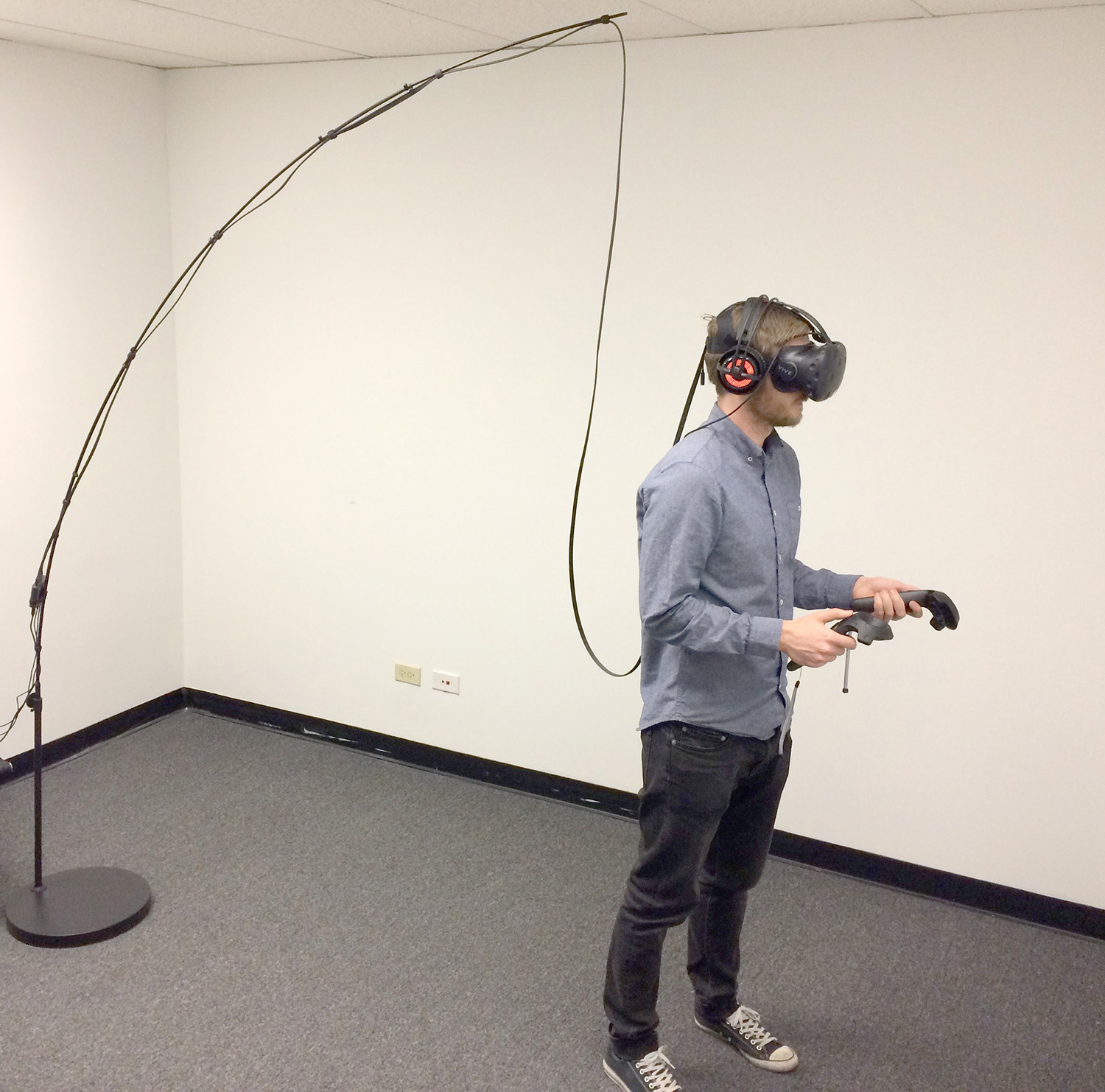
A lot of the complaints I see in the comments center around weight of the headset & resolution. Regarding weight wouldn't it make more sense to have an overhead track installed where you live discrete, that takes the stress off the helmet?
This person seems to have it mostly correct except the wires still touch their back. It would make sense to me to have nothing touching you so you don't feel encumbered.
Within days of buying an Oculus DK2 back in 2014 and trying a ton of applications, I knew the tech was years away from where it needed to be, so I sold the rift on ebay.
After the novelty wears off, you're left with this thing strapped to your head, and it's not comfortable. It's not ergonomic, it's awkward, and a blindfold to actual reality.
No doubt the headsets are improved from DK2, but they would need to be a LOT better before I bother trying again. 5 years is wishful thinking. Try 10 to 20 or more for the kind of VR that is like wearing regular sunglasses.
I read a novel published about 20 years ago (1999), that "predicted" how VR would take over the world. It starts with the VR headsets of today that you wear over your face with poor graphics and that don't seem very realistic. Then came better ones with eye tracking which replaced keyboards and mouse with eye tracking. Then electrodes which would directly interface with our brains to replace our sense of hearing and vision. Then wireless electrodes so you dont have to wear a helmet but are in VR/AR the moment you step into a room with a computer. Then slowly a Matrix like world where people are plugged into VR from their birth and have no idea there is a physical world or something beyond VR. Pretty interesting.
VR is absolutely perfect for sim racing and I hope it doesn't go away. Even if it just becomes another niche device that sim racers spend way too much money on.
I have to say, this article comes off as pretty biased. Gauging the future of VR by comparing it to social / mobile gaming adoption is a false comparison and just makes the author look dumb.
First of all, the author mainly writes about mobile and social games, so she obviously has no interest in VR and has probably never even tried it. Unfortunately for those on the fence about VR, she's painted an unfair and bleak picture. That's unfortunate for them because they may miss out on something quite fun and interesting.
I was a VR skeptic right up until two weeks ago when I tried a friend's DK3 and have since purchased a CV1 during the summer sale event. I was not a gamer beforehand, but the immersion of VR has sucked me in. That fact that you have to move to play is what makes it fun.
Maybe AI is dead too. It needs to get to the point where I have AI assistant which can feed me with the spoon and solve my relationships problems while doing it.


However, I'm still as excited for VR as I was in the beginning in regards to the technology. Give me a lighter headset, 100% wireless and great handtracking and finally some long, immersive games (can be ports, that's fine for me) and I'm ready to shell out money again.
As it stands today though, my VR hype is on hibernation until the next gen rolls around.