I just stopped caring about votes. It's often driven by inertia, and it can't differentiate a vote from someone who doesn't know anything vs a domain expert. Life is better once you stop caring about karma points.
Does Larry really lack enough self awareness to not realize these kind of statements make him sound like an orwellian super villain, or perhaps he does and simply does not care?
Larry doesn't care about anything other than Larry. For Larry, the biggest issue facing him beyond how he can live forever, is how he can ensure nobody ever commits a crime against him. The best way to ensure nobody ever commits a crime against him is to monitor every living human on the planet.
Any crime he commits can be figured out in courts with his high-priced lawyers so the idea that AI constantly watching you would be repressive seems misplaced to Larry.
For people that think I'm joking, at one point his primary philanthropic contributions were almost exclusively to life-extending efforts:
>Take the massive amount of money he once gave to life-extension research, which was the core focus of his philanthropic efforts.
>And so over the course of 15 years at the beginning of the 21st century he would donate over half of a billion dollars for anti-aging medical research, at a time when the field was seen as fringe science.
The point isn't about preventing people from commiting crimes against him. It is surely that oracle database would back the data centers run by the surveillance state.
Hmm, but has Larry considered that a scurry of squirrels may commit organized crime against his empire? Maybe he should invest in some deterrence there.
The trend has been more openness in this sort of behavior. After all, the public hasn’t seemed to respond to it with much negativity other than people occasionally complaining about these sorts of behaviors online. The highest level complaint seems to be public protest, which don’t seem to garner enough momentum to push change.
If there’s no repercussions, why not be transparent? Scary indeed, as it’s quite telling of the direction we’re headed in, IMHO.
If you're a billionaire today, you might be forgiven for thinking the current state of extreme wealth inequality is completely normal. You will obviously want to lock in a system that has benefited you and ensure that nothing ever changes.
Historically speaking though, wealth inequality in developed nations is reaching a point at which, as often as not, revolutions happen. Sometimes they're bloody. Sometimes not. There are two approaches to avoid a revolution:
1. Back off from controlling government and let reform happen gradually. Your wealth will be lessened, but you'll probably remain one of the richest people alive.
2. Lock everything in with a totalitarian panopticon state that you control. AI surveillance offers a huge advantage over surveillance networks used by past totalitarian regimes. e.g. East Germany's Stasi showed the limitations of surveillance in an age where humans had to do it themselves. With AI to do it, you can avoid employing a large portion of the population to watch the rest, and you can keep the power of that surveillance network concentrated in just a few hands, preferably yours.
It's clear which approach is being attempted in the U.S.. I'd just point out that #2 is inherently high-risk. If you lock in wealth inequality at today's levels (or make them worse) and then use repressive means to prevent any form of push-back, the state becomes brittle. If it breaks, the result could be a bloodbath. Approach #1 is much safer. Yet, here we are.
I do not believe Approach #1 has ever been attempted without quite a bit of blood leading up to its attempt, and I think it has only been attempted a few times even so, approach #2 - oppression, with resulting bloodiness - seems to be the norm.
One could argue that Solon the Lawgiver did #1 2600 years ago - abolishing debt slavery, supposedly abolishing most debts, freeing some public lands, coming up with council of Four Hundred.
Regime change when an occupying power leaves is a different scenario from changing underlying power structure of society where the controlling powers are in the society.
One reason for that is that when an occupying power leaves regime change must happen.
I don't think the Romanian Revolution counts as a civil war. Over the space of a week or so, it was: protests/riots, violent crackdown leading to military defection/coup.
Look at Syria for how a similar pattern of events did lead to civil war. Ceaușescu just didn't represent a section of the country with an interest in fighting for his regime. The risk of instability when an authoritarian passes is if they have been holding together a country with significant ethnic/sectarian/political divisions like Yugoslavia.
if you are a billionaire today, you are painfully aware that the wealth you have us on a timer, as human society burns through the resource windows and then decomplexifies and falls back into a sort of survival bootloop. What you buy with surveillance is tradeoffs of stability aka time. What you do with that time is to forward all vectors to escape the loop in some futures and prevent the loop from becoming hyper destructive due to gadgets from the golden times.
A panopticon thus exists in phases. first phase (centralized) to buy time, stabilize a complex society, then to help forward a gracefull decay, finally (decentalized) to prevent the decayed and loopstuck society from further self damage and keep complexity recover vectors open.
The dream is a Afghanistan with phones that can bootstrap itself out of the failed state.
> If you lock in wealth inequality at today's levels (or make them worse) and then use repressive means to prevent any form of push-back, the state becomes brittle.
well, not only the state, but how does capitalism survive that, who can buy anything (be a consumer) except for the essentials in that scenario, where do investments/growth go towards?
No offense but you're just injecting a trendy opinion without knowing anything about the man's history. Ellison was notorious even in the '90s-'00s and never made any real effort to hide it. The book "The Difference Between God and Larry Ellison: God Doesn't Think He's Larry Ellison" (yes, that's its actual title) came out all the way back in 2003, the title being a quip that had already been circulating for many years by that time.
Honestly I think I prefer openness, although I'll admit it's hard to be precise about what's ok and what isn't. In the spirit of free speech, "I disapprove of what you say, but I will defend to the death your right to say it." At the same time, defending somebody's right to speech does _not_ mean that individuals can't embargo / "cancel" that person -- I think this behavior is itself speech of a sort.
What would you change about the present situation? I feel that public protest is roughly all that can be allowed in response to speech (ie, speech in response to speech). Surely he shouldn't be jailed/fined/doxxed for this speech? What more should be allowed? Or is it just that the public protest isn't as strong as you'd want?
Speech and thought are interlinked. Encouraging our society's most powerful to pander to social media in what they say undoubtedly affects how they think.
Sure but what’s the alternative? Are you going to decide what people can say? This is all very 1984, if you haven’t read it you might find it interesting
The thing that makes any given arrangement of society work (or not work) is how quickly/cheaply it removes decision-making power from people who demonstrate poor judgement.
This is a difficult task, because people with decision-making power tend use that power to alter the system to solidify their position.
Capitalism, at its finest, does this by letting people make bad decisions with their money until they haven't got any. This was an improvement on, say, holding wars until enough people decision-makers get killed off. However, a variety of long-term policy shifts have meant this no longer appears to happen - merely possessing capital is so profitable that even astonishingly poor decisions cannot reduce your wealth enough to matter.
IMO, through this statement Larry Ellison has demonstrated the kind of poor judgement which a functional society cannot tolerate in a decision-maker, and lacking an effective way to remove this from the decision-maker pool is the primary cause of societal trouble today.
Are you saying that we/some govt org should seize his assets because he had a bad opinion?
Fwiw I agree with you in disliking the “eternal power“ dynamic that seems to come with being rich. I’d prefer to solve this by requiring more disclosure in lobbying efforts, restricting the kinds of donations you can make, etc. Money shouldn’t lead to political power IMO.
> Are you saying that we/some govt org should seize his assets because he had a bad opinion?
I'm saying that a system in which someone with poor judgement manages to accrue his level of assets is broken somewhere.
Policy settings under which "having capital" allows you to grow your wealth while making terrible decisions are bad policy settings.
Various alternative policies exist, the most obvious of which is adjusting taxation settings such that growing your wealth requires consistently making good judgement calls.
I’m not trying to be obtuse, my best guess is that I’m in favor of what you’re proposing. Can you add more details though? I’m certainly in favor of progressive taxation, which kindof matches the spirit of what you’re saying by reducing the profit margin for those who have massive amounts to “play with”. Maybe there’s a more direct method though? Maybe a wealth tax? Something else?
I'm explicitly not claiming any particular proposal is right; my background is not in public policy.
I'm pointing out that across a great many economic nations, times, and economic systems, the core problem of every social system is not the obvious stuff like "how do we allocate resources" - it's "how do we remove bad decision-makers" - because those people are implementing "how we allocate resources".
There's a great many ways to solve this problem, but there's little evidence that _anything_ is currently being tried. I'd support any policy that seemed reasonably likely to improve this situation.
> Does Larry really lack enough self awareness to not realize these kind of statements make him sound like an orwellian super villain
He's joining the attention economy. Saying something stupid but provocative yields earned social media. Larry Ellison saying something sensible wouldn't make HN's front page.
For one, he’s one of the OG’s who’s had vast wealth and power for longer than many others have been alive.
And two, he’s at an age where people lose any sense of self-awareness, shame, filters - all that shit.
Anyways I don’t think he cares that it makes him sound Orwellian. I suspect he’s fine with being Orwellian outright. Not having what he has is as unimaginable as for all of us having a fraction of what he has. It’s too much of a stretch for someone like that to extent so much to imagine.
And yeah it’s frightening, it’s why we did away with autocratic Sun King calibre aristocracy/royalty and all that. We can expect all the other zillionaires to follow this path reliably over the next few decades.
I doubt it’s the age of him, it moreso feels like the age of society.
With Musk swinging his arm to in the air to hail his führer it really feels like the defining moment of new age rich people, don’t get me wrong the build up was there but this is just the moment that best encapsulates it all.
The best person to personify the old age I’d say is Bill Gates, awful person behind the curtains I’m sure, real buddy buddy with Epstein but he did the whole “caring for humanity” shtick, he donated bits of his money, y’know he at least took some effort to make it seem like he cared.
> With Musk swinging his arm to in the air to hail his führer it really feels like the defining moment of new age rich people
We're five days into the Presidency. And Musk has stumbled across power the sorts he hasn't really had to wrangle with before. I'd be shocked if he comes out in 2028 better off, materially, than he is now.
Meaning power over the body (armed thugs, for example). Bit of a play on words.
Ma has power over the money, but Xi has power over Ma's body.
Rich people often think that money is everything (and they are usually correct), but there are some things that money can only buy, when facing a bat with nails driven through it.
Were those ties more business and philanthropic oriented or socially oriented?
I found this while searching for details surrounding the ties between the two:
The billionaire has acknowledged that he "shouldn't have had dinners with him" while his ex-wife Melinda French Gates said the business and technology magnate's relationship with Epstein played a role in their divorce.
However, the claim that Gates visited Epstein's private island in the U.S. Virgin Islands 37 times has not been substantiated.
I don’t mean age as in age of empires, I mean age as in old guy with no social filter anymore age.
Most people around 60-70 usually become quite shameless and cringey in one way or another.
As for Gates, he was dragged through anti-trust at a time when there were no other tech billionaires to team up with. His tech did not give him global reach - he just made a lot of money on office cubicle software back then.
But generally, yes. Absolutely - guy throwing salute is a defining moment of zillionaire IDGAF. Anti-trust success or failure is going to become the defining turning point for millennial generation.
Negative sixty eight years[1]. Oh, you didn't mean the private military contractors, of which there were about 250k involved in the iraq and afghanistan war, slightly more in total than deployed troops at any given time.
Many ultra-high-net-worth individuals hire them. It's no secret, they've been doing it since the 60s when kidnap and ransom insurance started being a serious thing, and it's only intensified over time. There was an interesting "bolt hole" real estate listing that claimed years supply of food, water, housing etc. for a "company sized group of security contractors" as an amenity.
The biggest problem is every creator of ceasing privileges from others genuinely believes that he is excluded.
  First they came for the socialists, and I did not speak out—because I was not a socialist.
  Then they came for the trade unionists, and I did not speak out—because I was not a trade unionist.
  Then they came for the Jews, and I did not speak out—because I was not a Jew.
  Then they came for me—and there was no one left to speak for me.
  —Martin Niemöller
3 Generated frames sounds like a lot of lag, probably a sickening amount for many games. The magic of "blackwell flip metering" isn't quite described yet.
It’s 3 extrapolated frames not interpolated. So would be reduced lag at the expense of greater pop-in.
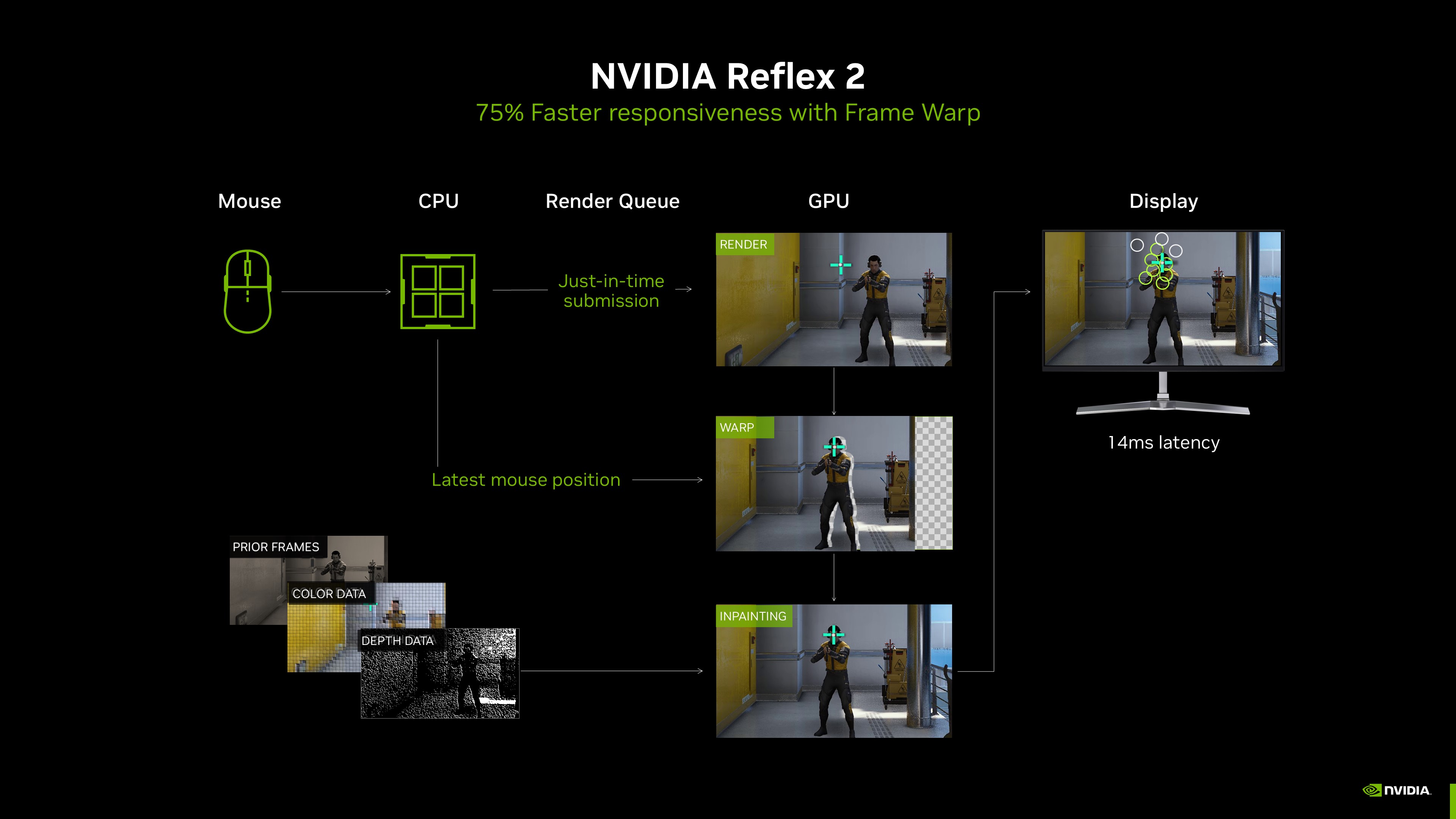
There’s also the new reflex 2 which uses reprojection based on mouse motion to generate frames that should also help, but likely has the same drawback.
"Frame generation (FG)" was not a feature in DLSS 2 - the subthread starter was speculating about MFG (of DLSS 4) having worse latency than FG (of DLSS 3), on the basis of more interpolated frames meaning being more frames behind.
To me this sounds not quite right, because while yes, you'll technically be more frames behind, those frames are also presented for a that much shorter period. There's no further detail available on this it seems however, so people have pivoted to the human equivalent of LLM hallucinations (non-sequiturs and making shit up then not being able to support it, but also being 100% convinced they are able to and are doing so).
Nobody is talking about DLSS 2 here so I don't know where that came from. The 2x, 3x, and 4x in my post are the number of generated frames. So 2x == DLSS 3, and 3x and 4x are then part of the new MFG in DLSS 4.
Digital Foundry has actual measurements, so whether or not that matches your intuition is irrelevant. But I think the part you forgot is that generating the frames still takes time in and of itself, and you then need to still present those at a consistent rate for motion smoothness.
Watched their coverage, not much in the way of details that would explain why the (slightly) increased latency. Your speculation about why MFG takes longer makes sense to me, although I have troubles picturing how exactly the puzzle all fits together. Will have to wait for more in-depth coverage.
Yeah, in hindsight I should have figured it was more generated frames presented at a lower frame times (shorter period).
The Digital Foundry initial impressions are promising, but for me with a 144hz monitor that prefers V-Sync with an an FPS cap slightly below, I'm not sure using 3x or 4x mode will be desirable with such a setup, since that would seemingly make your input lag comparable to 30fps. It seems like these modes are best used when you have extremely high refresh rate monitors (pushing 240hz+).
This is true, but it's worth noting that 3x was 5ms additional latency beyond original FG and 7ms for 4x, so the difference in latency between DLSS 3 FG and DLSS 4 MFG is probably imperceptible for most people.
yeah but it means MFG still has the same fundamental problem of FG that the latency hit is the largest in the only scenario where it's meaningfully useful. That is, at low 15-45fps native FPS, then the additional impact of an additional frame of buffering combined with the low initial FPS means the latency hit is relatively huge.
So Nvidia's example of taking cyberpunk from 28fps to 200+ or whatever doesn't actually work. It'll still feel like 20fps sluggish watery responses even though it'll look smooth
Do you have a source for this? Doesn't sound like a very good idea. Nor do I think there's additional latency mind you, but not because it's not interpolation.
Interpolation means you have frame 1 and frame 2, now compute the interstitial steps between these two.
Extrapolation means you have frame 1, and sometime in the future you'll get a frame 2. But until then, take the training data and the current frame and "guess" what the next few frames will be.
Interpolation requires you to have the final state between the added frames, extrapolation means you don't yet know what the final state will be but you'll keep drawing until you get there.
You shouldn't get additional latency from generating, assuming it's not slowing down the traditional render generation pipeline.
Could you please point out where on that page does it say anything about "extrapolation"? Searched for the (beginning of the) word directly and even gave all the text a skim, didn't catch anything of the sort.
The literal word doesn't have to be there in order to imply that it were extrapolation instead of interpolation. By your logic, there is no implication of interpolation versus extrapolation either. Nvidia simply won't use such terms, I believe.
They did specify [0] that it was intermediate frames they were generating back when the 1st version frame generation was announced with DLSS 3, which does translate to interpolation. It's only natural to assume MFG is the same, just with more than a single intermediate frame being generated.
It is also just plain unsound to think that it'd not be interpolation - extrapolating frames into the future means inevitably that future not coming to be, and there being serious artifacts every couple frames. This is just nonsense.
I checked through (the autogenerated subtitles of) the entire keynote as well, zero mentions there either. I did catch Linus from Linus Tech Tips saying "extrapolation" in his coverage [1], but that was clearly meant colloquially. Maybe that's where OP was coming from?
I will give you that they seem to intentionally avoid the word interpolation, and it is reasonable to think then that they'd avoid the word extrapolation too. But then, that's why I asked the person above. If they can point out where on that page I should look for a paragraph that supports what they were saying, not with a literal mention of the word but otherwise, it would be good to know.
Reflex 2 seems to be asynchronous projection [0]. How the two techs come together when both are enabled, I'm not quite sure how to fit together in my head, but clearly it works fine at least. Hopefully there will be more coverage about these later.
Deploying some sort of TPM remote attestation for DRM requires every component from every vendor to play nice, so I don't think you'll ever see that rolled out for Windows.
I would guess that the actual push for TPM is to have 'better' BitLocker, and Passkey support.
In practice the default BitLocker+TPM configuration isn't that great (no user entropy/pin, dTPM is basically worthless).
I have no actual understanding for how TPM is involved for Windows Hello/WebAuthn/Passkey or whatever, but at a glance it would seem Biometrics without a TEE seems like a very weak link.
I figured it’s more about ensuring the kernel and boot loading and OS are 100% unmodified by attackers/malware.
If that helps with bitlocker or passkeys or whatever that’s great. But I assume at its base it’s a pure integrity play.
I would think that would also let you know the public key stuff used to communicate with hardware authentication like a fingerprint reader is secure too, but I don’t know how that stuff works well enough to know if that’s true.
TPM can measure the Secure Boot state for later reporting (attestation) but when it comes to DRM, that’s not a terribly interesting bit of information, knowing the firmware and kernel are valid, when the configuration of the OS and installed applications is really the important part.
As far as I know there’s no real scalable way for that to work in the Windows ecosystem.
That makes sense to me. It just doesn’t seem that useful for DRM, seems like kind of a reach.
Especially in modern systems where the graphics card could do all of it and so the host PC never has access to the decrypted data or keys in the first place.
I think there's a large pool of good talent that can't fully be trusted to do the right thing (not slack off), but can be employed successfully with sufficient guardrails (return to office).
Loosely related anecdote why I feel so:
For a while right after Apple started its mandatory RTO and ramped up Caffe Macs, the soda "grab n go" sections had an honor system - you paid your $1.25 for a coke and went on your way. Apparently there was a _lot_ of petty theft of drinks, so they have a person with an iPad check you off now, and I assume theft has basically plummeted since there's far less employees brazen enough to just barge off with one without checking off their name.
So maybe the RTO is effective in someway? Or maybe the real lesson is that the soda should have been free to begin with.
There is a classic text [1] about exactly this, the free soda.
In short, when a company starts to pay attention to such petty details as the cost of soda, which must be a rounding error in the cost of running an office of a decent engineering company, it's a signal that the culture has changed. With that change, best engineering talent often leaves towards places where priorities are still aligned with lofty goals, not bean-counting.
(Disclaimer: of last 10 companies I've worked for, only two did not offer free soda, due to being 100% remote.)
I worked at the KFC/YUM! headquarters for 10 years. When I started, we had free soda in the lobby of the building. It was great for those late afternoon doldrums and a group of us would often walk down 5 flights of stairs to get a pick-me-up.
About 3 years before I left they removed the soda machines. My understanding was that it only cost about $30k / year and most of that was for cups & lids. We even had an executive that was willing to pay for it out of their budget. No go.
It turns out that the catering company that supplied food to the building didn't like losing out on the soda money. So they told KFC/YUM! to remove the free soda option, and they did. It really was the beginning of the end.
It's not so much that the soda was gone it was the thought of it. That free soda actually solved quite a few programming problems, or at least allowed us to solve them on our way downstairs. It also let us work harder/later than we normally would by giving us that afternoon journey. It's positive effect was much greater than it's financial cost.
Thanks for the explanation. It makes sense, but is entirely foreign to me (at least for soda). In my history of 20 years of software/DBA in the Australian mining/construction industry, most have had free coffee but none have had free soda. Though two did free Friday-afternoon beer and pizza.
My current place has free instant coffee (until it runs out) and everyone who wants to push for more than that is viewed with 'tall poppy syndrome'.
Yes, free basic cheap commodity drinks and snacks are bare minimum for a FAANG-class employer, and every other FAANG-class employer I'm familiar with goes well above and beyond that.
Even my first job out of college as a boilerroom MSP sysadmin earning $40k in manhattan gave us free soda (the only benefit lol)
I mean, even if you work as a mechanic at a body shop, there is often free coffee in an old pot in the break room, it's not that crazy.
But outside of that context, no of course I don't expect/care if my employer provides me with free soda. I don't even drink it.
It just seems weirdly cheapskate for a supposed FAANG-class employer.
I actually kind of agree as I am not even a soda drinker, but that was not the point. The point is the message it sends. And it really doesn't cost that much on a per-employee basis -- I would guess some employees might consume a six pack per day, valued at $5, and some others might consume nothing, valued at $0, so average that to maybe say $3 or $4. This is less than that employee already paid out of pocket to commute themselves to work. And having some basic food/drink taken care of centrally is more efficient in terms of saving time stocking up, going and buying more during break, etc.
But most of all, it's just the message. All the other "nice" employers do it, even some pretty "basic" employers do (not surprising, this is a very cheap perk, only a little more expensive than breakroom coffee), so if you don't, it you look like a cheapskate. Like what else are you cheaping out on?
I also don't drink much coffee, but would see it as a red flag if they cut costs by getting rid of the coffee in the break room, and that's a red flag that would hold even if I was working as a retail cashier (that's not an industry where free break room coffee is standard, but it's not unusual, so while I wouldn't care if a company never offered it, if I was a cashier at a company that had it, and then they took it away, the message would be obvious -- we are preparing to cut costs at the expense of your work life, our company is no longer growing, jump ship if you can)
Sure, you could cap the expense per-employee so its a non-issue. I was thinking about benefits in general that nobody cares about or uses. But even if they use it, snacks/food can get expensive real quick.
I remember when Oracle took over Sun and they brought in the free soda drinks where you can grab a can and they're constantly replenished. I brought in a backpack and filled it then took it home. After a week of doing that I had all these soda cans to drink but I realized I didn't like soda anymore. Larry is the best.
> I think there's a large pool of good talent that can't fully be trusted to do the right thing (not slack off)
Ever worked in an office? At any corporation size no one works 8 hours a day and if you want to slack, there are plenty opportunities in the office as well. Hell, you can spend the whole day there without doing ANYTHING.
So that is a non-point for me, slackers gonna slack.
I knew a guy whose daily routine was something like:
9:25 - Arrival (cafeteria stopped serving breakfast at 9:30.
9:30-10:15 - Breakfast
10:15-11:30 - A lot of walking around the office, having business-sounding conversations with others but really getting nothing done.
11:30-1:00 - Out for lunch.
1:00-3:00 - Sneak out to car in the parking lot for a nap.
3:00-3:30 - Daily standup. Vaguely talk about how he’s “merging code” or “updating library dependencies” this week.
3:30-4:00 - At desk working.
4:00-5:30 - Doing his walk-around-talk-arounds through the office hallways again.
5:30-6:00 - At his desk again!
6:00 - Cafeteria starts serving dinner. Grabs a bunch of food, throws it in his backpack, and heads to the parking lot.
This went on for years. The other teammates joked that he must have blackmail dirt on the boss because it was obvious to everyone that he wasn’t doing anything and nobody seemed to care. He was there when I joined the company and was there when I left, years later. He may very well be still there today, merging code.
I'm sorry but the example you gave for your argument makes no sense at all. Most people here have tasks and daily meetings where these tasks are discussed or at least briefly mentioned (in other words, your "iPad guy" is already there).
If someone is slacking, it is immediately visible. Can you abuse the system by providing fake explanations for why one task takes so long? Of course, but you can do the same whether you work remotely or not, and this can also be easily verified in both cases.
While I agree, there is nothing less satifying than backing up to a nvme external drive.
I still have some spinning disks large hdd as a secondary backup and it's so much more satisfying. I could listen to them work all day! Probably rooted in my brain from childhood.
Wait a few weeks and the digital version of the spinning media will magically appear thanks to the magic of an eye-patch, peg-leg, and parrot included service in a bay.