It's very easy to make websites without needing cookie popups in EU/UK. Every cookie popup is a reminder of how stale the thinking around tracking and data sharing is!
The cool thing about water is that evaporates all by itself. For free even. No electricity is required.
So an alternative to making the tumble dryer "smarter" can be to simply not use it for most of the time, thereby cutting the loss caused by "dumb" dryers.
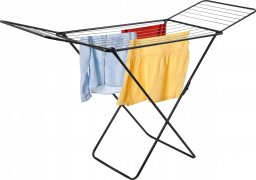
The engineering part that's missing is related to re-introducing and improving the many awesome laundry line systems that used to be available.
Where I grew up if you left the clothes out (but covered with inclement weather), depending on season, they would either dry perfectly or get a funky (awful) smell to them. I wish we had a drier back then, it would have made my teenage years less embarrassing.
Many British houses are already damp and small, and heating them to dry clothes doesn’t save energy. Putting clothes outside when it’s -2 degrees or raining consistently also doesn’t help.
I think I’ve seen the kinds of indoor drying lines you are perhaps referring to, but I don’t know how compatible they are with Northern Europe.
Dunno what counts as "Northern Europe", but in Poland nobody uses powered dryers, it's all natural. And it gets to -20 C in the winter here sometimes. Dry cold is not actually a problem for drying clothes.
I'm Polish and we've always had a dryer at home, no idea how my mum would have gone through that pile of loundry she always did otherwise. So YMMV.
And the problem in the UK is that relative humidy is so high you literally start getting mold inside your house if you just use an airing dryer, as most people do, a lot of houses have that characteristic "musky" smell because they are just too damp. In poland the air is a lot dryer(especially in winter!) so you don't get this problem.
I think that there are two assumptions that we tend to make that causes the idea of air drying frozen clothes to be unintuitive:
1. We don't expect solids to evaporate, because it's not something we notice often (though if you think about the fact that a few inches of snow can disappear in a couple of days while the temperature remains below zero Celsius, you suddenly realize that you do observe it if you live in a cold climate)
2. We're so accustomed to using heat to speed the evaporation of water. So we might assume that removing large amounts of heat energy will "stop" evaporation. Or at least cause it to slow so much that air drying becomes impractical.
But ice does, indeed evaporate (to be accurate, it sublimates). My question is how temperature affects the speed of evaporation at low temperatures. How long do you need to leave your wet clothes hanging below freezing before they are dry?
I live in a place where there is ice outside all winter. During winter the cold air can't hold moisture as much as hot air and most of the days are at 100% humidity even at -20 because the air simply can't hold more.
I might try this out on the deck next season but I don't assume ice is just going to sublimate away because it's literally outside all winter and doesn't go anywhere.
They evaporate faster in the cold, because the air is very dry when it's very cold. Or sublimate I guess? In any case they usually don't freeze unless they are very wet (which rarely happens - people use washing machines that rotate very fast for the last few minutes of washing to remove most of the water mechanically).
And when they do freeze it's not like cloth encased in ice, it's more like the clothes still look and feel dry - they just hold their shape :) If you put them at room temperature they finish drying within minutes.
> thereby cutting the loss caused by "dumb" dryers.
The loss that TFA and smart dryers are trying to cut is time spent on laundry. Having lived both with and without a tumble dryer, I'm very skeptical that there's a laundry line system out there that is less time consuming than even a dumb tumble dryer.
How about you hang your clothes indoors when it's raining inside? I've been doing that for years in a rainy country in a tiny studio apartment. No issues.
Dehumidifiers are pretty affordable and warms up your room a little. Still doesn’t solve the fact you need to ventilate your home. If you can - isolate your drying to a non living space.
The water that was in your clothes and evaporated over 12 hours at night naturally is the same water that evaporates in 1 hour in the powered dryer.
If you have working ventillation you're fine either way. If not - you're not. In fact I'd expect worse problems if you evaporate that same water quicker, because there's less time for it to escape outside.
Usually dryers are connected to dedicated ventilation out of the house, so the humidity doesn't transfer into your room directly. Otherwise, the laundry room would be a sauna.
Dryers typically are vented immediately outside via a dedicated tube and vent. That means that the air in the rest of the house never sees the moisture at all, so your whole-house ventilation system or dehumidifier doesn't need to work as hard.
Some driers, especially in Europe, condense the water in to a tank that you empty manually in to a sink. This is useful if you don't have an easy way to vent it and also shows just how much water is coming out of your clothes (multiple liters per load, sometimes!)
Still dependent on the overall climate. It's not necessarily about how much it rains, but how humid the air is. When I was in Virginia, it rained a lot, but the air clears up fairly quickly after rain.
In contrast, my grandmother lives in a village with such incredible rainy seasons, that this has been a pain point as perpetual as the rain itself. For a few months in summer, the air is so humid that even unused clothes have trouble stay dry. Condensation appears on the wall, and nothing ever dries, no matter where you hang them; indoors, outdoors, doesn't make a difference. Sometimes, they have no dry clothes for weeks during summer.
We have clothes lines in our backyard and hang drying clothing is the bees knees. For one, dryers tend to ruin clothing. When I didn't know any better I'd dry black t-shirts on lowest heat setting and they're all washed out and didn't keep their color.
For some items like wool underwear and t-shirts I hang inside because sun bleaching can be a problem.
Sun bleaches black clothing too. Plus it’s essentially 2-3 extra steps. A good quality 2 in 1 washer/dryer in a bad climate/limited space is a perfect fit for busy people.
> The engineering part that's missing is related to re-introducing and improving the many awesome laundry line systems that used to be available.
I live in a desert, and my current place has a not-tiny yard, so I'm curious about this. Anyone got examples or pictures of laundry line systems they really like?
One of the issues is that tossing your stuff in the dryer is fast and easy. Hanging clothes to dry is kind of tedious. It also tends to result in crinkly clothes (especially shirts and towels). But I am curious about these laundry line systems you mention!
I've seen many great things in photos where laundry lines are strapped out between windows and across streets "ad hoc". But most of them were in photos. I think the "pulley" that carries the line and the line itself seem to be more durable than what my local building market sells... I can only get nylon lines and small pulleys, so I'm not happy with the projects I've done so far. The best lines I've found are the ones with metal wire inside.. the ones without metal in them break very quickly.
One that I would really like to have is a strong, durable multi-line rack that sits below a window. If possible, I'd like to be able to expand and contract it.
There's also a lot of ideas shared online for creative indoor solutions.
Regarding crinkly clothes: generally if you hang up a wet shirt to dry, it gets less crinkly than in a tumble drier. That's an old tip for reducing ironing efforts :)
Regarding "hard" towels etc: This one is really difficult, especially terrycloth and similar material that's supposed to be very soft can seem hard after air drying. You can try to add vinegar as a softener if your water is hard, I find that makes a good improvement. And you can generally rub clothes soft - I tried folding towels and give it a good rubbing, works well to soften them up. I would also remark that after using a soft towel once and drying it, the terrycloth also becomes hard :)
All good points, but definitely more time consuming than "throw in dryer, take out an hour later".
If you're even lazier you can get a combo washer/dryer. Not quite as effective as a separate dryer but it's nice to have dirty clothes go in and clean, dry clothes come out without a middle step.
And as I can learn from other HN comments below, there was indeed real studies conducted in 2018, so the comical/logical hypothesis has been further developed and empirical evidence is now also there.
It's only the second time in history that a lobbying entity is banned. Second time since Monsanto in 2017. That's not a "path". Source: the first paragraph of the article.
This has nothing to do with "show trials". If you hold 14 lobbying badges and do not respect the European Parliament's Employment Committee's repeated requests to discuss important matters of employment in the European Union, then Amazon is really showing contempt for the lawmakers and the European institutions.
It's very understandable why they are talking about a "red line" here: If a company of the size and importance of Amazon refuses to sit down with lawmakers and discuss problems caused by their commercial activities on a European-wide scale, then they're not showing the kind of social and political responsibility that's fair to require from a corporation with direct access to European lawmakers.
The decisive body seems to agree:
> all quaestors were in favour of authorising the secretary general to withdraw their long-term access badges