I think the main tangible risk is if you have an autoimmune disorder such as HIV.
Seems like the reason for not treating in general is that human guts are already infested with all sorts of relatively harmless bacteria (and protozoa, etc.). And the drugs to treat toxoplasmosis, which are certain antimalarials and antibiotics, carry some risk. A big risk is that, if you nuke your gut biome with 1-3 antibiotics for everything you get infected with, and they develop resistance which spreads horizontally, it could prevent antibiotics from saving your life when you're infected with something serious.
That being said, if there's a link established between t. gandii infection and suicidality, I'd speculate you'll see lots of pressure from the public health folks for treating all infections.
This is not medical advice and I am not a doctor. I have time to sit in an armchair and argue about toxoplasmosis on a Friday night. Please take that into account.
Come to Georgia. Quite a few people have 10-15 dogs. Even in suburban neighborhoods. I've subjectively seen more "pack of dogs" type people than "cat ladies".
T. gandii and its lifecycle are not in the scope of evolutionary psychology, though. It actually reproduces (sexually) in cat gut and the (cysts of the) host animal actually need to be eaten by a cat (or other host). I agree that EP can lead to dangerous, political, and moralistic ways of thinking.
But the idea that parasites have lifecycles and incentive to survive and reproduce does not deserve such criticism. It's mainstream biology. Toxoplasmosis is a real thing that really affects behavior in wild mice. Read it on Wikipedia.
>Toxoplasma gondii infection in mice lowers general anxiety, increases explorative behaviors and surprisingly increases a general loss of aversion to predators (without selectivity toward cats).
Whether toxoplasmosis causes suicidal ideation in humans is less clear and more speculative, as you argued. I agree. But the mode of parasite transmission, assuming a psychological effect exists in humans, would indeed be Alice being eaten by a cat and then Bob touching cat shit.
>The young man broke into the enclosure, took off his clothes and jumped into the middle, horrifying other visitors who witnessed the attack.
>Once inside, the lions reportedly immediately pounced on him and began to 'play' with him.
>At this point, zookeepers intervened in the attack and shot the two lions in order to save his life.
>The director of the zoo, Alejandra Montalva, said: 'We believe that this person entered as a visitor and paid for his ticket.
>The zoo director said she was 'deeply affected' by the deaths of the two lions, a male and a female.
>One witness said the man was 'shouting things about Jesus'. They continued: 'He was screaming religious things.'
>According to the news channel, the suicide note that was found inside his clothes made allusions to the apocalypse as being a reason for his attempt to take his life.
>He added: 'He suffered several injuries and trauma to the head and the pelvic area. 'We have high hopes that will recover and that will be fine.'
How is this guy the victim here? What about the lions?
> Normally, a protozoan is not very likely to end up in a cat’s gut because rodents instinctively fear cats. In Toxoplasma-infected rodents, however, the fear of cats disappears (Vyas et al., 2007). The mere smell of a cat normally makes rodents flee, but rodents infected with Toxoplasma experience the smell of cat as sexually attractive (Berdoy et al., 2000, House et al., 2011). This makes them seek out cats, making Toxoplasma-infected rodents more likely to end up as cat food. These rodents still avoid other predators as before (Berdoy et al., 2000, House et al., 2011). The reversal of this innate fear reaction helps the protozoan reach its definitive host, a cat, and to propagate its genes to future generations.
I hear theories like "this parasite has evolved to make it's host want to be eaten by lions" and I instinctually think that's crazy, but then I remember all the way more crazy things that nature does, and it starts to sound reasonable. Thanks for sharing!
When I first learned how HIV (and retroviruses) worked, it was the same level of amazement. Like "it splices its own genes into your cells' DNA, and when your cells reproduce, they additionally make copies of the HIV virus" is just something that I would have never thought was real.
I think folks like myself, who became an "amateur epidemiologist" during covid (out of necessity, because of the information vacuum) were shocked to learn all these amazing things we weren't ever told. As an aside, the same is true for everyone who is now an "amateur diplomat" post-invasion and read about realism etc. and well-understood and reasonable explanations for "why the U.S. is always at war" that make it seem so logical. Crazy to think there are so many other fields keeping amazing secrets like this.
Nature is fucking terrifying. Every time I see some zoo program on the telly where "oh we're rehabilitating these endangered rabbits and then we'll release 'em back into the wild where they'll be free and happy". Not sure that's how the rabbits feel about it.
If I were a rabbit in one of these programs I'd feign a limp, hide in the corner, anything I could to avoid being cat or wolf fodder, or getting one of the dozens of tortuous diseases and parasites that infect rabbits in the wild.
Of course, the classic corporate oppression of "hi we're paying you $200,000/yr to write code... could you list out your contributions for the past quarter so we can evaluate your performance?".
I find it hard to believe you have 20 years of experience but don't see the point of performance evaluations. Imo it's part of being a professional to be able to answer the question "what are you working on"
It's very simple. They pay you, you do work. If they stopped paying you, you'd probably stop working.
Why would you expect that if you stop working, they won't stop paying you?
> Imo it's part of being a professional to be able to answer the question "what are you working on".
If they need an end-of-year self review to determine that, something has gone horribly wrong. They already know what I'm working on: they're the ones that assigned me to it, and I report on it regularly in standups. So what's the point of the review? If they don't already know what value I'm bringing, that's a red flag.
Sure it is. As long as the toilet works when you need it, you (a) don't actually have to check, and (b) the plumber is free to sequence their tasks in an optimal fashion.
The message from the plumber is based on the assumption that the default state of things is that the plumber has not done their job and things don't work. If you feel like that's the default state of things, you should choose a different plumber, not ask for notifications about which things don't work.
kqr: "Hi Mr. Plumber, could you let me know when 3-->4 happens. I need to use it once you're done, but I'm busy and don't have time to micromanage or continuously observe your work on the toilet."
(plumber's gaze narrows) "No. Fuck you, kqr. Fuck you, I'm not telling you jack shit. I have rights and dignity as a professional."
kqr: Wow, what a great plumber. I'd hire that person again.
>kqr: "Hi Mr. Plumber, could you let me know when 3-->4 happens. I need to use it once you're done, but I'm busy and don't have time to micromanage or continuously observe your work on the toilet."
plumber: Done sir! Your new toilets ready to go.
(6 months pass during which time the plumber completed some other work that was done satisfactorily and approved by the client)
kqr: I'm trying to decide whether I should keep using you Mr. Plumber. Please write me a few pages summarizing all the work you've done for me over the past 6 months. Make sure you emphasize how it has helped me move my KPIs, and how it helped me look good to my wife. Make sure talk about how the work you did contributed to our objectives as a family. Also make sure to add a bit about how you have developed as a plumber over the last 6 months and how you plan to continue to develop over the next.
Also, please write down what could you have done differently for an even greater impact to the KPIs. Don't hold back, it's important for you to reflect on your past decisions and make sure that next time you don't miss out on any opportunity to improve the toilet maintenance process when you're faced with similar situations.
If my toiletry needs were large enough to hire a plumber to spend 40 hours a week in my home, I would not expect the plumber to tell me when the toilet works again. I would expect the toilet to work, period.
Clearly, I would have two toilets for redundancy (much cheaper than 40 weekly hours of plumber time). In the rare occasion when both are broken at the same time I would expect the plumber to volunteer that information. The brokenness is the exception, the workingness the default assumption.
Since I gave them the work, I don't need them to summarize what I already know. Waste of time. I'd rather they continue working on their assigned tasks.
See my answer above. You're assuming is easy for management to know exactly what you're doing. This will vary from org to org and how many reports do they have, how complex the work is, how much autonomy everyone has, etc;
Sure, you can take the stance "they should know", but then don't complain when even well-intentioned managers can lose perspective or miss some of your accomplishments when is time to recognize your efforts (promo, raises, etc).
I consider myself a "well intentioned" manager, I care about my team and their work, try to keep up with the details, etc; but there's just too much going on at a large organization and I'm fallible. I may forget, or fail to see the complexity and value of something someone did (even my own accomplishments). There's nothing wrong with advocating for yourself and making your manager aware of your stance. If there's disagreement about how valuable something I did is I'd rather know when having that conversation. I may learn my manager cares more about x/y/z and not something I thought it was valuable but turns out is not important for the org or my manager for some reason I wasn't aware of.
> Why would you expect that if you stop working they won't stop paying you?
They aren't going to rely on someones self-written review to notice you haven't been working.
Chances are your manager could fill this out for you most of the time as they should have a good grasp of what you have been doing in your day to day.
Most of the time I can generate a list of what I have worked on via commit messages or ticket names to get a high level idea of what I have been doing. I still feel like my manager may have a better idea of what impact my changes have had then I do in some cases.
> Imo it's part of being a professional to be able to answer the question "what are you working on"
I do that almost every day during standups and every week during 1:1s. I have no problem with it. What I do have a problem with, is when I'm forced into making judgements about my work. That's for someone who gets paid more than me to do in the corporate context. My opinion about my work and all the other self-reflection stays with me. I don't want to bootstrap their work by coming up with all sorts of ways of rewriting history to match some artificial and arbitrary expectations which are anyway outside of my control. And so is the performance review itself, in the end. Some places even allow you to review what your boss said about your performance review and even 'contest' it. You know what happened when you did that? Literally nothing, except for a checked box saying that the employee disagrees. It's all pretend.
But they can, and in some contexts they do - it's just that they may see them differently than you see them. Perf review is a chance to share your own perspective.
I think a major bottleneck for fusion research from the lay public (including myself) is lack of interest.
Fission reactors work really well and have been around for 50+ years. If we are going to go nuclear instead of renewable, we need to address the elephant in the room.
The elephant in the room is: why not just fission?
And somehow harnessing the power of the literal sun will have a better safety rate? It's all speculation at this point because fusion doesn't exist yet... but it does seem like a huge undertaking to get superior safety over fission.
It’s not speculation because so much is known about the physics and elements involved. With fusion you want lighter particles which tend to be less radioactive, rather than heavy uranium etc particles for fission.
”Regulatory bodies have vast experience in the realm of safety and security for fission. We are working with them to ensure that all applicable knowledge is transferred to fusion."
Let me put the question another way: suppose we get fusion that's equally as safe as fission like IAEA is saying here. Why would we switch to it if we were unwilling to switch to fission?
You’re making false equivalences, and ignoring all of the fundamental differences between the technologies. The materials involved are different, the chain reactions are different, the kinds of radiation and half lives are different, the way you build the cores are different (and are still being worked on for fusion).
The entire reason why people are working on fusion IS the fact that it’s much much safer due to all of the key differences. That doesn’t mean there aren’t lessons from fission to transfer, just as lessons from ICE cars have gone to EVs.
My coworkers were talking about this at lunch the other day. An experienced tech guy asked all the employees there what they thought about whether a 4-year degree should be a requirement for tech jobs. All the new grads of course shit on their educations. A couple more senior people were of course more hesitant.
But college education does have value for most people beyond signalling. Whether it's worth $80K-$100K (depending on your state) I think is a harder question, but I definitely think it's >>$0.
I think the reason for this is hindsight bias, we don't realize how dumb we were before college vs. after college. Maybe going to an expensive day care where you are spoonfed super basic math and sociology or whatever is not valuable. But what I do think was valuable for me when I graduated 5-6 years ago from a state U.S. school was
(1) learning to talk with other people in a professional way,
(2) dedicating yourself for 4 years to studying one thing and becoming generally knowledgeable
and mature about that subject, so that very little can surprise you, and
(3) learning self control and independence, and also how to drink/use drugs without embarrassing yourself. Valuable professional skill especially in tech.
I don't think (2) can be accomplished unless you take the initiative to go beyond the basic requirements for the undergrad curriculum. At least in math/CS, which is what I studied. But in industry, that maturity comes in handy especially as you're given loosely scoped tasks and you have to determine what's possible or impossible and then convince various manager types from foreign countries who are pushing back and sometimes threatening you. And as your peers whine and are weeded out, you see more and more how valuable that maturity is.
This is a great summary of what makes Clojure-the-language awesome to work with.
The REPL is way too complicated as a selling point, but it's THE concept I took from Clojure and ported it to my workflow in other languages. It has made me appreciate Hot Reloading in front end apps (and make sure it always works perfectly), make my Ruby console reload friendly, organize my React apps so business logic stays in models I can use in a REPL.
In social science and humanities, I agree with you that self studying is an uphill battle. You'll just sound naive unless (1) you've made a herculean effort in studying, and (2) you've thought very critically on your own about how you will assimilate and where you will fit into the existing space of thought. There are no definitively correct opinions in these fields but plenty of influential people have theories. My experience is that it's all about how you convince others to join your "team", whether what you say is appropriate and within the Overton window, whose "side" are you on, etc. In some sense the thing that is "taught" is how to argue, what's acceptable to think, and who is on whose side or not. And the punishment for saying the "wrong" thing is more severe than in mathematized fields.
Textbooks and/or (current) edtech are not going to be effective there.
But in hard scientific topics (mathematics, algorithms, engineering) there are facts and ideas that are taught, and it's equally easy or hard to learn from prose as it is from listening. In my experience you can be very effective self-studying as long as you already have basic background about the field and what's the point. I skipped 2-3 years of math in school by simply reading the textbook over the summer, doing the exercises, and just asking to skip to the next class. You do this a few times and then you realize that in-person classes are also just them reading the textbook to you. I don't regret it whatsoever.
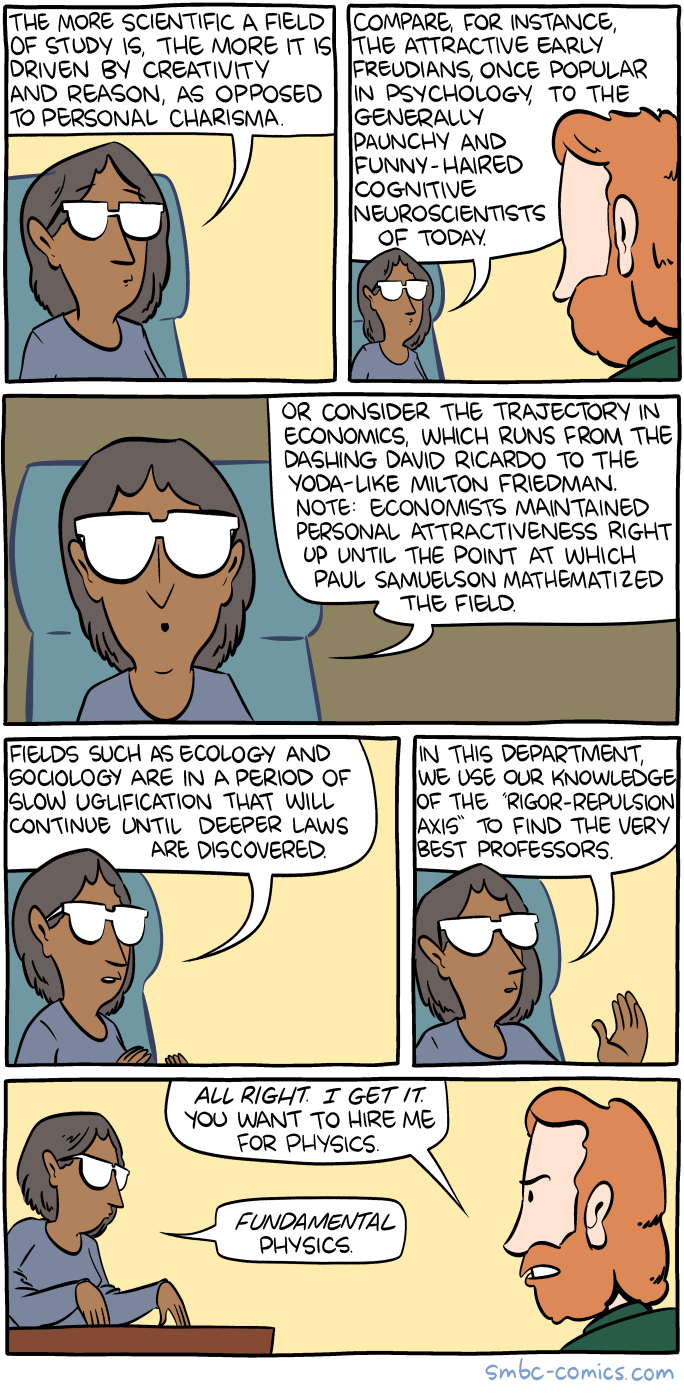
I'd argue the difference is how mathematized a field is, probably along the same lines as SMBC:
I’ve taught mathematics for over 20 years in higher education and I strongly disagree with your view on the relative ease of learning math on one’s own. Let’s take a simple example. Here’s the distributive property for rings:
a(b + c) = ab + ac
It’s easy for me to convince someone that because of this property we get the following:
3(x + 2) = 3x + 6
It’s much harder to convince someone that
3x + 6 = 3(x + 2)
It’s hard to convince someone that factoring is just using the distributive property reading right to left instead of left to right. It’s much harder to convince them of this just from reading it in a book. The nuance will be lost. They need examples that one goes over in a classroom to see this and a book can’t contain enough examples without being too many pages or without boring the reader with what appears to them to be minutia. They can’t grasp the nuance from reading. They grasp it from doing problems and being guided on the problems at the time they do them.
Books and videos can not replace a teacher. Your experience is not the norm and you should not use it as a guide for what is realistically possible for most people.
this has been doing rounds on twitter how people do not have grasp of basic maths and it points out a good argument for people who have been taught "good basics"... like i recently asked a doctor who says they are bad at maths and they just blurted out 3. i asked why and they responded, "uh.... bodmas?"
its such a small thing really, like in your primary and secondary education, of all the classes you attend, this is just a tiny tiny topic that must've been taught but because you were taught its importance and use it as a building block early on, it just feels like second nature.
like the tables of 2-9. pretty hard for kids to remember but once they do and they are taught to HOW to use it, it really helps them
I think this is an apples to oranges comparison. You get taught pemdas or bomdas early on and then use it hundreds of times throughout school and the rest of your life. The value of learning it is clear.
Whereas ring theory is very much specific to algebra and you're not going to use it programming, doing chemistry, or whatever else outside math. Finding motivation to learn pure math is a bit harder.
GP's example illustrates a good point. I agree with their point.
I think that OP's fundamental error is talking about school vs university. When I started my bachelor's studies in math the professor covered 3 years of high-school math in the first 2-3 weeks of the first semester.
Up to that point I too thought I could just learn by reading the textbook. University (assuming a good one, mine wasn't world famous but has a good reputation nationally & in Europe) level maths is completely different level than high school level math, and having access to the professors makes a big difference (although I was often the only student coming by at their office hours if it wasn't before a test, so I guess not everyone agrees with that).
If you're talking about me (GP not OP); when I said "school" I meant during my undergrad at a university. I'm claiming that I skipped 2-3 years of math at university by self studying, specifically 2 years of analysis, 1 year of topology, and some algebra.
You can absolutely do this for university math using textbooks if you're motivated enough. Which I was.
Sorry for the colloquialism. "School" means university in the U.S. tech industry, but apparently not in Europe.
Edit: Reply to child comment before I log off. Haha I agree. The really valuable things I learned from math professors had nothing to do with the curriculum though. It was more like stories about all the people they saw going crazy trying to get tenure, ultimately failing and then seeking revenge against those who denied them; how they all go to conferences sometimes and drink very heavily afterwards in the nearest bar; and just little colloquialisms. Math academia was a really interesting subculture of very interesting people.
No worries! I think for undergraduate studies I’m sure you can. Although motivation levels of “motivated enough” have to be pretty high!
My experience was that pretty quickly professors (and TAs) provided insight and guidance I couldn’t (or at least didn’t) get from just reading the textbook. But also that this increases the further you go in your education- in a 200 student auditorium class for linear algebra or calculus the professor isn’t going to be giving you any individual attention but in my school even by the 3rd-4th semester classes were already often small (15-20 students) and we had actual conversations with the professors about the material (and beyond).
I agree with you except for the very last point, that "students need to be guided on problems at the time they do them". I think this issue is fundamental to the tradeoffs of self studying that I've experienced. I want to point out: the guide doesn't necessarily have to be a human. And textbooks accomplish this by giving examples that walk through how to solve problems similar to the exercises. Unfortunately this is a useful secret about textbook and problem design that is not common knowledge to students. (I.e., the principle of charity, principle of relevance, Chekhov's gun, etc.)
I agree with the point of your example, but maybe not the choice of example.
For your example, Gallian (which imo is the standard intro algebra book) includes this property in the definition of a ring: "Property 6. a(b + c) = ab + ac and (b + c)a = ba + bc". (Probably in order to disclaim the confusion you're talking about.) Then he goes on to derive 6-7 other properties of groups that will (of course) be useful in the exercises.
I definitely found it's really important when self-studying to pick the right textbook. Definitely you have to be an experienced educator to write a good book that anticipates most of these things. But I agree that it's impossible for any textbook to anticipate every place someone reading it might get stuck. Let's say for a given student it happens 5-6 times in a really high quality textbook like Gallian or Rudin PoMA. They have 3 options (1) ask on mathematics.stackexchange.com and probably get an answer because it's a great community, (2) try to figure it out themselves, or (3) pay $600 and invest 3h/wk to take an algebra class that might cover the first 1/2 of the textbook in 4 months.
I think where we disagree is what are the constraints of the tradeoff between attending a class vs. reading the book. My experience has been that, if the subject is interesting enough, reading a good quality textbook is cheaper and 2-3x faster than taking a course, but at certain points it can be much more challenging. I think where it depends on which student is how much more challenging, i.e., will they be able to dig themselves out of those holes in a few minutes or a few hours. I was personally in the middle of these two extremes, but I still thought it was worth it to self study after taking 3-4 classes in the math department, then I skipped a bunch (7 semesters) of analysis/algebra/topology and came back and took 2-3 grad courses, where I didn't really understand the main goal of the subjects until I took the classes. And then I went into CS industry and never used any of it again. But I don't regret the experience; it was legitimately interesting to learn about math.
I think you have to be legitimately interested in a subject to self study it successfully. But that's true about studying serious math in general though: you have to be unrelentingly into it, or else you're just really misguided and shouldn't be there, given the high competition, poor odds for any future in math, and no practical use for any of the theory.
That's my experience with it and why I made the argument that I made.
I think your quote from Gallian doesn't address syzarian's example, actually.
The two properties you quoted are about the fact the distributivity works whether you're multiplying on the left or on the right. That's one possible left-right confusion, but I would argue most weak students believe it holds even when it doesn't, so in a sense they're too permissive in their reasoning.
However, syzarian's example is about a different left-right confusion: whether you can read an equality both forwards and backwards. I've seen this confusion in students: they will readily believe that you can distribute a factor over a sum (going forward), but be very skeptical about the act of factoring out (going backward), even though it's justified by the same equation. In this case, the students aren't permissive enough in their reasoning.
This is the kind of misconception (that equality has a "direction") that's much easier to suss out with an in-person interaction, whether it's with a teacher or other students.
Oh. Wow, you are right. I honestly just read the definition in Gallian wrong, and then, even as I was typing it, I swear I thought it said "ba + bc = b(a + c)". What a crazy experience of confirmation bias by me.
I obviously agree that a human is extremely effective at explaining that "equals" is symmetric and not the same as "implies". I'm just arguing that the task also can be done in prose to similar, if inferior, effect.
I did agree however that because math has so many gotchas like this, then no textbook will ever disclaim all potential sources of confusion like the example by GGP. And so our discussion boils down to the tradeoff between the price and time investment of taking a class vs. the increased difficulty of self-studying. And how different people assign value differently to each side of the tradeoff, which I claim is the root of our disagreement.
My example was geared toward those people learning beginning algebra in 9th grade or so or the great many students who place into pre college level math during their first semester of undergrad. I used the word “ring” because as I was writing my comment I didn’t want any readers to think my example only applied to integers, or rationals, or reals. So I said “ring” trying to capture a nuance that very few people would appreciate.
I contend you are an outlier in the extreme. I think very few people can read a math book and get anything out of it unless they have had training. For one thing, in lower level math we lie to students all the time. We just can’t be honest about things because students at that level can’t appreciate the insane number of nuances. For example, ask a first year calculus student what “dx” means and their answer will be complete nonsense but they don’t know that. We can’t tell students what “dx” really is because it is quite beyond their level of understanding.
Thanks for the discussion. I appreciate your perspective.
I feel that this comment misunderstands both hard sciences as well as social sciences and humanities. My wife is a historian. The idea that the way to succeed in history is to just make various influential people like you since there is no actual "correct opinion" is just rank bullshit.
And the idea that in, say, computer science, that there is precisely one correct approach to a given problem is also completely bogus once you've moved beyond trivial questions.



Seems like the reason for not treating in general is that human guts are already infested with all sorts of relatively harmless bacteria (and protozoa, etc.). And the drugs to treat toxoplasmosis, which are certain antimalarials and antibiotics, carry some risk. A big risk is that, if you nuke your gut biome with 1-3 antibiotics for everything you get infected with, and they develop resistance which spreads horizontally, it could prevent antibiotics from saving your life when you're infected with something serious.
That being said, if there's a link established between t. gandii infection and suicidality, I'd speculate you'll see lots of pressure from the public health folks for treating all infections.
This is not medical advice and I am not a doctor. I have time to sit in an armchair and argue about toxoplasmosis on a Friday night. Please take that into account.