Thanks for the informative post. In America, I frequently see/hear the diesel engines idling all night at rest/truck stops. Smart cruise control that coasts perfectly over the top of a hill sounds great, but if the driver leaves his engine idling for 8 hours so he has ac… feels like that matters more, no? Has there been any sort of push for batteries or solar to power the sleeper cab amenities instead of running that engine while not driving?
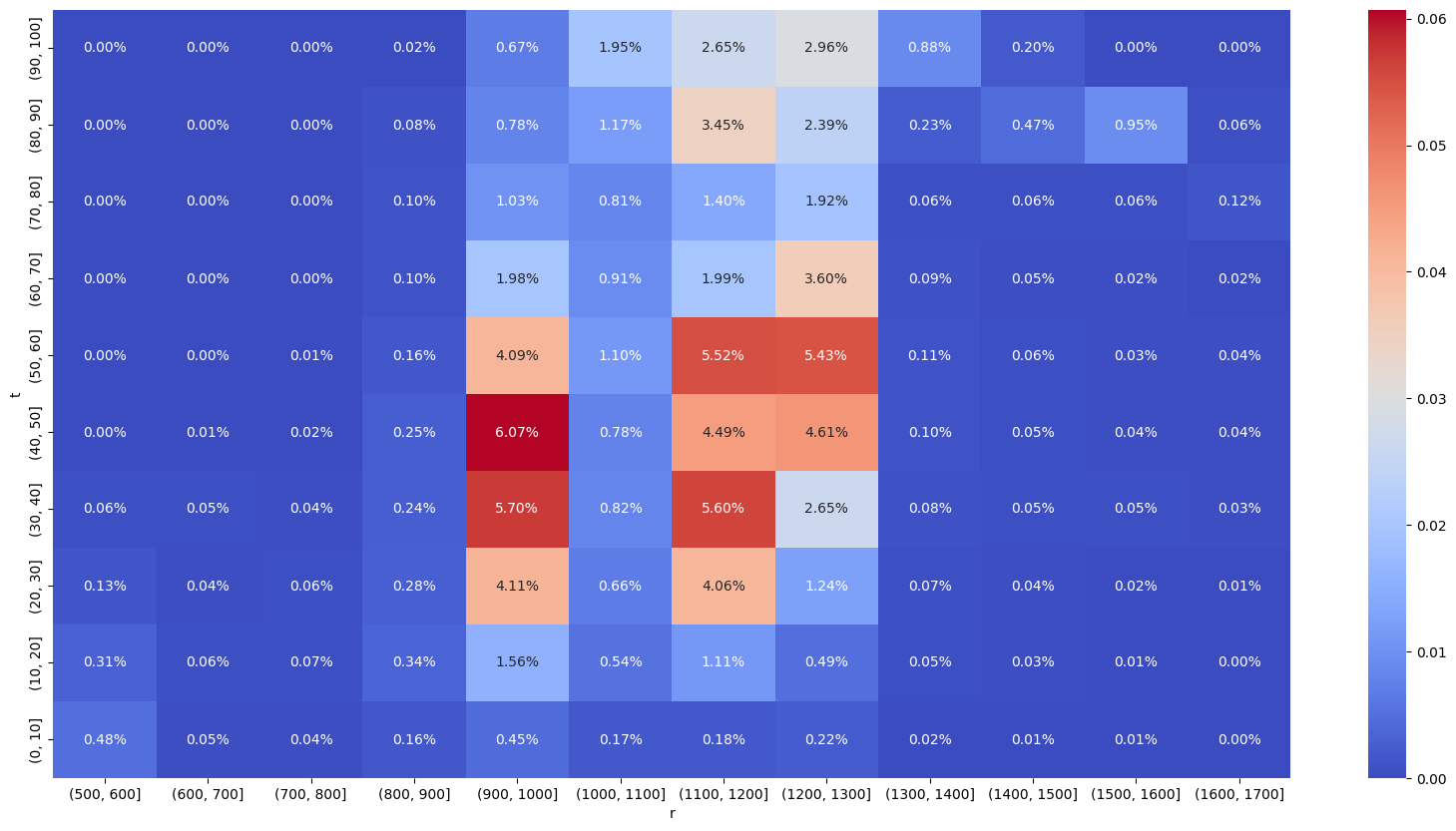
So, here is approximately a weeks worth of data (around 700l of diesel), looking at the histogram on the right hand side, theres an awful lot of time spent at 0-10% this is around 60% of the trucks time.
However, when you multiply the time by the fuel consumption within that same time period, you get a volumetric chart, where we can see that 60% of the time, accounts for only 2% of the fuel use.
So, for idling, whilst it's noisy, produces CO2, a 5% improvement at highway speed will get you so much more of a fuel and co2 saving than eliminating idle. although, both, do both.
Roger that - thanks for the OC graphs. In the first chart, the sloping cluster of data points, is that just the max torque output of the engine then? And the vertical clusters at ~950, ~1050, and ~1110 - can we assume those are some sort of cruise control or gearing outcome?
Also, your 28.5M+ miles driven is such a great stat - thanks for sharing this knowledge!
Correct, the engines will have a peak reported torque at one particular RPM, usually quite low (maybe 900RPM off the top of my head), at higher RPM, the peak torque may only be 90% of the peak torque, but at 50% more RPM, you end up with (100 * 0.9 * 1.5)=35% more 'power' despite the torque being lower.
This is detailed in J1939 (canbus protocol) PGN (parameter group number) EC1 (engine configuration 1) if you fancy a rabbit hole.
The vertical clusters will be a combination of gearing and cruise control, exactly. At the vehicle speed limit in the top gear (usually 12) most trucks will cruise around 1200rpm (exception being the scanias with supercruise). It's likely this truck did a lot of urban driving or was in average speed zones.
You also get a lot of drivers (suprisingly more younger than older drivers) that are happy to set it at 53mph, get the green tick for the telemetry to try and get a bonus, but then have a really low stress drive. It creates a bigger speed differential so they can be overtaken by other trucks easier, and realistically results in 10-20mins over a 10hr shift, to some, a 10hr chilled out shift is better than 9hr40mins of pushing it.
A lot of the time, the idling you may hear next to a truck that's parked up on break may actually be a refrigeration unit. Most fleets have telematics that would give a driver a red flag if they idled excessively, a lot of trucks even turn themselves off (although it's easy to bypass).
But unless they are mandated, an idling truck uses <1 litre per hour, assuming AC over summer months only (as they will have a webasto style diesel heater for the winter), results in about $1,000 per year in idle fuel. Assuming a fleet has their vehicles on a 3 year rotation, the APU needs to be $3k or less, with zero failures for it to be economically worthwhile. (additionally, the charge for those batteries needs to come from somewhere, you can do retarder/brake enabled alternator charging which would help though).
So unless mandated by carbon emissions targets, the lower risk option is just to burn diesel.
However, at around 1k litres per year, that's around 2.5tonnes of CO2, so if cost isn't a lever that can be pulled to change this behaviour, CO2 may be.
Many trucks have auxiliary power units (APUs) -- essentially small generators -- to power the AC and other house loads at rest stops. Some states have anti-idling laws.
I don’t read popsci but if you’re interested in a rigorous treatment I’d recommend The Human Career by Klein which has the broad overview and The Human Past edited by Scarre which is more of a textbook.
I mostly just read the papers as they are published but I’ve heard good things about those two books (they’re on my reading list but I haven’t read enough to form an opinion)
It is so wild to me the idea of large enterprises that rely on the big "old" databases (db2, IMS, vsam) - on one hand, I think "there must be a whole devops crew that supports these on-prem systems that are super old and unique" and the other hand is "they must be pretty reliable for the task at hand and no one wants to touch the migration project to update." Which makes me think these are still in use at the biggest and oldest enterprises( banks, government entities). Would love to hear any anecdotes from folks who work on those today.
A DevOps crew? Mainframes aren’t something that are just part of some random web app project in a company. A System Administration team would be the likely maintainer. But a lot of mainframes are designed to be run with very little manual maintenance these days.
They’re also wildly different architecturally from your typical rack of x86 servers, which is why the initial reaction to Linux running on a mainframe sounded stupid at first. When I worked at IBM in the 2010s, a Linux Zserver felt more like a VM running inside the mainframe than anything else. There were abstractions of the mainframe components that intentionally leaked into the Linux side that were interesting. I knew very little about traditional mainframe software development at the time, so I was very fascinated by how it all worked.
I don't have firsthand experience but I do know that IBM mainframes (Z-series) are still actively developed and lifecycled. Whether this is purely financial (as in: we keep the customer locked in to our ecosystem regardless if there are alternatives available which offer the same level of robustness etc.) or the platform really is better suited to the specific requirements set by banks, government agencies etc. remains to be seen..
The article claims it helps stop condensation, but I have several memories of little ice crystals and/or condensation that originate right at the little hole…
holy hell google cloud is so confusing i just ended up using (a much more expensive) digital ocean droplet instead for a little project. I guess they only really care about enterprise customers who can burn tons of money figuring it out, but it made me never want to use it again.
Same with google ads - super fuckin shit UI/UX, super confusing to understand what is going on.
companies like digital ocean, supabase, etc can make money (from people like me) because they just circumvent the bullshit or wrap the dogshit experience (aws) into a much better experience. bless supabase.
I’m literally afraid of the cloud console dashboards from the big providers. That’s especially true with the quagmire that is AWS.
It’s so easy to leave a resource turned on that you are no longer using, and so hard to tell which resource belongs to which project, or have high confidence you set up permissions correctly. They have multiple products whose only job is to monitor and configure your AWS accounts. Multiple. That’s not a brag. That’s an admonition.
Digital Ocean, Hetzner, Render, etc, seem to have figured out how to rent millions of dollars of computers and services out every month without requiring you to become “certified” on their platform.
How is their managed Kubernetes product nowadays? I've realized all I really use on GCP and AWS is managed Kubernetes and Postgres, and I feel like I must be overpaying particularly for GPU instances.
Baring them using specific marketing terms (so you have EC2 for what are basically virtual machines), for which both the docs and the portal itself provide helpful information, what do you mean? I find GCP's console and whole set up to be slightly better, but both it and AWS are fine.
Now Azure, or anything made by VMware, you just know they hate you.
I agree that Google's console is slightly better, but a few of my gripes with AWS specifically:
1. input fields that lack basic validation so you do some action and then get an error message that is cryptic when simple "if this value selected in drop down, you can't do X". Another example of this is needing to get quota increase for your AWS account for an instance type, but nothing on the frontend tells you that, and you have to go through 3 or 4 weirdly linked support ticket/pages to figure out how to make a request for an instance.
2. As another commenter said, billing - so many pages and ways to cut the data but somehow it still seems complicated to find "which instance is attached to resource X that is costing me $Y per month"
3. Documentation not matching UI - so many PMs/TPMs over the years making resources that you find a blog/post that is a walk through, but then you find they redesigned or moved a button and that makes it difficult to follow.
4. I worked at Amazon for a bit and the internal tools feel like they were built in the early 2000s and I think I have PTSD from that which I still ascribe bad feelings towards AWS as there are similarities
I think as you use it, you start to understand the gotchas and the flows you need to do to get something working. I also appreciate there is a ton of stuff they are empowering users to do and the scale is incomprehensible, but just frustrated the UX is so poor.
I just started using Azure for another project and my goodness, I can't even login to that vs the microsoft ads account w/ the same email because of some weird MS365 permissions issue - by far the worst.
I love how people think Azure is somehow worse than AWS when the latter isn't even a single portal, it's many, each of which shows just one product in one region. Oh, you needed a VM with a network and some storage, including access to blobs somewhere else in the world? Just open up a dozen tabs and join the randomly generated gibberish resource identifiers yourself manually like a savage!
> I love how people think Azure is somehow worse than AWS when the latter isn't even a single portal, it's many, each of which shows just one product in one region
Yep, which means that even an entire AWS region being down has no impact on anything else. Unlike Azure where a single DC in Texas being out meant no auth for anyone, anywhere in the world.
And aren't Azure and O365 infamous for having a convoluted web or multiple portals to such an extent that there are multiple websites trying to help you navigate them with direct links?
And in any case, Azure is not a serious cloud provider and anyone picking it is at best not paying attention, at worst negligent at their job (yeah I know, Azure is the cloud your bosses' boss picks after some golfing and a nice dinner). They have a ~quarterly critical, trivial to exploit, usually cross-tenant, vulnerability. Often with Microsoft having no mitigation and having the the faintest idea if it was exploited. And stalling the security researchers for weeks if not months.
The security posture of Azure is so appalling it's clear nobody at that org who has any power cares about security in the slightest. And it has been obvious for a few years now. Search Wiz's blog just for their collection of ~10 Azure CVEs. For the latest horrific one, cf: https://www.cve.org/CVERecord?id=CVE-2025-55241
Although Azure just randomly fails, and then it turns out it actually worked but the UI had failed. But then the next step throws an obscure error message, but you get around that on a different screen, so on so forth…
The really fun part was after getting billing finally set up in the cloud console trying to find what model name you actually have to use to call it via the API.
Conflicting information? Sure! Gemini cloud help being useless? Naturally.
Oh and don’t forget that error message being returned when you try to call the API is because you didn’t give your project the proper permissions in google cloud console. What permissions do you need? ¯\_(ツ)_/¯
Google Cloud Console feels like being stuck in the seventh circle of hell.
This outage was affecting developer.apple.com and pushing iOS app versions to test flight/production. I thought I was going crazy, thanks for posting this.
This comment made me question the specifics of my mental model pushrod vs overhead cam engine. I found this site that has three nice gif’s which was exactly what my visual brain wanted to see for comparing the differences - https://www.samarins.com/glossary/dohc.html
Thanks for the comment as it was the impetus for me to expand my engine knowledge today!
Well said and exactly my thoughts on it as well. Eric has done more than he really had to, and it is unclear to me what rebble really wants/is positioning for.
Thank you for posting this, it really gave me an answer to the "huh, how did all that drama from last week play out." IMO rebble jumped to some conclusions and felt robbed/cheated by what Eric was doing. With Eric going above and beyond to open source everything, I really feel he is trying to live up to what the original promise of pebble was. It is cool what rebble did to keep the pebble community alive, and I get that they might feel slighted, but if you take all egos out of the equation, what Eric is doing is like the best possible outcome - we get new pebble devices. Isn't that the best possible outcome?
Slight correction, apparently Eric posting one of those WhatsApp screenshots was not okay with the person on the other side (who iirc is a rebble guy), who added that those grievances he had were taken out of context in the screenshot.
The pebble (or rebble?) subreddit had this in the comments if anyone wants to read more.
As always, the truth appears to lie somewhere in the middle, and while this does appear to be more of miscommunication than malice, it's a bit disappointing to me overall.
I see it as the melodramatic theater that goes hand in hand with the development of tech we love. Linux lore is by all measures filled with these types of moments, and as time goes on there are moments of peace and moments of chaos. With any luck the end users live to see another day of tech or software they enjoy. It’s part of our story as humans.
Eh. imo this is a hard moral high ground to claim if you publicly (and falsely, as we now know) accuse someone of a crime and threaten legal action in a blog post
If I go to amazon autos, I see more than just Hyundai and Ford pre-owned certified cars for sale - I see toyota, chevrolet, kia, jeep, honda, etc. I guess this announcement is an official partnership with Ford corporate, but I assume smaller dealerships could have integrated before this.



reply