Every power user of LLMs thinks that they are the ones that know how to hold it correctly, in reality they usually have major Dunning Kruger and are convinced they're living in some hyper productivity mode when actually they're all just copying each other making low effort slop that all sounds the same, looks the same and does the same things.
For the record, the comment you deleted was something to the effect of:
checks notes
The company you work for is committing genocide. You should be locked up in a concrete cell for 10-15 years for working at <wrong robotics company because you're a dufus>
---
Maybe get better notes? Or try going offline for 10-15 years?
No offense, but if you think your using AI in the development and design of your site, voxos.ai , gave you a competitive advantage it didn't. I can instantly tell when someone used an LLM to build their whole site and lets just say... Its not a good thing.
I'm not even trying to be mean, although it probably comes off that way. I'm just saying we live in a world with handmade watches from Switzerland and mass manufactured watches made in Vietnam. Nobody cares about the mass manufactured watch from Vietnam, whereas the handmade watch gets all the attention (and money). We now live in a world with the same dichotomy of software. Be creative with your pursuits, put effort into them it will pay off.
It may be the case. I've been around in the industry for 25 years and I barely code. I babysit multiple instances of Claude and we were very purposeful and deliberate in altering our workflows for it; we made our local dev environments capable of spinning up multiple instances to work from parallel worktrees. We added MCP servers to let LLMs observe our CI, Jira and deployments.
Most of our time is spent doing spec work, planning, and injecting the proper context into LLMs. Like the OP, our metrics have drastically improved the time for delivery of new features, slightly improved bug resolution times, and now we're bottlenecked by needing more code review and manual QA to handle the workload.
Why is there manual QA step? If AI was that good you would go straight to prod. Actually have agent deploy live with full control over the whole production environment.
Insurance systems with dozens of integrations and multiple iterations of UI frameworks with QA that has deep domain knowledge who understands how the pieces interact with each other in ways most devs don’t.
Sure, if you want to get crazy with it you put prepaid phone in another location, put it on your Tailscale VPN then proxy all traffic through the prepaid phone with something like: https://github.com/kost/revsocks
Phone doesn't even need data if you have access to wifi wherever you stash it.
Whole idea of "put phone in location X" alone is much harder to implement than to buy 5, 10 or 100 VPN account or servers with crypto and setup how you like.
Like you need to physically be there, need ability to connect phone it to electricity and somehow maintain if it e.g reboots. And stay anonymous while doing so? I'd say that Hollywood kind of solution.
I'm having trouble finding dictionaries or other references that add the qualifier that it needs to be self-tested and not relying on the research of others. Can you point me to one?
Watching the entire economy of a superpower bet its entire future on SOTA text autocomplete models has been interesting to watch (which I think you're referring too).
Previous Empires naively bet their entire future on the words of magicians, or people who claimed they could look into water, the sky and fire and tell you what the future is going to be.
Machine Learning Engineers are the modern day Empire's court magician.
we live in a closed greenhouse system, the water just doesn't just disappear and most of the Earth is covered in it. Plenty of countries completely rely on desalination already, I think we'll be fine. I'm much more concerned about everyone becoming a moron from using AI.
Kansas cannot run on desalination plants ... there's no salt water. The gulf coast of Texas is 1000 miles away.
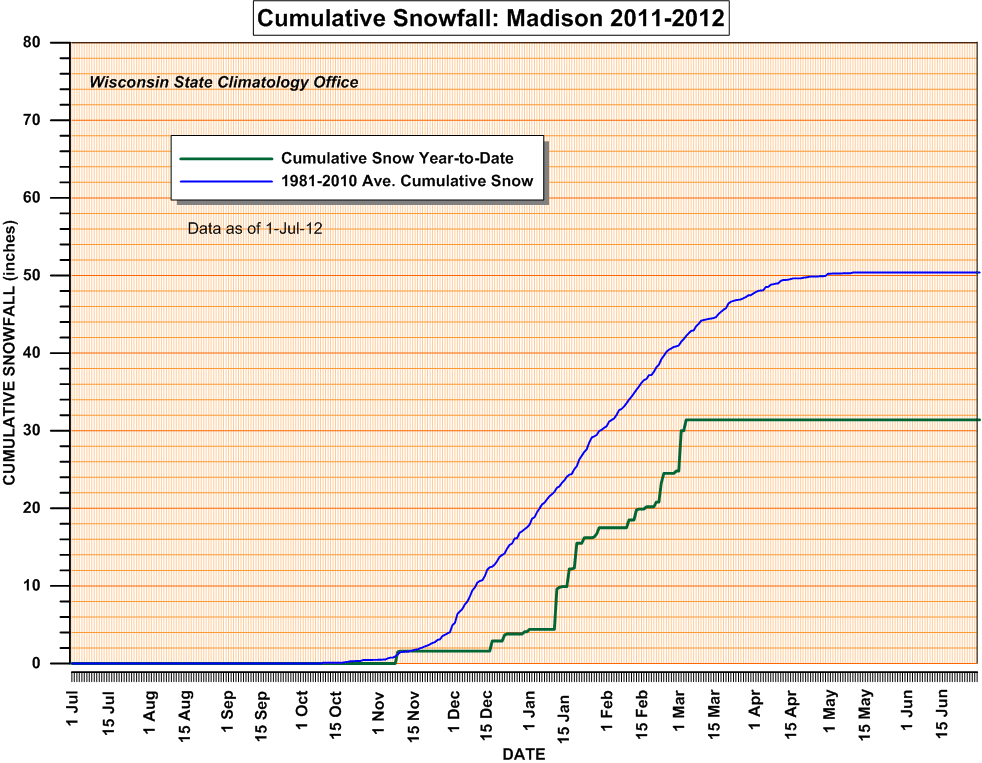
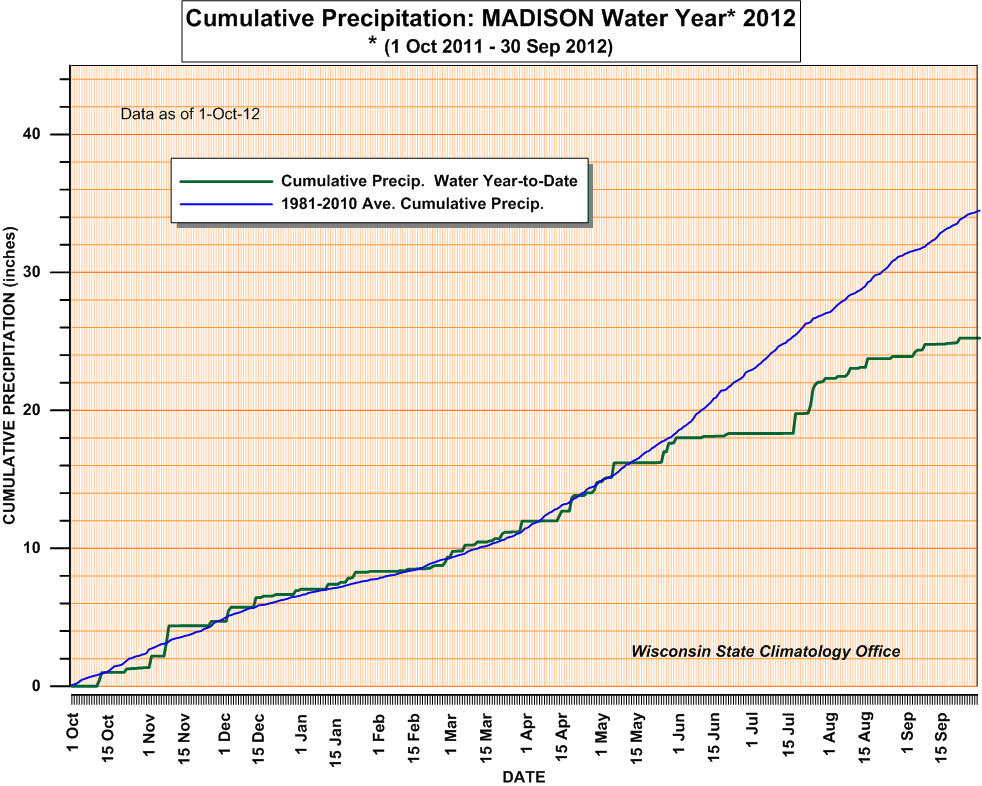
While aquifers do regenerate (Groundwater levels in the Kansas High Plains aquifer see first overall increase since 2019 https://kgs.ku.edu/news/article/groundwater-levels-in-the-ka... ) I'm going to point out that news article has seven years of declines previously.
And what the fields looked like ... http://www.wcwcw.com/feature96.html (also has a national map, and all of Nebraska, Kansas, Iowa, Missouri, and Illinois were in bad shape - Wisconsin looked pretty good by comparison in that map).
The problem is that aquifers are really cool natural filters, and only refill as fast as groundwater moves through the soil. So they're a finite resource. Instead of depleting them, people who want to farm in deserts should probably start desalinating or whatever themselves instead of assuming subsequent generations will do it.
The government made it literally the only way to claim much of the land out west[]. They require that you come up with an agricultural land including plan for watering crops on that acreage in order to claim the land. And you're required to execute the plan to get the deed.
In fact, this is the only remaining way I know of to more or less 'homestead' federal land in a way that results in a permanent deed. The rest of the homesteading type stuff was revoked back in like the 70s or 80s.
AFAIK it's been available since the 1870s but after the 20s they clamped down a lot harder on ensuring you were actually irrigating it and had agricultural plans.
I'm not sure if the BLM has relaxed their discretion under Trump.
Do you think laws go away just because they're old?
The Colorado River compact came into effect in 1922 and I'm almost surprised literal fist fights haven't erupted over it during the modern negotiations.
I’m no lawyer, but according to my perusing (sourced directly from the BLM), the 1877 Desert Land Act is very much obsolete.
The age of a law does not matter with regards to its validity, you are pedantically correct. But it very much matters to its relevancy, which was my argument. Laws regarding horse traffic in Manhattan may still be valid, but a lot less relevant than they were hundreds of years ago - assuming they haven’t been repealed.
Regarding the “Colorado River compact”, I would say my qualifier of “quite niche” is important. Ownership and water rights over the second largest watershed in the US by affected population is far from “niche”.
On the other hand, how settlers can claim public land in the desert (which happens incredibly rarely now, by design) is quite niche.
Even if you presume it's obsolete, the fact remains the land was distributed under a model where it had to be claimed, developed, and irrigated for agriculture. The water distribution and well systems alone required for agriculture far surpass use for residential purposes, for example, but once you have wells and irrigation suitable (not cheap in the desert, and also valuable) for agriculture it may be more economical to just keep going with it. The momentum of that remains and the economic incentives aligned with those policy choices remain with us as to part of the reason why desert land is used as it is. The first developed use of land can have a lot of influence on what happens next, it's quite different from starting from an undeveloped state with pure free market forces on development.
Qatar, Kuwait, UAE. And these guys rent out tons of farmland in the USA to grow crops because they can flood irrigate and get five crops of alfalfa a year to feed their livestock.
Plants require a ton of desalinated water and Animals who eat plants as such require desalinated water too.
There are countries in middle east like UAE, Saudi arabia etc. which rely on desalination but they are relying it for the clean drinking water, not for the food generation. They import almost 90% of their food iirc.
The amount of energy required to desalinate all water and the environmental impacts to get that energy would literally be quite catastrophic and I am not even sure if it would be even feasible and food prices would literally skyrocket or food would simply be produced even more less by magnitudes of order.
Alfalfa/hay uses so much water that cultivation of it is banned in Saudi Arabia. They import large amounts from the US - basically we're exporting water.
Desalination isn't really much of an option for deeper inland and much higher than sea level areas. Tell me, which ocean is Dodge City KS going to pull from?
and desalination is so efficient/cheap at scale already that it barely affects water prices in those countries (less than 10% already, further shrinking every year as methods improve)
This is by far the dumbest post in this thread by a mile. It's funny saying AI will make people dumber when you've obviously don't understand this issue in the first place. Food security is human security. When you take a huge percentage of a countries grow able land out because it stops raining then food proces go up, often dramatically.
Desalination uses far more power than AI ever would.
we live in an open system at any scale except the whole universe and even that is gaining energy
the earth is slowly losing both hydrogen and oxygen, and has tons of energy coming in from the sun
into the scale of a field, or a state or a country or a continent, theres very obvious flows of the water cycle introducing water via rain/snow, and removing it via evaporation, seepage, and rivers.
the only closed system is if you make one of those wine fermenter biospheres, and even there its open to energy coming in via light
The energy required to transport water from the coast to our major agricultural areas would be astronomical, and the resulting brine waste would create its own environmental crisis. If we get to a point where we're forced to bypass natural water cycles entirely, our native ecologies will have already collapsed. At that point, we'll be trying to engineer our way out of a total ecological apocalypse as masses starve in bread lines.
3k is like 1/50th of the penalty you're going to get if you make a mistake on your taxes, trust me I know, and Anthropic isn't going to be covering those penalties.
IRS is going to make a ton of money off you naive people. Get a better CPA who's not committing malpractice like your current one.
Not sure why this is getting down voted. You will get audited 3 years after the offense and they will charge you interest higher than the worst credit card for those three yrs (during which you had no clue you offended). Be fool and replace your CPA with your favorite text autocomplete machine learning model and let me know how that works out for you.
The downvotes are because my post was clear and they did not understand the point. We did not replace our CPA. We replaced the book keeper. The human CPA is the human in the middle reviewing the work of the AI. There is no responsible business owner alive today who would trust an LLM to replace their CPA, IMHO.


reply