In every city I know of, the parish for public transit more than pays for the cost of collecting. Also, in every city I'm aware of, even the ones with high transit ridership (Tokyo), there is lots of room for adding more transit and getting even more people on, but money is lacking to do that.
I'm also aware of no place where people who use transit to consider cost one of the major barriers to using it more. The barrier, even for the poorest people, is almost always not cause, but the service just doesn't meet their needs. Which is to say most transit systems need to raise their fares a little more and use that extra money to give people the service they actually want.
Yes but Qt comes with the drawbacks of being tied to Qt.
With Electron + React, you'd be able to rip out any components you need and place them in other web apps. The browser is (psychologically) avoiding vendor dependencies to a greater degree than other options.
Each of those hundreds of transit agencies are small, but many of them cover populations similar to Switzerland. Some of them cover much larger populations. They should be able to do what so soon as doing entirely within their little agency and yet they are not.
This is completely backwards read Marx. Superstructure (culture, politics) flows from the economic base (there are some important exceptions, but that’s the dominant arrow).
While building codes are different, those are not different enough to explain the difference. I've seen plenty of people try to propose layouts for apartment buildings that would meet the U.S. requirements and be much cheaper, but no one builds them, even though they should be legal.
The real problem is families in the US don't desire apartments and so no one builds apartments that families would desire to live in, thus perpetuating the problem.
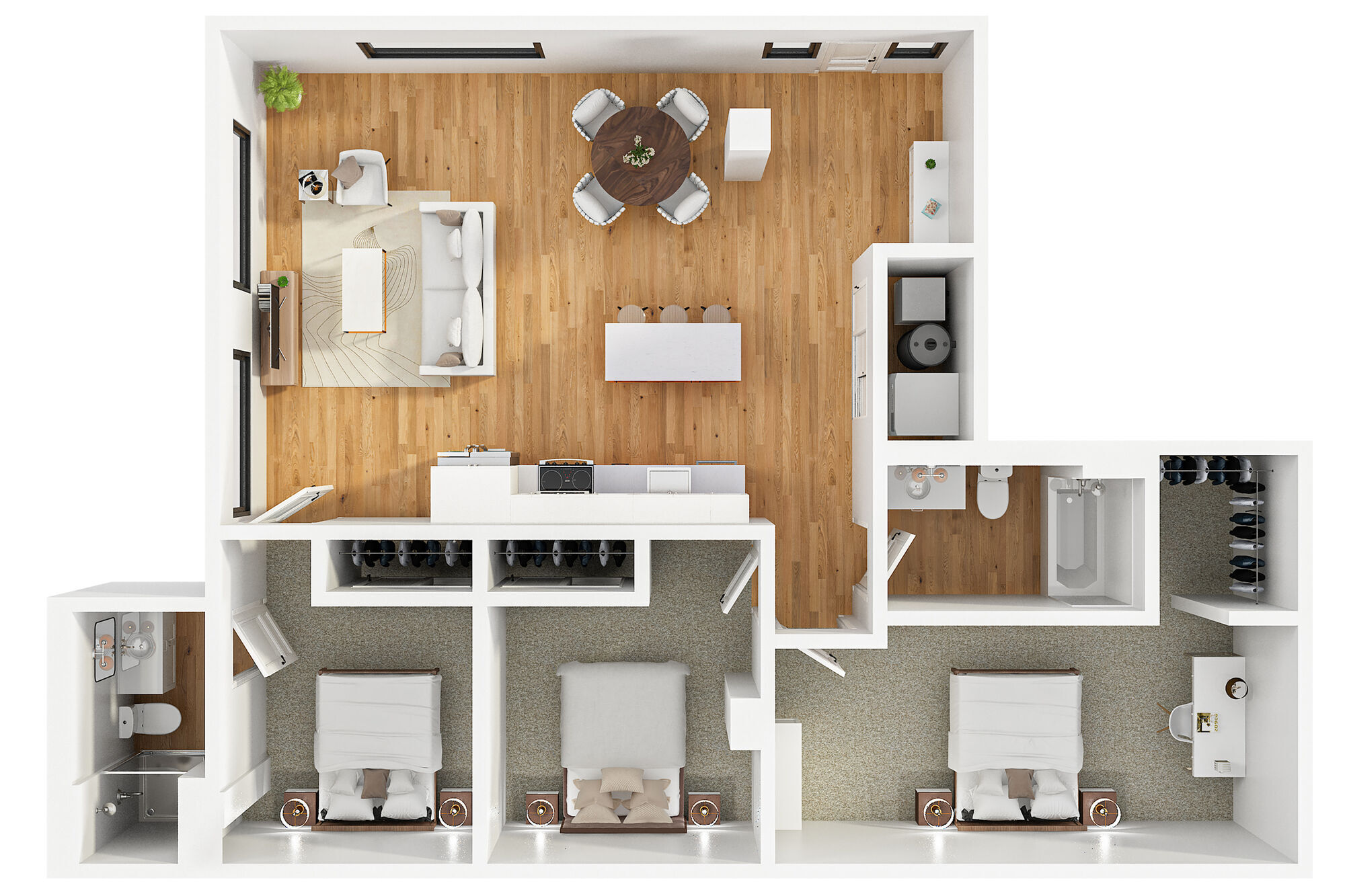
You should be looking places other than California before asking this question. In my suburb of Iowa we have apartments that are very similar to this one as far as sizes but the rent is much cheaper. There are also a number of three bedroom apartments in those new buildings, for much more reasonable rent. These apartments have the large parking lots required in the U.S. They have the large elevators required in the U.S. They have the dual staircase required in the U.S. I guess they don't have windows that provide cross ventilation, but realistically in a modern building, insulation is so good you don't need those, and our climate is enough harsher than most of Europe that you will be using HVAC most of the year.
As soon as you look at comparisons like this that are also in the US but somehow managed to be much cheaper, you realize the problem isn't whatever this analysis is about. It's got to be something else.
I moved to California from Nebraska, so I'm well familiar with what you're talking about. And while that's true, it overlooks a few things:
* My salary:housing ratio is better in California than in Nebraska. I have to work fewer hours each month to pay for my home here than I use to, for roughly similar niceness.
* What is spendy is services, like paying someone to do work on the house. Those workers make more here, too.
* On a side note, anything you buy from a national retailer costs the same in both places. An iPhone or a minivan both cost $X whether you live in CA or IA, so I only have to work about 1/4th the amount of time to buy a new phone here as I use to.
Yes, the cost of living is a lot higher here. Especially for those in tech, in my experience the pay difference far outweighs the cost difference, even including housing.
Nebraska housing is actually a bad deal given the wages. It's cheap by national standards, but my wages doubled moving from CBIA to Chicago. Rent in Chicago is of course much higher, but adjusted for income, my place is way nicer and actually a similar portion of my income
Preach it, neighbor. And nothing whatsoever against NE or IA. Those are nice places to live with a lot to commend for them. Still the low cost of living is kind of misleading unless you’re on a fixed income such that moving elsewhere would raise expenses without raising pay.
Yeah i mean, i get why my friends with kids didn't leave, but at the same time, i would so much rather raise my kids in Chicago. Some of them i think are starting to realize the same, as they come out to visit.
Des Moines and Omaha are pretty good, though. I'm especially partial to Omaha. However I personally still wouldn't live there by choice, either one. But i know people that are happy in both all the same.
I'm Googling for "Des Moines apartments" and clicking on any that I find that have double loaded corridors and so far I'm 0 for 4 on finding any that have a three bedroom apartment.
I disagree on HVAC: i have proper ventilation on both ends of my apartment, if it's under 75 my apartment never gets uncomfortable with windows open on both ends, and i grew up with 69F Des Moines houses.
And in Des Moines, you HAVE to drive, you HAVE to have parking at home, everyone owns a car, there is no alternative way of living.
Where i live now, i have a car, i still live in an apartment, i can walk to the train or the bus or the grocery store or the bar, and i still use my car sometimes, but if i couldn't, i wouldn't really be missing out.
That to me is the problem: places where kids have no room to explore or play, where people's livelihoods are attached to their ability to maintain a car, where people on foot are treated as second class. That's definitely most of my experience in Iowa suburbs
What is a better option? Before your answer, remember it sometimes really is the case that the economy is down and in two years things will recover and everything will rent out again. Your answer needs to smooth that out.
Rolling average including vacant months as $0? And if that isn't smooth enough, add some smoothing factor, count vacant months as 10% of the last paid value, or maybe the first vacant month as 50% with further months decaying. Or some other fancy accounting that makes more sense than the current method.
"remember it sometimes really is the case that the economy is down and in two years things will recover and everything will rent out again"
Where do we draw the line between reality and fantasy then? If the terms of a deal are not reflecting the reality of the moment (i.e. the office rent market demand quotes) but some figure people come up with on their own, then let's call it what it is -- gambling (in which case it should be treated as such).
Not caring is why we are in this place where rent doesn't go down. Now, maybe it is really is not your problem, but be aware that it is a problem for someone and in turn, you can raise your costs if you are shopping at those businesses. If financials doesn't pencil out, then either the business closes or they raise prices.
> Not caring is why we are in this place where rent doesn't go down.
Not sure what you mean. What I mean is that I am fine with policies that effectively force the building owner to lower the rent (if their net worth is high enough) even if it means they take a loss, because I am fine with forcing people with lots of money to take losses. So the rent will go down.
> The other side of this is that landlords hate to reduce rent to rent vacant spaces because their paying tenants will demand rent reductions or move.
That too is a "it depends". For a failing mall, getting anyone into the empty spaces starts to become important to the other tenants because anything that draws people into the mall is a potential customer. Customers will even no shop you just because they know there is nothing else in the mall. Thus some malls near me have museums and the like inside - anything to get traffic.


I'm also aware of no place where people who use transit to consider cost one of the major barriers to using it more. The barrier, even for the poorest people, is almost always not cause, but the service just doesn't meet their needs. Which is to say most transit systems need to raise their fares a little more and use that extra money to give people the service they actually want.
reply