I haven't experienced anything on the standard 5g/day. I've taken 20g/day saturating for a week straight before too and nothing there either, although by that point there is a bit more "taste" in the liquid. Same taste imo as a pure caffeine tablet, oddly.
The farmer wants the gmo crop. They see the yields they get and go hell yeah. They can't use the seeds next year because these are often hybrids taking advantage of hybrid vigor. These crops get more out of existing fertilizer applications. This is the whole point of them: inputs cost less, yields go up, more profit.
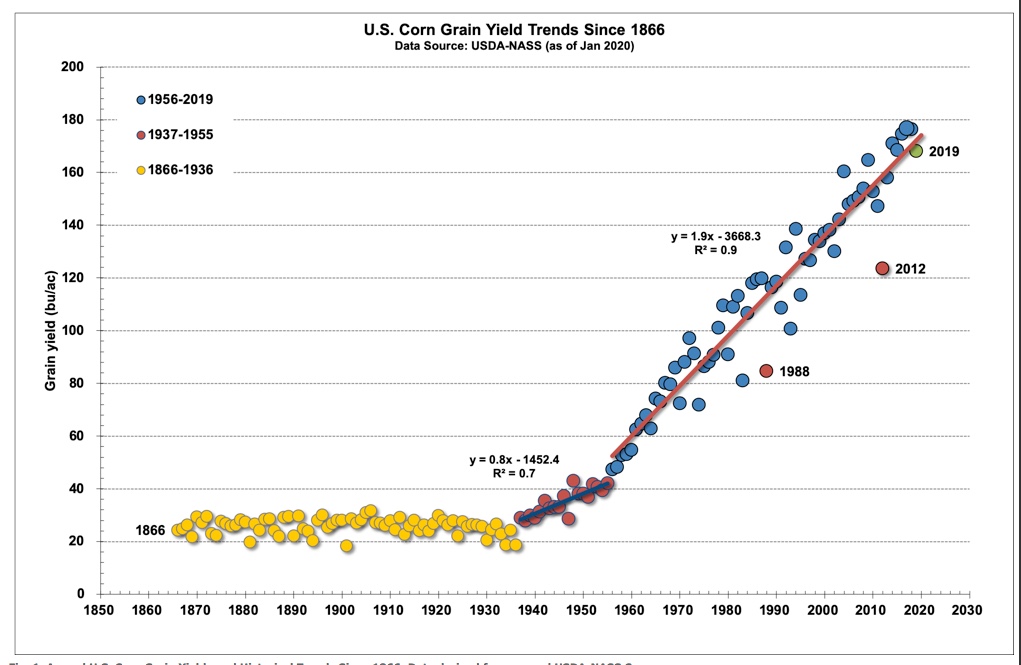
Look at this figure of corn yields per acre (1). Yellow is the "old age" where yields were stagnant. Red is when fertilizer began to be used. Now the huge slope change, has been in exploiting genetic hybrids. GMO allows protection of desirable hybrid traits that might be lost in breeding, introduction of traits to to other strains. Traits of interest are primarily around lessening usage of fertilizer, lessening usage of insecticides, as these are all input costs the farmer would rather not pay especially if they can get the same yield without paying. Thank you GMOs for keeping this linear change in yield even over the last 15 years! Could you believe we improved our corn yields substantially over these 15 years? Remarkable the work biologists do in the quiet of their field.
But of course, lay people just think it is a big conspiracy. They don't understand any of this. They think GMOs are copyright but that belies a lack of education of the last century of agriculture development, since that doesn't make sense as farmers have been using hybrids and ordering new seed some 70 years now in certain crops. It is the nations who have to resort to reusing seed and these inferior strains that are suffering poor yields and food insecurity. Over here, we feed far more with far less land under the plow every year. Their yields are still stagnant at historical levels. And climate change is coming for them, while we are understanding the very genetic basis of our yield improvement. They will be using seeds we engineer for them to be high yield in their changing environment to survive widespread famine in the coming decades. GMO is the greatest human invention, more important than even computers.
I'm starting to see goat herds used a lot for wildfire brush abatement for large business properties on steep hillsides (not sure if I've seen an individual residential lot goat-abated but maybe it happens too). Normally hard and dangerous work for people with power tools, but the goats seem happy and in their element.
Another factor that these studies seem to miss from the beef question is the fact there is more pasture land than viable agriculture land. Beef are often grazing on marginal land that would not be fit for much else. Clearcutting the amazon to meet beef demand is one thing but that isn't the case for I'd guess most places they have been farming beef for the past 100 years.
Spotify sucks too with this. Theres certain artists where if I create a radio station from a song/album or whatever, I will know what like 20 of those songs in that generated station will be. Maybe 8-15 artists and the same 1-3 songs they pick from that artist for that given sort of radio generated call. The feature is good for a toe dip into discovery but you hit the bottom of its depth almost immediately. Sometimes it changes the generated playlist, but hardly. Feels way more siloed than actual FM radio. I might have to start building my own playlists again and do old fashioned discovery, which was almost a part time job evaluating discographies and studying genre history.
California already restricts access to ammunition. Only California residents can purchase ammunition in the state, and only after going through a background check. It is also illegal for a California resident to buy ammunition out of state and import it without a background check. It is legal for a non-resident to take ammo into the state, but they cannot transfer it to a California resident, and California residents cannot transfer ammo to them. This creates lots of issues for hunters. The laws are so byzantine that hunting organizations have guides about what is and isn't allowed.[1]
Even though I'd bought multiple firearms in California, this background check always rejected me, probably because my name doesn't fit in their databases. Somewhere between 10% and 16% of legal firearm owners in California are denied ammunition due to this faulty system.
blackpowder is just barely chemistry, more like engineering.
carbon, sulphur, and potassium nitrate, in a particular ratio.
potassium nitrate is watched, and reported in large quantities, or particular form, but can be manufactured by most people that can follow a recipe.
regulating the propellant cant stop it from being made.
also someone really didnt think it through by regulating "receivers"
they regulated what is most often the easiest part to manufacture.
the core parts [barrel, bolt, chamber] are difficult to build, require tech to build from stock, and are sold off the shelf, while receiver needs 4473 as if it was a fully functional firearm, and that is the part that can be built, from a 2x4 or a billet of material, depending how long you want it to last.
Making a bullet is definitely more difficult than printing a plastic gun handle (you need the bullet itself, and the cartridge fit it perfectly), and you have a non-zero chance to lose some parts of the body if you make a mistake.
Lead melting is not difficult. The brass case you can just collect used ones.
The primer would be harder to make (you can buy them online ofc) but with access to fireworks it is possible with no knowledge of chemistry and no realistic risk of losing body parts.
The guy who killed Shinzo Abe didn't need any of these things and still shot him.
Black powder guns, at least ones of antique design (but modern production), are federally ~unregulated already anyways. A 6 year old in North Dakota could order one mailed right now to his house, no background checks, right off the internet -- legally.
There is also the "felon carry" as its called late 19th century black powder percussion pistols, you can also order off the internet, regardless of criminal history and with no scrutiny of the chain of custody.
black powder is cheap and easy to make, its also dirty, slow expanding, very smokey. but when there is no powder available, blackpowder is the most expedient thing.
its also low gas pressure so if you are manufacturing from tentative material, you really should load with black powder, and use enough that it wont squib.
there are a few videos still around, where people load with smokeless powder in a musket, or muzzle loader, instead of blackpowder.
That's true, but the battles of Lexington, Concord, and Menotomy (And by extension, arguably the entire Revolution) were literally started by the Brits trying to confiscate their materiel. This was long before the French became involved.
Because the 2A and related jurisprudence exists and so that will be struck down in court in about 10wk whereas a "novel" convoluted regulation like micro managing printers will take 10yr.
Gun Control legislation is plenty slow to move through courts as well. The California magazine limits passed in 1999, it is sitting at the Supreme Court, waiting now 26 years later.
The Sullivan Act was passed in 1911, and it took 111 years to overturn (Bruen). So gun control cases move slowly like everything else.
you need tight tolerances for modern ammo, a shotgun, or muzzle loader is more forgiveing. reloading materials are not federally regulated as firearms, you just dont want to have more than 2lbs at a time, or that could bring trouble.
you want to be able to KNOW and SEE the difference between a blackpowder, and a smokeless powder, and what not to put it in.
one thing that would add a lot of friction is if the primers are regulated.
thats the funny thing, felons cant possess firearms or ammo, however you can possess reloading materials, and be fine there until you start actually reloading, then you are in possession of ammo.
People would probably use smuggled primers if arms were outlawed. The rest of the chemistry is easy enough to work with and the primers are small enough they'd likely flow along with fentanyl with the cartels anyway.
> if you can make a gun, you can certainly make ammunition
theoretically true but having re-sleeved ammunition, the chances of injury is tremendously different. That said, a lot of people in California are having to resort to re-sleeving ammunition, not out of choice but because for all practical purposes, California has made buying ammunition impossible.
While you can crawl and bite your way through getting a horribly castrated gun in California, the real struggle begins buying affordable ammunition.
For regular people to own a gun that you can actually use in California, (not LEOs or certain other people), you either needed to have inherited them or bought them from the cartels. Otherwise you own something of limited use that insanely expensive to operate.
Can't you make a blunderbuss pretty easily with some rocks and scrap? I wonder how straight shooting a musket you could make? Probably pretty straight if you happened on something manufactured that already happens to fit pretty precise into your cylinder I'm guessing. You could probably get pretty far with airguns too. I mean a pellet gun is already enough to kill a bird or squirrel outright and pretty damn accurate. I probably wouldn't want to take one of those to the neck or soft part of the head.
pellet guns use the "diablo" profile to the pellets.
pellet guns have low spin per inch, and use drag to add extra stability.
and keep velocity below that trans-sonic shock range.
if you went to a reloading shop, and purchased some .177, or .22 projectiles, trimmed them down, or core them to about half wieght, and it will perform like a small rifle.
>pellet guns have low spin per inch, and use drag to add extra stability. and keep velocity below that trans-sonic shock range.
They are strong enough to embed the pellets into wooden fence boards already though. I think that is plenty enough velocity to blow out your trachea, enter your brain through your eye socket, and probably also penetrate the soft part of the skull.
> For regular people to own a gun that you can actually use in California, (not LEOs or certain other people), you either needed to have inherited them or bought them from the cartels.
or, you can just break these stupid, unenforceable laws and buy out of state or just "uncastrate" it yourself.
no idea why so many people get their panties in a twist everytime California passes an unenforceable law. they're unenforceable.
I've always felt that it you want to really impact gun violence, tax the hell out of ammo and gunpowder. Like $20/bullet. For those who believe in self-defense, a handful of bullets is all you need your entire life, and ideally they'll go unused.
Could probably create exceptions for bullets used at the gun range, so you can become proficient and safe.
Tricky part would be hunting, but restricting such a tax to ammo used for handguns is probably an 80% solution.
I've always felt if you really want to impact election fraud, tax the hell out of votes. Like $1,000/vote. For those who believe in democracy, a handful of votes over a lifetime is all you need, and ideally the right candidate wins anyway.
Could probably create exceptions for local elections, so you can still participate in your community.
Tricky part would be general elections, but restricting such a tax to federal races is probably an 80% solution.
States that already have a voter ID law haven't had any issues. The bigger objections are to those who say that the ID you can use to drive, board an airplane, buy ammo, etc, aren't good enough for voting.
The states aren't very logically consistent on ID laws. Illinois requires an FOID to bear arms but not an ID to vote. Arizona requires an ID to vote but not one to bear arms. Vermont is probably the most consistent non-ID state, not requiring an ID to vote and also not requiring an ID even to conceal carry a gun.
I can sort of buy the ID argument from places like Vermont but the arguments in many/most states are just complete bullshit where they've worked backwards to rationalize it and that's why there is no consistency for ID gating of rights within even the same state.
> Could probably create exceptions for bullets used at the gun range, so you can become proficient and safe.
Amusing to imagine the red diesel of sport shooting - better hope the tax authority doesn't find any combustion-proof dye on the self-defense shell casings!
To be honest I was thinking more along the lines of you either store ammo at the range, with a checkin/checkout process, or you can receive a tax receipt for number of spent casings.
It's legal to go target shooting on most public lands, and on private property in rural areas (assuming you own it or have the owner's permission). People can easily burn through 1,000 rounds in a weekend in such places. Are they going to get a $20k loan and collect every casing for a refund? Of course people should pick up their brass on public lands, but if you have a private range, there's no need to keep it pristine constantly.
Also brass is often ejected forward of the firing line, meaning cease fire must be called frequently for individuals to collect their brass. And if multiple people are shooting at once, how do they determine who shot which casing? Considering the financial incentives, I could see frequent disagreements over brass ownership.
Then there's the issue of implementation. A proposed law and its implementation are often quite different. For example, California requires a background check when purchasing ammunition. Only California residents can buy ammunition in the state (which creates a problem for out-of-state hunters). This system is plagued with false positives. When I lived in California, I purchased multiple firearms but was unable to buy ammunition due to being incorrectly denied. This happens to 10-16% of legal firearm owners in the state. My assumption is that any sort of ammo tax/refund scheme would be similarly fraught with issues.
Honestly, I think such restrictions are a fool's errand. Both smokeless powder and automatic actions have existed for over a century. Given current US culture, effectively restricting such simple technology would require draconian laws & enforcement of those laws. This is actually a more difficult problem than previous failed attempts to restrict alcohol and other drugs, as the government needs a constant supply of firearms and ammunition.
Major grocers are more inclined to form cartels on price than to engage in organic competitive action. These businesses are too large and incentives too perverse for free market dynamics to apply anymore.
>Major grocers are more inclined to form cartels on price than to engage in organic competitive action.
Even if we take at face value that this is happening, their margins are famously low (ie. low single digits[1][2]) that any improvements are likely negligible. In the best case scenario where they're run as competently/efficiently as a normal grocery store, but don't take any profits, you'd be saving like 50 cents on a $10 pack of ground beef. Of course, all of this would go out the window if it's less efficient, either due to government incompetence[3], or lack of scale.
"The Transportation Department workers arrived at 9:15 p.m., right on time. Mr. Boyce and his crew were ready, having fitted the roof and rear wall panel 30 minutes before. By Monday, the structure was nearly complete. “This is all like synchronized swimming,” Mr. Mansylla said. “To build a structure in New York City in, what, 48 hours? That’s as fast as it gets.”
Your article doesn't say anything about cost, only that it got built fast. Every time the toilet example gets cited, the punchline is the cost, not how long it took, although that was appalling as well.
From the wikipedia article:
>The toilet's original proposed cost of $1.7 million inspired media coverage and criticism of the San Francisco government.
The whole point is in principle these things are good ideas but in practice they are tools weaponized by NIMBYs. This is the fig leaf that keeps them around. "But why would you do away with environmental review???" As if you were to stab 55 gal drums of toxic waste and dump them into a river. But really you were trying to build an apartment as large as many other existing apartments in the middle of the city. Or in this case, install something on the sidewalk.
> The class-action case was brought against a group of companies that includes Loblaw and the Weston companies, Metro, Walmart Canada, Giant Tiger, and Sobeys and its owner, Empire Co. Ltd.
> The plaintiffs allege those companies participated in a 14-year industry-wide price-fixing conspiracy between 2001 and 2015, leading to an artificial increase in packaged bread prices.
What's the point of this observation other than for shock value? Yes, when you multiply small percentage by a huge number, you're still left with a huge number. That doesn't mean it's suddenly worth doing unless you can make the argument that it scales easily.
>That doesn't mean it's suddenly worth doing unless you can make the argument that it scales easily.
Otherwise it's like saying "you know what everyone should do? Raise their own chickens! Sure, you might be only saving $1 or whatever a day, but multiply that 365 days per year and 340 million Americans, and that's billions we're all collectively saving!"
And no, running a grocery store isn't something that scales easily.
The whole egg fiasco is as far as I am concerned the biggest proof of price gouging cartel behavior there is. And people assume it is normal.
Vast majority of product sold when inventory is low, they just go out of stock still at MSRP right to the last sku in the inventory. Then, you wait until more are available, also at that same price.
Really, why would prices go up for the eggs in this situation if not for gouging? Sure plenty of chickens were culled. But the remaining chickens aren't costing more than they did before the cull. Whoever is producing the remaining eggs being produced is producing them for the exact same overhead they have always been producing. Feed is still probably the same. Maybe cheaper with an excess of feed on the market needing to be sold and moved out of feedlots before the next crop comes in, from the chicken culling your competitors were doing. Water is still probably the same. Power is still probably the same. Staff are still getting the same pay. Property taxes are still the same. Really, who is getting the $10 from the $12 dozen of eggs? Probably some guys smoking cigars if we are being honest.
>Really, why would prices go up for the eggs in this situation if not for gouging? [...]
Supply and demand. Just like blocking the Strait of Hormuz doesn't make oil 2x more expensive to produce everywhere else in the world, you're still left with the problem that the world has ~20% less oil to go around. That means the price of oil gets bid up until it's high enough to convince 20% of oil consumers to stop using oil.
You know what they say about massively consolidated multinational corporations with tens of thousands of employees and millions of square feet in real estate: no one making money there.
That may be, but you can direct subsidies towards inverse relation to the store’s income. You can even add extra taxes for large chains.
But as others said, groceries are working on minimal margin. And all of them work with the same wholeselles (except those with vertical integrations), and this is a nation wide problem.
>That may be, but you can direct subsidies towards inverse relation to the store’s income. You can even add extra taxes for large chains.
Not really imo. Private market passes costs to consumers and leverages subsidy offers to achieve rat race outcomes out of competing local governments off each other. It is how you end up with the classic case of a city courting some business but offering enough tax abatement where the city isn't actually getting anything out of the business, and once the abatement expire the business just leaves for somewhere else that will cut them a better deal. City ends up hostage to the business demanding ever more favorable incentives and removal of all taxes (there's been free trade zones established in the middle of ho hum suburbs, stuff brought in there doesn't even count as imported to the US).
Interesting. I think it really depends on the competitiveness of the market.
In a highly competitive market, every cost saved would be passed to the consumer, obviously this is simplistic microeconomics and doesn’t actually works this way.
In my city, there’s a supermarket approximately every 150 meters. Food cost is high, but for the entire country. Actually research shows that food cost is higher in low density towns where there is much less competition.
I wonder if there is a way to improve pricing more systemically by combating some of this.
Or if there could be some kind of network and information protocol that could provide a decentralized alternative.
Maybe there could be an Internet protocol or NYC Internet protocol that food suppliers could list low price items with. Independent stores could order from here, shipped to their store, or maybe one or two city warehouses where they could pick up.
Maybe another system where suppliers could voluntarily detail cost disruptions, allowing government or other organizations insight and sometimes the possibility of helping alleviate those issues etc.
I mean the government already spends a lot to subsidize retail food purchases. Maybe another idea is just a very easily accessible new app for credits that is NYC only?
It's just that making a single store puts all of the logistical and other issues onto one government department and location, which has been shown in socialist countries to break down.
I am all for a few more socialist policies (I am lucky to have survived this long on outsourcing rates without a consistent healthcare plan), but it definitely needs to be a contemporary effort and not some centralized 1950s model.
This is probably not far off from how things already work in distribution. Most restaurants are ordering from the same food wholesalers in a given region. When I go to more "independent" grocers or local chains they still have much of the same offerings as major grocers in my area, so I'm guessing they also order from the same sets of distributors (or lease shelf space to the same groups). And I'm not talking just the packaged stuff. But when certain varietals come in e.g. Cosmic Crisp apples, its like all the grocery stores in the area are getting the Cosmic Crisp apples over the next few weeks with the same sticker and all.
I know for stuff like seafood there is a saturday night 1am fish market near our harbor where significant volume is sold wholesale to restaurants and grocers (but also individuals interested in filling a chest freezer).
So I think already there are just few places to order food wholesale in a given region so those prices are probably somewhat even. Then of course you go to vons, kroger, ralphs, save4less, the local korean grocer, and see different prices for the exact same commodified product like Cosmic crisp apple or 6 pack of coca cola, there is your markup that comes from the grocer itself on top of the regional wholesale price. Grocers like to have flexibility in markup to play psychological games like rotating sales, coupons, and offer rewards programs. Seems that sort of finagling isn't tolerated at the next level of abstraction in business to business sales.
Cost disruptions might be good to put the blame on who exactly in the chain is gouging prices. At the end of the day, the eggs in the egg shortage were not more costly to produce than beforehand. And the egg farms that were culled of their hens, were probably not that much of an anchor on operations given that they probably were not consuming their usual power, water, farmhands probably all laid off, land bought and paid for probably decades ago by this point, way out in marginal farmland where property taxes are probably quite low. Certainly not enough to quadruple the price of eggs. And how interesting how Trader Joes still sold $2.99 dozen racks during this whole crisis.
Those are pretty extraordinary claims with very little evidence.
And, even if they are true, the obvious solution would be to enforce the already existing antitrust and competition laws, not to have the government directly engage in commerce.
Why is government directly engaging in commerce such a controversial topic. The government already does it in various forms: VA hospitals, Medicare price negotiations, government subsidies in agriculture, owning 10% of Intel etc.
Too much to write in a HN comment so here is a substack post (1) probably worthy of its own HN post.
And how is that the obvious solution? You see who is in the Whitehouse and you think this is a champion of antitrust and lifting up the little man? Quite the opposite. NYC government is a separate entity than federal government with different limits to its powers. They can't do anything about cartel behavior. They can, however, open a municipal grocery store.
The government engages in commerce all the time. If we took that argument to its logical conclusion there would be no libraries as they compete with book stores. There would be no armies as they compete with Blackrock mercenaries. No public transit as it competes with private transit. No public events as that competes with ticketmaster. No public schools. No public universities. No scientific research grants. No sheltering or feeding the poor. No treating the sick. No treating veterans. No bridges. No roads. No harbors. No anything. What really would be the role of government after we stripped it of all its potential influences on the world of commerce? I can't even imagine what might even be left...
No, it seems a big role in this country for government is facilitating conditions for commerce. Educating the populace such as to upskill the nation's labor pool. Building roads free for businesses to use in transporting goods to market. Treating the sick before they get so ill as to be an undue burden on the medical system that threatens its entire latent capacity. Offering cheaper food seems in line with that. People aren't going to use the spare money to throw into a river; they will use their extra money to circulate back into the economy probably in more productive ways than Kroger buying back its stock or its executives or shareholders squandering it on oysters and boat fuel.
That post was not at all worth my time, it just cherry picked data without ever putting it together to show intentional price manipulation or monopolistic behavior (no, showing concentration isn't enough).
> They can't do anything about cartel behavior.
Incorrect, several states have passed their own antitrust laws, there's nothing that limits it to the federal government.
> The government engages in commerce all the time. If we took that argument to its logical conclusion there would be no libraries as they compete with book stores. There would be no armies as they compete with Blackrock mercenaries. No public transit as it competes with private transit. No public events as that competes with ticketmaster. No public schools. No public universities. No scientific research grants. No sheltering or feeding the poor. No treating the sick. No treating veterans. No bridges. No roads. No harbors....
I do think the government should get out of many of those, so your argument doesn't really land for me.
> No, it seems a big role in this country for government is facilitating conditions for commerce.
I don't see how the government driving out competition by running its own grocery stores, presumably at a loss, is "facilitating conditions for commerce".
>I don't see how the government driving out competition by running its own grocery stores, presumably at a loss, is "facilitating conditions for commerce".
If someone is stealing your only $20 out of your pocket and I stop them and you now have $20 in your pocket, I've just created conditions for commerce on the part of you taking that $20 and spending it someplace else in the market than on the thief. When you give a dollar to a rich person vs a working class person, that dollar is far more likely to be circulated back into the economy in the latter case than in the former case. The poor person spends the bulk of their paycheck on needs and a handful of wants, real hard items, not speculative assets. The rich person bids up Tesla stock and makes Elon into a billionaire off a PE of 317 now, thin air pumped into the balloon in other words with all this money tied up in overpriced TSLA stock than empowering real work in the economy.
What do you believe the role of government is? Do you believe that every resource we use in life should be priced such that a handful of individuals have the opportunity to live fat off the transaction? Inefficiencies at every level of the supply chain?
> If someone is stealing your only $20 out of your pocket and I stop them and you now have $20 in your pocket, I've just created conditions for commerce on the part of you taking that $20 and spending it someplace else in the market than on the thief.
But, to engage with your ridiculous bait and switch: whether I or the thief have $20 is irrelevant to the commerce as he'll presumably spend it at the market too, so even this ridiculously contrived example falls flat on its face.
> rich person bids up Tesla stock and makes Elon into a billionaire off a PE of 317 now, thin air pumped into the balloon in other words with all this money tied up in overpriced TSLA stock than empowering real work in the economy.
Here you go again with some ridiculously biased example, but I'll engage with it for your own sake: money that's invested doesn't just disappear, it goes into the pockets of employees and suppliers or gets reinvested in some other way, continuing the cycle.
>But, to engage with your ridiculous bait and switch: whether I or the thief have $20 is irrelevant to the commerce as he'll presumably spend it at the market too, so even this ridiculously contrived example falls flat on its face.
Nope, poor person spends far greater share of their wealth on real items.
>Here you go again with some ridiculously biased example, but I'll engage with it for your own sake: money that's invested doesn't just disappear, it goes into the pockets of employees and suppliers or gets reinvested in some other way, continuing the cycle.
Ahh yes, it all trickles down. That is why wages have kept pace with inflation and why inequality has remained the same over the decades! No hoarding going on! It was right in my back pocket the whole time!
Please formally define what you believe the role of government is. I am genuinely curious on what these anarcholibertarians such as yourself actually believe in.
Good article, thanks for sharing. I haven't tried to verify its claims but at face value pretty illuminating.
It seems to me both that:
1. If this article is true then independent groceries should have a slam dunk in keeping prices low. They aren't subject to the price fixing cartel of the big grocers so if they lower prices they'll drive demand to their store and win out on the market. Margins for staples are quite low anyway so volume is the best way to make profits. This means we should observe independent grocers right now outcompeting large chains or driving costs lower .
2. Alternatively if the price gouging is coming from consolidation of the CPG market then state run grocery stores will be just as ineffective at combatting high prices as independent grocers. I guess one can argue that a sufficiently large amount of state run demand can negotiate better CPG pricing but I'm not sure this experiment is big enough.to leverage this.
Personally I'm not a fan of state run businesses because the US is so polarized. Today's support can turn into tomorrow's opposition. It's hard to build a lasting institution when differences in candidates and parties can wipe out any wins or losses.
Instead I'd like to either see state subsidizing of staples and CPGs using taxes (paying into a food price stabilization fund used to negotiate and aquire staples and CPGs at cost and then resold to grocery stores at lower prices, along with maximum margin guarantees from grocery stores) or I'd like so see an incentive program for independent grocers along with a state blessed way of having disparate grocers negotiate better prices.
But I also don't live in NYC and this initiative's success or failure isn't being run on my tax money.
>Personally I'm not a fan of state run businesses because the US is so polarized. Today's support can turn into tomorrow's opposition. It's hard to build a lasting institution when differences in candidates and parties can wipe out any wins or losses.
Certain states the government actually operates the liquor stores so this isn't wholly unprecedented. Government also does this sort of thing for armed forces. It is interesting how the US military with its associated progression, benefits, services, and provided housing, is sort of a gleam into what a communist united states might have looked like in another timeline. Kind of ironic when you get a pro military pro capitalist person I guess. They have more experience with de facto communism than most and seemed to have liked a lot of aspects.
A big part of schooling that I didn't realize until I was an adult is learning self discipline. The boring terrible class you hate and can't pay attention for is a feature, not a bug. You ought to learn how to get over yourself, be able to dig in on something uninteresting, and get what you need to get done. That is probably the single greatest skill schools teach people entering adult hood. Unfortunately it only takes for some students. Those students who always get As, who went on to med school and what not. How did they do it? Probably by getting over themselves as a step one. I wish I could slap my 16 year old self across the head.
Rest assured, if you force students to learn basic english and math, the vast majority of students will experience this as being forced to study things they don't care about.
The difference with what I'm suggesting is that they won't be forced to learn about 7 or 8 different things they don't care about at the same time.
The allocation of teachers' time will be better with a more constrained curriculum, and the classes where students choose to learn about a subject will be a more engaged.
Framing learning things you're uninterested in as "learning to get over yourself" is odd. This isn't an ego problem, and dictating personality traits to such an extent is a questionable goal.
>Framing learning things you're uninterested in as "learning to get over yourself" is odd. This isn't an ego problem, and dictating personality traits to such an extent is a questionable goal.
It is an ego problem. You will not have the liberty to be choosy over whatever might be in front of you in life. You will have to shovel the shit, figuratively or quite literally in some cases. The sooner you can learn this lesson, the easier life will be for you, and the more helpful you will be to others around you.
Domestic students sometimes get a local/in-state discount so they actually cost more since they aren't paying as much tuition upfront. GP also alluded to international students coming to the US to learn and then taking their big brains back home instead of starting a company here. This was already an issue before Trump II but has been exacerbated by ICE's gestapo tactics along with all of the other roadblocks that Trump and team are trying to insert via executive order, strategic defunding, and all the other mob/shakedown behavior.
>GP also alluded to international students coming to the US to learn and then taking their big brains back home instead of starting a company here.
I'm not sure this is such a big issue. If the research environment is poor in their home country, the VC environment is probably even worse. Also consider every foreign professor teaching in the US right now is essentially a modern Operation Paperclip victory against their homeland. And there are a lot of them. Plus the student is still contributing to American research efforts as a grad student here. It isn't all unilateral effort unilateral benefit. They are advancing their PIs grant effort. They are probably teaching and mentoring.
Even without internet, many of the scientists of Eastern European extraction were able to share secrets to the Soviets. I don't believe any Operation Paperclip scientists were directly implicated as atomic spies (and there may be some reasons the US wouldn't want to bring attention to that), but plenty of other operations occurred, and plenty of other scientists did in fact share secrets with the Soviets.
Now, with the Internet and strong crypto, it's trivial for Chinese professors to send IP back to collaborators in China. That is the basis of the 1000 Talents Plan (1), one of 200 Chinese "talent recruitment" plans.
This is not at all hypothetical. I used to swim with Kang Zhang, who has done amazing work to cure chlamydial blindness, but also took that IP from the US to China (2). Another ophthalmologist would drive all the way from UCLA (the north end of LA) to San Diego to swim with us. I asked him why. He said it was to keep an eye on Kang: he had more macaques in China to run experiments on than anyone in the US could possibly access.


reply